
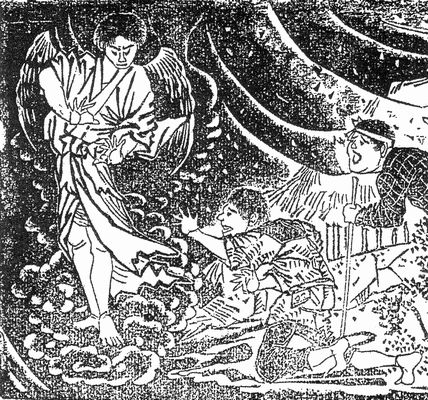
Tengu-kakushi: The Eerie Phenomenon of Being Spirited Away
Japan’s mountains are breathtakingly beautiful, covered in dense forests and shrouded in mist. But in Japanese folklore, they are also places of deep mystery and occasional danger. For centuries, when a villager vanished without a trace, only to return days or years later in a dazed state, it wasn’t called a kidnapping or an accident. It was called Tengu-kakushi—hidden by the Tengu.
For cultural travelers and folklore enthusiasts, understanding this phenomenon offers a fascinating glimpse into how ancient Japan viewed the supernatural power of nature. From the eerie silence of the deep woods to the vibrant masks sold at temple festivals, the legacy of the Tengu remains alive today.
The Origins of the Vanishing
The term Tengu-kakushi (天狗隠し) literally translates to “hidden by a Tengu.” To understand the phenomenon, one must first understand the creature behind it. The Tengu are legendary mountain goblins or spirits, originally depicted as kite-like birds of prey and later evolving into the long-nosed, red-faced figures seen in masks today. They are masters of the wind, swordsmanship, and illusion.
Historically, the concept of Tengu-kakushi served a sociological function. In rural, pre-modern Japan, people—especially children and the elderly—would occasionally wander off into the treacherous terrain. Attributing these disappearances to the whims of mountain spirits provided a supernatural explanation for a tragic reality. It turned the unknown terror of the wilderness into a specific, albeit frightening, entity.
The phenomenon is deeply rooted in Mountain Worship (Sangaku Shinko). Mountains were considered the realm of the kami (gods) and spirits, distinct from the mundane world of the village. Crossing the boundary without respect invited spiritual abduction.
The Legend: Tales of the Returned
Unlike stories of ghosts who kill, the legend of Tengu-kakushi is unique because the victims often return. However, they are rarely the same as when they left.
In classic folklore, a person “hidden” by a Tengu might vanish for days, appearing suddenly on a temple roof or in a distant village. They would often be in a state of kewai (signs of a strange presence), suffering from memory loss, lethargy, or what was historically termed “fox possession” or divine madness. They might claim to have flown through the sky, visited glittering palaces, or been trained in martial arts by the Tengu.
One of the most famous historical accounts comes from the Edo period scholar Hirata Atsutane. He documented the story of Torakichi, a boy who claimed to have been whisked away by a Tengu master to other worlds and mountains. Unlike tragic disappearances, Torakichi’s detailed accounts of the supernatural realm became a sensation, bridging the gap between terrifying superstition and mystical wonder.
Modern Culture: From Horror to Fantasy
The concept of Tengu-kakushi has permeated modern pop culture, arguably becoming Japan’s most famous supernatural trope globally, thanks to Studio Ghibli.
Spirited Away
The Japanese title of Hayao Miyazaki’s Oscar-winning film is Sen to Chihiro no Kamikakushi. Here, Kamikakushi is a synonym for Tengu-kakushi (hidden by gods vs. hidden by Tengu). The protagonist, Chihiro, wanders into a spirit realm—a direct retelling of the ancient abduction folklore tailored for a modern audience.
Anime and Literature
Beyond Ghibli, the trope appears in series like Demon Slayer (where the mentor Urokodaki wears a Tengu mask) and the horror visual novel Higurashi When They Cry, where the term is used to describe mysterious disappearances in a cursed village. Today, the Tengu is less a figure of pure terror and more a symbol of nature’s untamable power and mystery.
Traveler’s Tips: Visiting the Realm of the Tengu
If you want to experience the atmosphere of these legends without actually getting spirited away, there are specific destinations in Japan known for their Tengu lore.
1. Mount Kurama (Kyoto)
This is the ultimate Tengu destination. It is said to be the home of Sojobo, the King of the Tengu. A hike from Kibune to Kurama-dera Temple takes you through ancient cedar roots and mystical groves.
- Tip: Look for the massive Tengu head statue at Kurama Station.
2. Mount Takao (Tokyo)
Easily accessible from central Tokyo, Mount Takao is associated with the Tengu who protect the Yakuo-in Temple. Statues of both the long-nosed (Daitengu) and beak-faced (Karasu-tengu) varieties guard the temple halls.
- Tip: Try the “Tengu-yaki,” a bean-paste-filled cake shaped like the goblin, sold at the summit.
Safety in the Mountains
While we enjoy the folklore, the origins of the legend warn of real dangers. When hiking in Japan:
- Stick to marked trails: The dense forests can be disorienting.
- Respect the silence: Loud noises were thought to offend the spirits (though a bear bell is recommended for safety!).
- Watch the sunset: Folklore states that Oma-ga-toki (the time of disaster/twilight) is when the boundary between worlds is thinnest. Plan to finish your hike before dark.
Sources & Further Reading
For those wishing to dive deeper into the history of Japanese mythology and mountain worship, the following texts are essential:
- The Tono Monogatari (Tales of Tono) by Yanagita Kunio: A pivotal collection of folk tales, including disappearances, from Iwate Prefecture.
- Konjaku Monogatari Shu: A collection of tales from the late Heian period that features early depictions of Tengu.
- Nihon Shoki (The Chronicles of Japan): While focused on creation myths, this 8th-century text establishes the foundational reverence for mountains and celestial phenomena (sometimes described as “Amatsu-Kitsune” or celestial foxes/dogs) that evolved into Tengu lore.
- The Catalpa Bow by Carmen Blacker: An excellent academic resource on shamanistic practices in Japan.