
The Enso Circle: A Journey into Zen Enlightenment
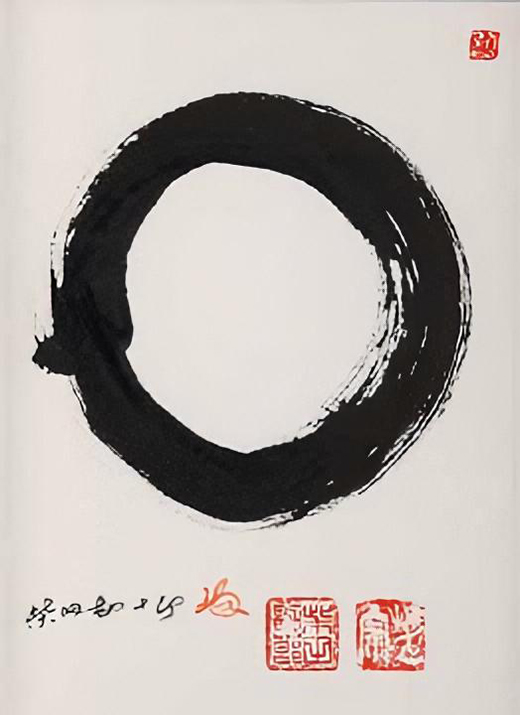
In the realm of Japanese aesthetics and spirituality, few symbols are as deceptively simple yet profoundly complex as the Enso. A single brushstroke of black ink on white washi paper, the Enso is a circle that represents everything and nothing simultaneously. For travelers and culture enthusiasts exploring Japan, understanding this symbol offers a key to unlocking the enigmatic heart of Zen Buddhism.
Introduction: The Universe in a Single Stroke
Walk into any traditional tea house in Kyoto or a modern art gallery in Tokyo, and you are likely to encounter it: a roughly drawn circle, sometimes closed, sometimes open, created with a single, uninhibited motion. This is the Enso (円相), literally translating to “Circle Form.”
In Zen practice, the Enso is not merely art; it is a visual record of a specific moment in time. It represents enlightenment, strength, elegance, the universe, and the void (mu). It is the ultimate expression of the artist’s inner state. Unlike Western geometric circles, which strive for mathematical perfection, the Enso embraces the beauty of imperfection (wabi-sabi). The splatter of ink, the fading trail of the brush, and the asymmetry are all celebrated as evidence of the human spirit interacting with the present moment.
Origins: The Way of the Brush
The practice of painting Enso is deeply rooted in Hitsuzendo (the Way of the Brush), a discipline of Zen calligraphy. While circular symbolism exists in many cultures, the Japanese Enso traces its lineage back to Chinese Chan Buddhism, which later evolved into Zen in Japan around the 12th and 13th centuries.
The Enso gained prominence through the Rinzai school of Zen. Masters would paint these circles as a form of active meditation. The concept is that the character of the artist is fully exposed in that single stroke; there is no possibility for correction or hesitation. Once the ink touches the paper, the creation is final. It is a spiritual exercise in trusting the self and letting go of the desire for control, reflecting the core Zen teaching of “no-mind” (mushin).
The Legend: The Void and the Ox
While the Kojiki and Nihon Shoki catalogue the mythological origins of Japan’s islands and Shinto gods, the “legend” of the Enso is philosophical rather than historical. It is most famously associated with the “Ten Ox Herding Pictures,” a series of poems and illustrations used in Zen tradition to describe the stages of a practitioner’s progress toward enlightenment.
In the traditional sequence, the eighth stage is often represented by an empty circle or an Enso. This stage is called “Both Bull and Self Forgotten.” Here, the seeker has transcended the duality of the self and the world. The legend tells us that the circle represents the great void—the source of all existence.
There is also a famous story concerning the Zen master Hakuin Ekaku (1686–1768), who is often credited with reviving Rinzai Zen. When asked to display his wisdom, he simply drew a circle. When asked to explain it, he said nothing. The legend implies that truth cannot be captured in words, only in the direct experience of the symbol. An open circle signifies that the movement of the spirit is not contained; it is part of the greater flow of the universe. A closed circle suggests the perfection of the cosmos.
Modern Culture: Minimalism and Design
Today, the Enso has transcended its monastic roots to become a global icon of Japanese design and minimalism. In modern culture, it is frequently used to symbolize balance and harmony in a chaotic world.
- Corporate Identity: Many Japanese companies and global tech firms utilize Enso-like motifs to convey innovation and fluidity. It represents a move away from rigid corporate structures toward organic growth.
- Tattoo Culture: The Enso has become a popular design for tattoos, symbolizing a personal journey toward enlightenment or the acceptance of one’s imperfections.
- Digital Mindfulness: In an era of digital noise, the Enso appears in meditation apps and wellness branding, reminding users to breathe and center themselves.
Despite its commercialization, the authentic practice remains alive. Contemporary calligraphy artists continue to reinterpret the Enso, blending traditional techniques with avant-garde expressionism.
Traveler’s Tips: Experiencing the Circle
If you are planning a trip to Japan, here is how you can engage with the culture of Enso:
- Visit Kennin-ji Temple (Kyoto): As the oldest Zen temple in Kyoto, it houses spectacular artwork. Look for the “Circle, Triangle, Square” garden, which uses the Enso concept in landscape architecture.
- Try a Shodo Workshop: Don’t just look at Enso; create one. Many temples and cultural centers offer Shodo (calligraphy) classes. Trying to paint a perfect circle with a soft brush is a humbling and enlightening experience.
- Shop for Tenugui: Look for traditional cotton hand towels (tenugui) featuring Enso designs. They make for lightweight, meaningful souvenirs that carry the essence of Japanese aesthetics.
- Meditate at Ryoan-ji: While famous for its rock garden, the spirit of the Enso—the appreciation of void and space—is palpable here. Sit on the veranda and contemplate the empty spaces between the rocks.
Sources & Further Reading
To deepen your understanding of the spiritual landscape that gave rise to the Enso, consider exploring these texts:
- The Shobogenzo: Written by the Zen Master Dogen, this text explores the philosophical underpinnings of Zen time and being.
- Kojiki (Records of Ancient Matters): While primarily a Shinto text, reading the Kojiki provides context on the indigenous spiritualism of Japan that Zen Buddhism later interacted with and complemented.
- Zen Mind, Beginner’s Mind: A modern classic by Shunryu Suzuki that explains the concept of mushin (no-mind) essential for painting the Enso.