
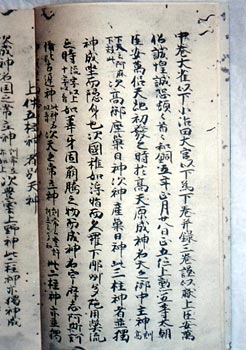
Unveiling the Kojiki: The Soul of Japanese Mythology
When travelers stand before the vermilion torii gates of Kyoto or toss a coin into an offering box in Tokyo, they are stepping into a world shaped by a text written over 1,300 years ago. That text is the Kojiki (Records of Ancient Matters). Far more than a dusty history book, the Kojiki is the vibrant, chaotic, and profound heartbeat of Shintoism and Japanese cultural identity. For the culturally curious traveler, understanding this ancient chronicle unlocks the deeper meaning behind Japan’s shrines, festivals, and even its pop culture.
The Origins: A Political Masterpiece
Compiled in 712 CE, the Kojiki is Japan’s oldest extant chronicle. It was commissioned by Emperor Tenmu and completed under the reign of Empress Genmei. The task fell to a court noble named O no Yasumaro, who transcribed the oral histories memorized by a remarkably talented reciter named Hieda no Are.
While it is a collection of myths, the Kojiki served a very specific political purpose. In the 8th century, the Imperial Court sought to solidify its authority. By compiling these stories, they established a direct lineage connecting the Imperial family to the gods (Kami), specifically the Sun Goddess Amaterasu. Unlike the Nihon Shoki, which was written shortly after in Chinese and focused on diplomatic history, the Kojiki was written using Chinese characters to represent the Japanese language (a style known as man’yogana), preserving the indigenous songs, legends, and soul of the Yamato people.
Legends of Gods and Men
The Kojiki is divided into three parts: the Age of the Gods, the transition to earthly rule, and the lineage of the Emperors. The most captivating section for visitors is undoubtedly the Kamitsumaki (Volume 1), which details the creation of the world.
The Creation of Japan
The narrative begins with the primal couple, Izanagi and Izanami. Standing on the Floating Bridge of Heaven, they stirred the ocean with a jeweled spear. The brine that dripped from the tip formed the first island, Onogoro. They descended to marry and give birth to the islands of Japan and various elemental gods.
Tragedy and the Underworld
The story takes a dark turn when Izanami dies giving birth to the Fire God. Grief-stricken, Izanagi travels to Yomi (the Underworld) to retrieve her. He fails after seeing her decomposing body, leading to a chase that establishes the boundary between the living and the dead. This myth explains the Shinto obsession with purification (harae)—cleansing oneself from the pollution of death.
Amaterasu and Susanoo
Upon purifying himself in a river, Izanagi births the three