
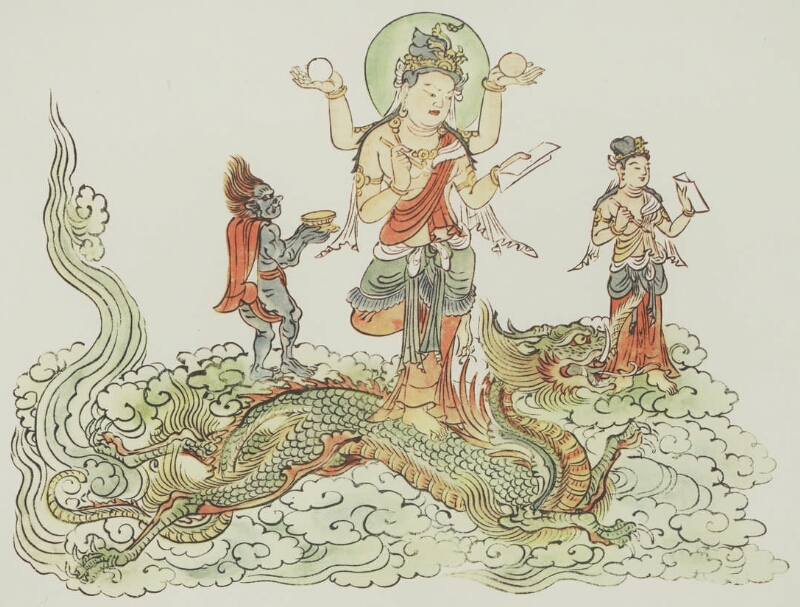
Myoken Bosatsu: The Guiding Light of the North Star
In the vast pantheon of Japanese deities, few are as celestial and mysterious as Myoken Bosatsu. While many travelers flock to Kyoto to see the serene faces of Amida or Kannon, there exists a powerful figure worshiped not for earthly compassion alone, but for the unwavering command of the cosmos. Known as the deification of the North Star (Polaris) and the Big Dipper, Myoken Bosatsu represents the center of the universe—a guiding light for samurai, travelers, and modern seekers alike.
Introduction
Imagine standing in a silent temple courtyard at midnight, looking up at the only stationary point in the night sky: the North Star. In Japanese Buddhism, this star is not merely a ball of gas but a sentient, powerful Bodhisattva known as Myoken.
Myoken Bosatsu (妙見菩薩) literally translates to “Wondrous Seeing” or “Exquisite Vision,” implying the ability to see the truth of the universe and distinguish good from evil. Unlike typical Buddhist figures who wear simple robes, Myoken is often depicted in armor, wielding a sword, and standing atop a tortoise intertwined with a snake. This unique iconography hints at a deep, complex history that blends Buddhism, Taoism, and Shinto into a singular spiritual force.
Origins: A Celestial Syncretism
The origins of Myoken are a fascinating study in cultural blending, known in Japan as shinbutsu-shugo (the syncretism of Shinto and Buddhism).
Myoken was not originally part of the primitive Buddhist pantheon in India, though the name is a translation of the Sanskrit Sudrsti. Instead, the cult of Myoken has strong roots in ancient Chinese Taoism, where the North Star was revered as the Emperor of Heaven who governed human lifespans and fortune. When these beliefs crossed into Japan during the Asuka and Nara periods, they merged with Esoteric Buddhism.
Over time, Myoken became associated with Ame-no-minakanushi, the primordial creator kami mentioned in Japan’s oldest chronicles. This fusion allowed Myoken to be worshiped in both temples and shrines, surviving centuries of religious shifts to remain a potent symbol of protection and guidance.
Legend: The Guardian of Warriors
The most enduring legends of Myoken Bosatsu are tied to the samurai class, specifically the Chiba clan of the Kanto region. According to folklore, during the Heian period, a warrior named Taira no Tadatsune was in a dire situation during a rebellion. He prayed fervently to the North Star for deliverance. Myoken appeared to him, guiding his path and ensuring the survival of his lineage.
From that point on, the Chiba clan adopted the moon and star crest (tsuki-boshi) as their emblem, crediting their martial success to the Bodhisattva. This association transformed Myoken into a war deity—not one of bloodlust, but of strategic brilliance and protection.
Another prevalent legend involves the creature Myoken stands upon: the Genbu (Black Tortoise). In Chinese feng shui, the Genbu protects the North. In Japanese statuary, this tortoise, often wrapped in a serpent, symbolizes the grounded earth supporting the celestial heavens, reinforcing Myoken’s role as the bridge between the sky and the human realm.
Modern Culture: Festivals and Pop Culture
Today, Myoken Bosatsu is still venerated with great enthusiasm, particularly during the Chichibu Night Festival (Chichibu Yomatsuri) in Saitama Prefecture. Held every December, this is considered one of Japan’s top three float festivals and is recognized by UNESCO. While the festival is technically Shinto, the deity honored is a fusion of Myoken and the kami of water and mountains. The spectacular fireworks launched during the festival are meant to greet the stars, continuing the ancient celestial conversation.
In broader culture, the imagery of the North Star as a guardian persists in anime and manga, often referencing the magical arts of Onmyodo (Japanese cosmology), where Myoken is a central figure in star rituals used to ward off disasters.
Traveler’s Tips: Where to Find Myoken
If you wish to pay respects to the North Star during your travels, here are the essential destinations:
- Nose Myokenzan (Osaka/Hyogo): Located on the peak of Mt. Myoken, this temple offers stunning views and a profound atmosphere. It is the headquarters of the Myoken faith in the Kansai region. The distinct star crests found on the lanterns here are visually striking.
- Chiba Shrine (Chiba City): Once a Buddhist temple, now a Shinto shrine, this is the ancestral home of the Chiba clan’s worship. The architecture is magnificent, painted in vermilion, and dedicated to Ame-no-minakanushi (the Shinto equivalent of Myoken).
- Etiquette: When visiting, remember that Myoken is a deity of destiny. It is common to pray here for direction in life, career success, or protection during travel. Look for the statue standing on a tortoise—it is the tell-tale sign you are in the presence of the Polestar.
Sources & Further Reading
For those interested in the deep historical context of the deities mentioned:
- The Kojiki (Records of Ancient Matters): While Myoken is a Buddhist/Taoist figure, understanding the Shinto counterpart Ame-no-minakanushi (the first kami to come into existence) is crucial. This deity is described in the opening passages of the Kojiki.
- The Nihon Shoki (The Chronicles of Japan): Provides further context on the early star worship and the introduction of continental beliefs to Japan.
- Japanese Mandalas: Representations of Sacred Geography by Elizabeth ten Grotenhuis (for information on Star Mandalas).
Myoken Bosatsu remains a shining example of Japan’s ability to absorb and harmonize different beliefs into something uniquely beautiful. The next time you see the North Star, remember: you are looking at the same guiding light that ancient samurai trusted with their lives.