
Okuribi: The Sacred Flames that Guide Spirits Home
As the humid heat of the Japanese summer begins to wane in mid-August, a hush falls over the bustling cities and quiet villages alike. It is the end of Obon, the season of ancestors. While the beginning of this period is marked by Mukaebi (welcoming fires) to invite spirits back to the earthly realm, the conclusion is defined by a more poignant spectacle: Okuribi (送り火), or “send-off fire.” These sacred flames illuminate the night sky, serving as a spiritual beacon to guide the souls of the departed back to the other world.
While fireworks festivals (hanabi) are boisterous celebrations of summer, Okuribi is a solemn, deeply spiritual event that captures the essence of the Japanese appreciation for the ephemeral. From the famous giant characters set ablaze on Kyoto’s mountains to the quiet floating of lanterns on local rivers, Okuribi remains one of Japan’s most moving cultural traditions.
The Origins of the Farewell Fire
The tradition of Okuribi is inextricably linked to Obon, a fusion of indigenous ancestor worship and Buddhism introduced to Japan in the 6th century. The core belief is that during Obon, the barrier between the world of the living and the spirit realm grows thin, allowing ancestors to visit their living relatives.
Historically, fire has always played a purifying and guiding role in Japanese rituals. The specific practice of Okuribi dates back centuries, evolving from simple household fires to community-wide events. During the Edo period (1603–1867), these rituals became more formalized. The fires are meant to ensure the spirits do not get lost on their return journey and to show gratitude for their visit. It represents a final act of filial piety, a warm goodbye until the next year.
Legends of the Five Mountains
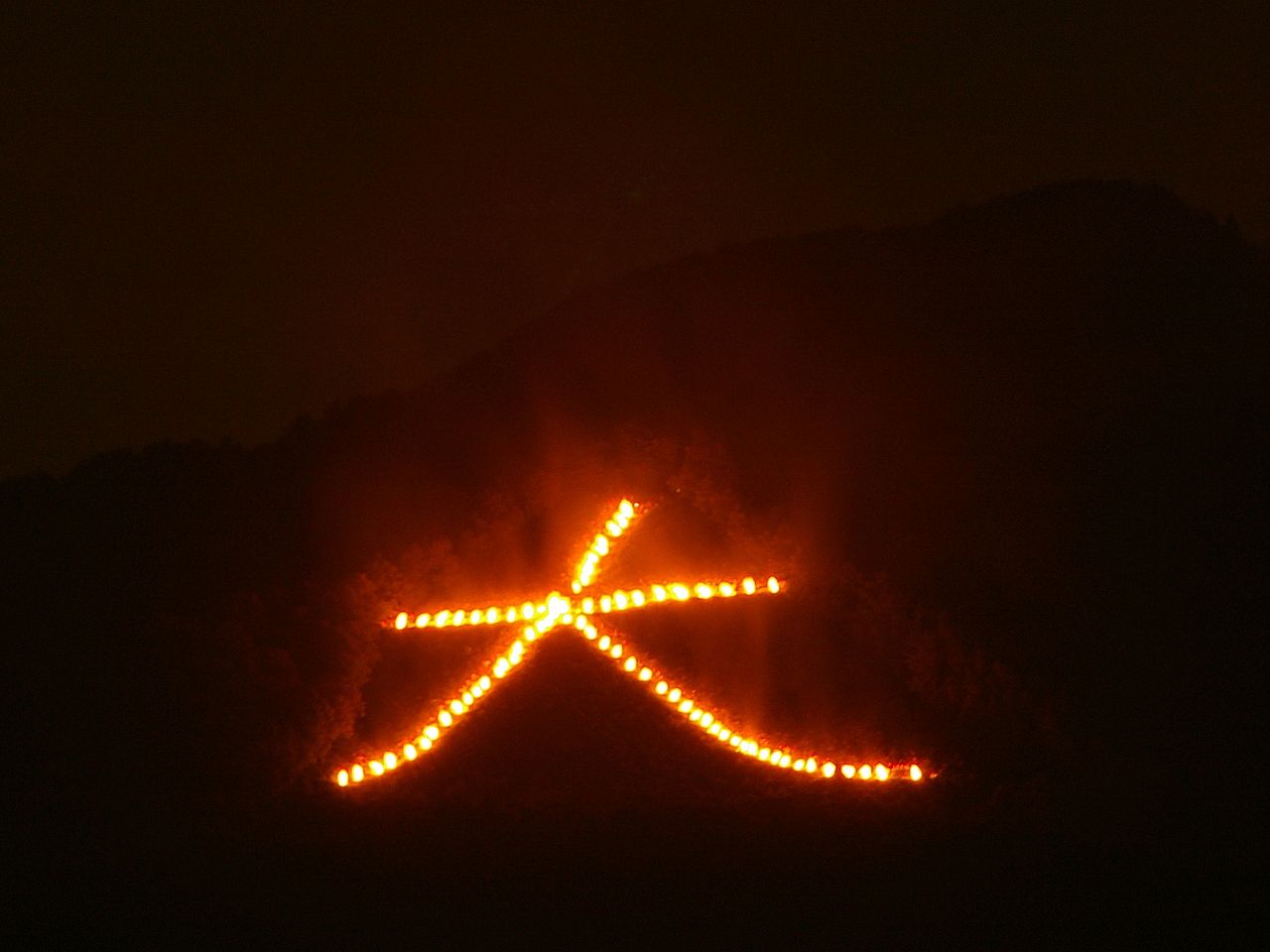
The most famous manifestation of this tradition is the Gozan no Okuribi (Five Mountain Send-off Fire) in Kyoto. On the night of August 16th, five immense bonfires are lit on the mountains surrounding the ancient capital. While the exact historical origins of the Kyoto fires are shrouded in mystery, local legends provide colorful explanations.
The Great “Dai” and Kobo Daishi
The most prominent fire is the Daimonji (大文字), shaped like the character “Dai” (meaning “big” or “great”) on Mount Nyoigatake. A popular legend attributes the origin of this character to Kobo Daishi (Kukai), the founder of Shingon Buddhism. It is said that when a plague swept through Kyoto, Kobo Daishi climbed the mountain and lit a fire in the shape of the character to pray for the sickness to end. The intense light was believed to carry his prayers to the heavens, cleansing the city below.
The Boat and the Torii
Other shapes include a boat (Funagata) and a shrine gate (Torii-gata). The boat shape is often associated with the vehicle that ferries souls across the Sanzu River—the Buddhist equivalent of the River Styx. The Torii shape represents the gateway between the sacred and the profane, further emphasizing the transition the spirits are making back to the afterlife.
Okuribi in Modern Japanese Culture
In contemporary Japan, Okuribi serves as a poignant reminder of the changing seasons. It marks the psychological end of summer and the return to regular life after the holidays. While the religious significance remains strong for older generations, for younger people and tourists, it is also a time of communal gathering.
Beyond Kyoto: Toro Nagashi
While Kyoto’s mountain fires are spectacular, Okuribi takes other forms elsewhere. A common variation is Toro Nagashi (floating lanterns). Instead of bonfires on mountains, paper lanterns illuminated by candles are set afloat on rivers or the ocean. This creates a mesmerizing river of light, symbolizing the spirits flowing back to the pure land of the ocean. The mesmerizing sight of thousands of lanterns drifting into the darkness is a quintessential image of Japanese beauty.
Traveler’s Tips for Viewing Okuribi
Experiencing Okuribi can be the highlight of a trip to Japan, but it requires planning and respect.
- Timing is Key: The Gozan no Okuribi in Kyoto takes place annually on August 16th. The fires are lit starting at 8:00 PM. Arrive hours early to secure a spot.
- Best Viewing Spots: You cannot climb the mountains during the event. The best views are from the banks of the Kamo River (specifically around the Demachiyanagi area) or from the upper floors of hotels in downtown Kyoto.
- Etiquette: Unlike fireworks displays, cheering or loud partying is generally frowned upon during the lighting. It is a moment of prayer and reflection. Observe the silence or hushed tones of the locals.
- Weather: August in Kyoto is notoriously hot and humid. Dress in light, breathable fabrics (a yukata is appropriate and festive) and stay hydrated.
- River Lanterns: If you prefer a more intimate experience, look for Toro Nagashi events in places like Asakusa (Tokyo) or Arashiyama (Kyoto), which often occur on similar dates.
Sources & Further Reading
For those interested in the deep spiritual roots of these traditions, the following historical texts and resources provide context on Japanese views of the afterlife and nature worship:
- The Kojiki (Records of Ancient Matters): While not mentioning Obon specifically, this text establishes the foundational Japanese concepts of the spirit world (Yomi) and the relationship between the living and the divine (Kami).
- The Nihon Shoki (Chronicles of Japan): Offers early historical accounts of the introduction of Buddhism to the Imperial court, which paved the way for syncretic festivals like Obon.
- Kyoto City Tourism Association: Provides updated schedules and historical context for the Gozan no Okuribi.
- “The World of the Shining Prince” by Ivan Morris: excellent background reading on Heian-era court life and the aesthetic of mono no aware which permeates the Okuribi tradition.