
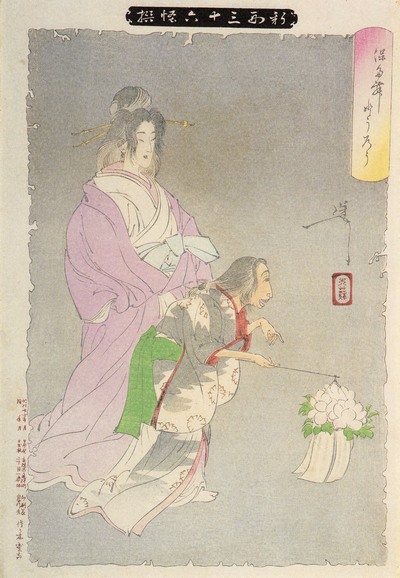
The Haunting Tale of Botan Doro: The Peony Lantern
In the humid heat of a Japanese summer, a peculiar tradition takes place. Unlike the campfire stories of the West meant to startle, Japanese ghost stories, or kaidan, are told to induce a chill that cools the body down. Among these tales, few are as beloved, romantic, and terrifying as Botan Doro, or “The Peony Lantern.” Alongside Yotsuya Kaidan and Bancho Sarayashiki, it stands as one of Japan’s Three Great Ghost Stories.
For cultural travelers and folklore enthusiasts, understanding Botan Doro offers a fascinating glimpse into the Edo period’s views on love, death, and the supernatural. Let us walk through the mist, guided by the soft glow of a peony lantern, into the heart of this spectral legend.
Origins: From Chinese Folklore to Edo Rakugo
While Botan Doro is quintessentially Japanese today, its roots are continental. The story was adapted from the Chinese collection Jiandeng Xinhua (New Tales for the Trimmed Lamp Lamp), specifically a tale called “The Peony Lantern.” It arrived in Japan during the 17th century and was adapted by the writer Asai Ryoi in his collection Otogi Boko (Hand Puppets).
However, the version that captured the nation’s imagination was crafted in the late 19th century by the legendary Rakugo (comic storytelling) master, Sanyutei Encho. He transformed the narrative into a suspenseful oral performance that emphasized human psychology, karmic retribution, and the eerie atmosphere of Edo (modern-day Tokyo). Encho’s version is so influential that most modern adaptations in Kabuki theater and film are based on his storytelling.
The Legend of the Peony Lantern
The story centers on a young samurai named Hagiwara Shinzaburo, a handsome scholar living a quiet life. He falls deeply in love with a beautiful woman named Otsuyu. However, due to social constraints and misunderstandings, they are kept apart, and Otsuyu dies of lovesickness, pining for him.
Unaware of her death, Shinzaburo sits on his veranda during the Obon festival—the time when spirits return to the living world. Through the darkness, he sees a soft light approaching: a beautiful peony lantern held by a servant, guiding a woman. To his joy, it is Otsuyu. She claims that she had merely run away to be with him, not died.
Delighted, Shinzaburo begins a secret nightly affair with her. Every night, the distinct sound of wooden clogs (geta)—karan, koron—echoes in the street, signaling her arrival.
One night, a servant grows suspicious of Shinzaburo’s declining health and peeks through a crack in the sliding doors. To his horror, he does not see Shinzaburo holding a beautiful woman, but rather embracing a rotting skeleton, driven by the spirit of the dead.
Terrified for his master’s life, the servant consults a priest, who confirms that Shinzaburo is being drained of his life force (qi) by the ghost. Shinzaburo is given protective ofuda (holy talismans) to paste over every opening of his house to keep the spirit out.
For nights, Otsuyu cries outside the house, unable to enter. However, the story takes a tragic turn due to human greed. The ghost bribes the servant (or a neighbor, depending on the version) with gold to remove the charms. The servant betrays his master, peeling away the protection. The next morning, Shinzaburo is found dead, his body entwined with a skeleton, a peony lantern resting nearby.
Modern Culture and Legacy
Botan Doro has permeated Japanese pop culture for centuries. It remains a staple of the Kabuki repertoire, where the contrast between the beautiful living actor and the skeletal reveal creates dramatic tension. In cinema, classic directors have adapted the tale, using it to explore themes of obsession and the porous border between the living and the dead.
The story also influenced the aesthetic of the Japanese ghost (yurei). The image of the pale, beautiful woman carrying a lantern is now an iconic trope in anime and manga. Furthermore, the onomatopoeia karan, koron—the sound of the ghost’s footwear—is instantly recognized by Japanese audiences as a harbinger of the supernatural.
Traveler’s Tips: Experiencing the Legend
If you are visiting Japan, particularly during the summer, there are several ways to connect with the legend of Botan Doro:
- Visit Ryukoku-ji Temple (Tokyo): Located in the Taito ward, this temple is said to be the resting place of Otsuyu. While she is a fictional character, the line between fiction and reality is blurred here, and many fans visit to pay respects.
- Summer Rakugo Performances: In July and August, theaters in Tokyo like the Suehirotei in Shinjuku often feature ghost stories. Even if you don’t speak fluent Japanese, the atmospheric acting of a Rakugo storyteller performing Botan Doro is chillingly effective.
- The Sanyutei Encho Memorial: Visit the grave of the storyteller who popularized the tale at Zensho-an Temple in Yanaka, Tokyo. The temple houses a famous collection of ghost scroll paintings (yurei-ga) collected by Encho himself, which are displayed to the public only in August.
Sources & Further Reading
For those interested in delving deeper into Japanese mythology and the literary history of this tale, the following texts are essential:
- Otogi Boko (Hand Puppets) by Asai Ryoi (1666): The Edo-period collection that first adapted the Chinese tale for a Japanese audience.
- Jiandeng Xinhua by Qu You: The original Ming Dynasty Chinese collection that served as the source material.
- The Peony Lantern by Sanyutei Encho: Transcriptions of the famous Rakugo performance are available in translation, showcasing the oral tradition of the story.
- Note on Historical Context: While ancient texts like the Kojiki establish the Shinto view of the afterlife, Botan Doro is a product of the later Edo period, reflecting Buddhist themes of attachment and karma.