
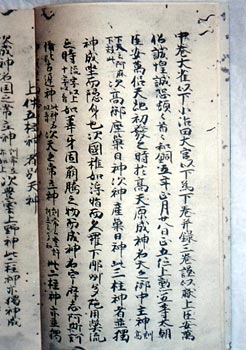
Kojiki: Unveiling the Origins of Japanese Mythology
For any traveler or culture enthusiast exploring Japan, the lines between history, spirituality, and nature often blur. To understand the soul of this island nation—why the sun is revered, why the Imperial family is held in such high regard, and why Shinto shrines dot the landscape—one must turn to the Kojiki. Known as the “Record of Ancient Matters,” this ancient text is the cornerstone of Japanese mythology and the oldest extant chronicle in Japan.
The Origins: A Court’s Quest for Legitimacy
The story of the Kojiki begins not in the heavens, but in the political courts of the Nara Period. Compiled in 712 AD, it was commissioned by Empress Genmei. The goal was political as much as it was cultural; the Imperial Court sought to legitimize its rule by tracing its lineage directly back to the gods.
The creation of the text is a legend in itself. It is said that a court attendant named Hieda no Are possessed a phenomenal memory, having memorized the oral traditions and genealogies of the clans. A scribe named O no Yasumaro transcribed these oral recitations into the written record we have today. Unlike the Nihon Shoki, which was written shortly after in classical Chinese to impress foreign dignitaries, the Kojiki was written using Chinese characters to represent the Japanese language, preserving the rhythm, songs, and narrative soul of early Japan.
The Legend: From Chaos to Order
The Kojiki is divided into three parts, but the first volume—the Kamitsumaki (Volume of the Age of the Gods)—is the most captivating for modern readers. It details the creation of the world and the birth of the kami (spirits/gods).
The Creation of Japan
The narrative begins with the primal couple, Izanagi and Izanami. Standing on the Floating Bridge of Heaven, they stirred the chaotic ocean below with a jeweled spear. The brine that dripped from the tip formed the first island, Onogoro. Descending to this island, they performed a wedding ritual and gave birth to the islands of Japan and a pantheon of elemental deities.
Amaterasu and the Cave
Tragedy strikes when Izanami dies giving birth to the fire god. Izanagi’s subsequent purification ritual creates the most significant deities in Shinto: Amaterasu (the Sun Goddess), Tsukuyomi (the Moon God), and Susanoo (the Storm God).
The most famous myth involves the sibling rivalry between Amaterasu and Susanoo. Offended by her brother’s violent behavior, Amaterasu retreats into a cave, plunging the world into darkness. It takes a raucous party thrown by the other gods—featuring dancing and laughter—to lure her out. As she peeks out, her light returns to the world, a myth that underscores the vital importance of the sun and communal ritual in Japanese agriculture and religion.
Modern Culture: Echoes of the Past
You might expect an 8th-century text to be dusty and forgotten, but the Kojiki is alive in modern Japan. Its influence permeates pop culture, politics, and daily life.
- Anime and Manga: Characters and techniques in popular series like Naruto (Amaterasu, Tsukuyomi, Susanoo) or games like Okami are direct references to the deities found in the Kojiki.
- The Imperial Family: The Japanese Imperial Family is cited as the direct descendants of Amaterasu through her grandson, Ninigi-no-Mikoto, who descended to earth to rule. This lineage is central to the identity of the Chrysanthemum Throne.
- Sumo: The sport of Sumo has origins in the strength contests described in these ancient myths, serving originally as a ritual to entertain the kami.
Traveler’s Tips: Walking the Mythical Path
To truly experience the Kojiki, you must leave the neon lights of Tokyo and visit the “Power Spots” associated with these legends.
1. Takachiho (Miyazaki Prefecture)
Located in Kyushu, this is arguably the most significant mythological site. You can visit the Ama-no-Iwato Shrine, dedicated to the cave where Amaterasu hid. Nearby, the Takachiho Gorge offers a mystical atmosphere that feels untouched by time. Watch a Kagura dance performance at the shrine, which reenacts the funny and dramatic stories from the Kojiki.
2. Izumo Taisha (Shimane Prefecture)
While Ise is for the Sun Goddess, Izumo is the domain of Okuninushi, a descendant of the storm god Susanoo. It is one of the oldest and most important shrines in Japan. In the tenth month of the lunar calendar, it is believed that all the gods of Japan gather here for a meeting.
3. Ise Jingu (Mie Prefecture)
This is the spiritual home of the Japanese people, dedicated to Amaterasu herself. The architecture here predates Buddhist influence, offering a glimpse into the pure aesthetic of the ancient Yamato people.
Sources & Further Reading
For those wishing to read the myths firsthand, several excellent translations and historical analyses differ slightly in interpretation but capture the magic of the original text.
- The Kojiki: An Account of Ancient Matters – Translated by Gustav Heldt (a modern, accessible translation).
- Kojiki – Translated by Donald L. Philippi (highly regarded for its academic notes).
- Nihon Shoki (The Chronicles of Japan) – For a comparative historical perspective.
Understanding the Kojiki transforms a trip to Japan from simple sightseeing into a journey through a living mythology.