
The Legend of Tenome: Japan’s Hand-Eyed Yokai
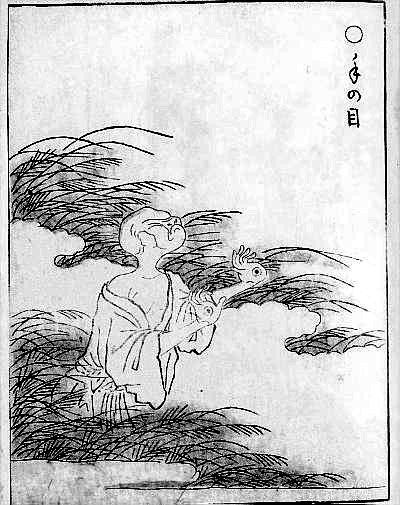
Japanese folklore is a labyrinth of the strange and the supernatural, populated by creatures known as yokai. Among these entities, few possess an appearance as striking and unsettling as the Tenome (手の目). Picture a humanoid figure, elderly and frail, wandering through the night. It has no eyes on its face—only smooth, blank skin. Instead, its eyes are embedded deep within the palms of its hands, waving about to scan the darkness.
For travelers and culture enthusiasts fascinated by the macabre side of Japanese history, the story of Tenome offers a fascinating glimpse into the Edo period’s imagination and the concept of vengeful spirits.
Origins and Etymology
The name Tenome is quite literal. In Japanese, Te (手) means hand, no (の) is a possessive particle, and Me (目) means eye. Thus, it translates directly to “Eyes of the Hand” or “Hand-Eyes.”
While oral traditions of blind spirits likely existed earlier, the definitive visualization of Tenome comes from the renowned ukiyo-e artist and folklorist Toriyama Sekien. In 1776, Sekien published Gazu Hyakki Yagyō (The Illustrated Night Parade of a Hundred Demons). His illustration of the Tenome solidified the creature’s image in the cultural zeitgeist: a blind man searching the night, eyes wide open on his palms.
Unlike the mischievous tanuki or the water-dwelling kappa, the Tenome falls into the category of more malevolent spirits, often associated with tragedy and unresolved grudges.
The Legend: A Blind Man’s Rage
The most pervasive origin story of the Tenome is rooted in human suffering and betrayal. According to folklore, the Tenome was once a human man who was blind. He lived a modest life, relying on his other senses to navigate the world.
One night, while traveling along a lonely road (often cited as being near Kyoto), the blind man was accosted by a band of highwaymen. They robbed him of his meager possessions and, in a cruel act of violence, murdered him. As the man lay dying, consumed by fear and rage, he cried out in despair. His last thought was a fervent wish: “If only I could have seen their faces, I would know who to haunt.”
His rage was so potent that it transcended death. He returned as a yokai, but his desire to “see” manifested grotesquely. Since his physical eyes were useless in life, his new spectral sight appeared on his hands—the very tools a blind person uses to feel their way through the world. Now, the Tenome wanders graveyards and lonely roads, waving his hands in front of him, hunting for the men who killed him. Tragically, he cannot distinguish his killers from innocent travelers, making him a danger to anyone unfortunate enough to cross his path.
The Encounter at the Temple
A famous folktale involves a young man who bravely—or foolishly—decides to test his courage by spending the night in a graveyard rumored to be haunted by a Tenome. An elder warns him, but the youth insists.
As midnight approaches, the young man hears the shuffling of feet. He hides inside a long wooden chest (nagamochi) to observe. He sees the Tenome approach, sniffing the air and waving its palms. The creature senses fresh life. It approaches the chest and begins to pry it open. The next morning, the villagers find the chest undamaged, but the young man is gone. In some versions, all that remains is his white bones, stripped of flesh, revealing the Tenome’s terrifying predatory nature.
Tenome in Modern Culture
The imagery of the Tenome has permeated pop culture far beyond the borders of Japan. Its surreal design taps into a universal fear of the uncanny valley.
- Pan’s Labyrinth (2006): Perhaps the most famous visual twin of the Tenome is the “Pale Man” in Guillermo del Toro’s masterpiece. While del Toro has cited various influences, the resemblance to the Tenome—a child-eating monster with eyes in its palms—is undeniable and introduced this specific horror to a Western audience.
- Video Games: The creature appears in various forms in games like Cuphead (as a boss in the afterlife level) and the Shin Megami Tensei series, where folklore accuracy is highly prided.
- Anime: In GeGeGe no Kitaro, the quintessential yokai anime by Shigeru Mizuki, the Tenome appears as a recurring character, sometimes depicted as an antagonist and other times as part of the yokai community.
Traveler’s Tips: Seeking the Supernatural
If you are visiting Japan and wish to explore the world of Yokai:
- Mizuki Shigeru Road (Sakaiminato): Located in Tottori Prefecture, this street is dedicated to the creator of GeGeGe no Kitaro. You can find over 170 bronze statues of different yokai, including the Tenome. It is a must-visit for folklore fans.
- Kyoto: As the setting for many classic ghost stories, Kyoto offers various “ghost tours.” Visiting ancient graveyards or the darker history museums can set the mood, though specific “Tenome” shrines do not exist, as he is a wandering spirit.
- Yokai Art Museums: Look for exhibitions featuring ukiyo-e prints by Toriyama Sekien, often held in Tokyo or Kyoto museums, to see the original 18th-century depiction of the creature.
Sources & Further Reading
For those interested in the academic and historical study of Japanese monsters, the following texts and databases are essential:
- Toriyama Sekien: Gazu Hyakki Yagyō (The Illustrated Night Parade of a Hundred Demons), 1776. This is the primary visual source for the Tenome.
- Inoue Enryo: Works by the founder of “Yokaiology” (Yōkaigaku), who studied the psychological and sociological origins of these legends.
- International Research Center for Japanese Studies: Kaii-Yōkai Denshō Database. An excellent resource for cross-referencing folklore variations.
While ancient texts like the Kojiki or Nihon Shoki deal with gods and the creation of Japan, the Tenome belongs to the later, earthier folklore of the Edo period—a time when the supernatural walked side-by-side with the mundane.