
The Red Baby of the River: Unveiling the Kawaakago
Imagine walking along the banks of a misty river in the Japanese countryside at twilight. The reeds rustle, the water laps gently against the shore, and suddenly, you hear a sound that freezes your blood: the distinct, sorrowful cry of a human baby. Your instinct is to rush toward the sound, to save the infant. But if you are well-versed in Japanese folklore, you stop. You know that this is not a human child, but the Kawaakago.
As a travel and culture enthusiast exploring the depths of Japan’s yōkai (supernatural monsters and spirits) lore, one quickly realizes that the waterways are teeming with spirits. While the Kappa is the most famous water imp, the Kawaakago—or “River Red Child”—is a fascinating, albeit eerie, cousin that deserves its own spotlight.
Origins and Appearance: What is a Kawaakago?
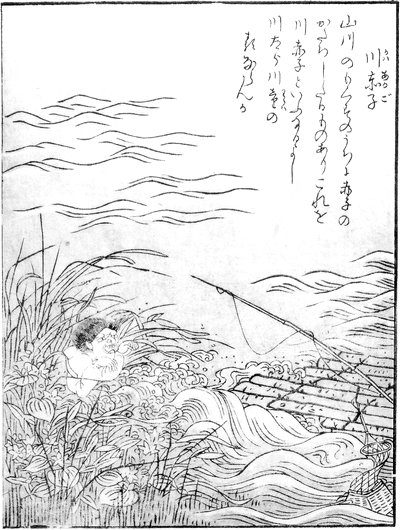
The name Kawaakago (川赤子) literally translates to “River” (Kawa) and “Red Child” (Akago). This nomenclature provides the most accurate description of the creature. In classical folklore illustrations, particularly those from the Edo period, the Kawaakago is depicted as a small child or infant with bright red skin.
Unlike the green, beaked Kappa, the Kawaakago looks startlingly human, save for its coloring. It is often portrayed crouching among the reeds or wading in shallow waters. Some descriptions suggest it has webbed fingers, linking it to its aquatic habitat, but its primary defining feature is its resemblance to a toddler.
The most definitive visual origin of this yōkai comes from Toriyama Sekien, the master encyclopedist of Japanese monsters. In his 1779 work, Konjaku Gazu Zoku Hyakki (The Illustrated One Hundred Demons from the Present and the Past), he sketched the Kawaakago dwelling in the wetlands, solidifying its image in the Japanese cultural consciousness.
The Legend: A Trickster of the Wetlands
The legends of the Kawaakago are less about malevolence and more about mischief and the uncanny. While many water spirits in Japan, such as the Funayurei, are vengeful ghosts seeking to drown the living, the Kawaakago occupies a gray area.
The Crying Trap
The primary behavior associated with this spirit is mimicry. It is said to hide in tall grasses near rivers and ponds, imitating the sound of a crying baby. The goal is simple: to lure concerned travelers off the path and into the water. However, unlike more predatory monsters that might devour the traveler, the Kawaakago usually enjoys the prank itself. Once the traveler gets close, soaked and muddy, the “baby” might vanish, swim away with supernatural speed, or simply laugh at the foolish human.
The Parasitic Guest
There are rarer, regional variations of the legend where the Kawaakago is more intrusive. In some stories, if a human attempts to pick up the crying “infant,” the spirit becomes incredibly heavy or clings to the person, refusing to let go, effectively pinning them to the spot until it gets bored. It serves as a supernatural warning: Do not interfere with things that do not belong to the world of men.
Modern Culture and Symbolism
In modern Japan, the Kawaakago has transitioned from a source of rural fear to a character in pop culture. You can spot variations of this spirit in anime and manga, most notably in the works of Shigeru Mizuki, the creator of GeGeGe no Kitaro. Mizuki played a massive role in reviving interest in yōkai like the Kawaakago, transforming them from obscure folklore into beloved mascots.
Symbolically, the Kawaakago represents the dual nature of water: life-giving and innocent (like a child), but also unpredictable and potentially dangerous. The redness of the skin is also significant; in Japanese culture, Akago (baby) implies redness, but red is also a color often associated with protection against evil, creating an ironic twist where the spirit itself is the trickster.
Traveler’s Tips: Experiencing Yōkai Culture
If this red river child has piqued your interest, you don’t need to wander into a swamp at night to find it. Here is how you can experience the culture of the Kawaakago on your next trip to Japan:
- Visit Sakaiminato (Tottori Prefecture): This is the hometown of Shigeru Mizuki. The famous Mizuki Shigeru Road is lined with over 170 bronze statues of yōkai. Keep your eyes peeled, and you might spot the Kawaakago among them.
- Tono City (Iwate Prefecture): Known as the City of Folklore, Tono is the setting for The Legends of Tono. While famous for Kappa, the local museums and storytelling centers cover all manner of river spirits.
- Yōkai Art Museums: Visit the Miyoshi Mononoke Museum in Hiroshima Prefecture, which houses a vast collection of yōkai scrolls and artifacts. It is the perfect place to see Edo-period depictions of creatures like the Kawaakago.
Sources & Further Reading
To deepen your understanding of Japanese mythology and the Kawaakago, consider exploring these texts:
- Konjaku Gazu Zoku Hyakki (1779) by Toriyama Sekien: The primary visual source for many yōkai, including the Kawaakago.
- The Legends of Tono (Tono Monogatari) by Yanagita Kunio: Essential reading for understanding the relationship between Japanese rural life and water spirits.
- Nihon Shoki and Kojiki: While these ancient texts focus on shinto deities (Kami) rather than the Edo-period Kawaakago, they provide the foundational context for the sanctity and danger of nature in Japanese belief systems.