
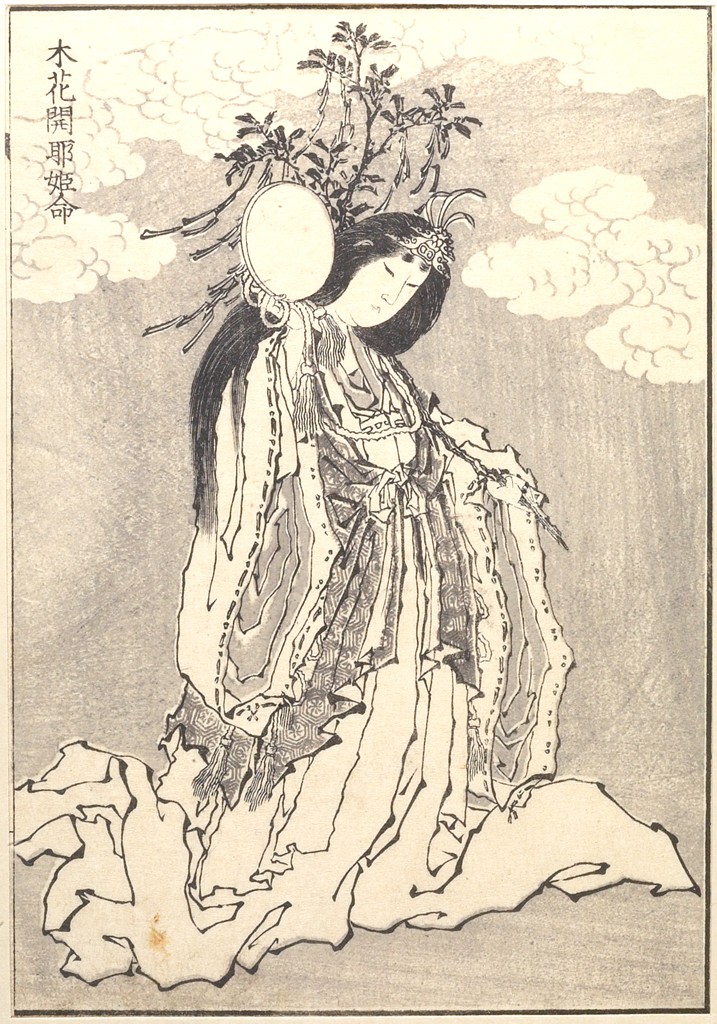
Meet Konohanasakuya-hime: Japan’s Fiery Fuji Goddess
When travelers gaze upon the snow-capped perfection of Mount Fuji, they are looking at more than just a geological wonder; they are beholding the domain of one of Japan’s most complex and beloved deities. Konohanasakuya-hime (often shortened to Sakuya-hime) is the Shinto goddess of Mount Fuji, cherry blossoms, and volcanoes. She embodies a uniquely Japanese duality: the delicate, ephemeral beauty of a blooming flower and the terrifying, destructive power of fire.
For cultural travelers and mythology enthusiasts, understanding Konohanasakuya-hime unlocks a deeper appreciation of Japanese shrines, festivals, and the spiritual significance of the country’s most iconic mountain.
Origins and Name
Konohanasakuya-hime (木花咲耶姫) translates roughly to “Princess of the Flowering Trees.” In Shinto mythology, she is the daughter of Oyamatsumi, the Great Mountain God. Her name is synonymous with the sakura (cherry blossom), representing earthly life—beautiful and vibrant, yet fleeting.
She appears prominently in Japan’s oldest historical chronicles, the Kojiki and the Nihon Shoki, which date back to the 8th century. As the avatar of Mount Fuji, she is worshipped to prevent volcanic eruptions, protecting the people from the mountain’s fiery wrath. Over centuries, she has evolved from a local mountain spirit into a major guardian deity found in shrines across the archipelago.
The Legend: Beauty, Rejection, and Fire
The most famous myth concerning Konohanasakuya-hime explains not only her divine power but also the origin of human mortality.
The Marriage Proposal
According to legend, Ninigi-no-Mikoto, the grandson of the Sun Goddess Amaterasu, descended from heaven and met the beautiful Princess Sakuya on the beach. Enraptured, he asked her father, Oyamatsumi, for her hand in marriage. The father was pleased but offered Ninigi both Sakuya and her older sister, Iwanaga-hime (Princess of the Rock).
However, Iwanaga-hime was not as physically beautiful as her younger sister. Ninigi rejected the Rock Princess, sending her back to her father while keeping Sakuya. This decision had grave consequences. Oyamatsumi revealed that had Ninigi accepted the Rock Princess, his descendants (humanity) would have had lives as enduring as stone. By choosing only the Blossom Princess, human life became like the cherry blossom: beautiful but destined to wither and fall quickly.
The Trial by Fire
Shortly after their marriage, Sakuya became pregnant. Ninigi, suspicious of how quickly this happened, accused her of infidelity with an earthly deity. To prove her purity and divine lineage, Sakuya entered a windowless hut and set it on fire before giving birth.
She declared that if the children were illegitimate, they would perish in the flames. If they were the true sons of the heavenly grandson, they would be unharmed. Amidst the roaring fire, she gave birth to three healthy sons: Hoderi, Hosuseri, and Hoori. This act cemented her status as a goddess of fire, easy childbirth, and protection against disaster.
Modern Culture and Worship
Today, Konohanasakuya-hime remains a vital figure in Japanese spirituality. She is the principal deity of the Sengen Shrines (Asama Shrines), of which there are approximately 1,300 across Japan.
Culturally, she is often depicted in art wearing flowing robes and holding a cherry blossom branch. In pop culture, her influence extends to anime, manga, and video games (such as the Persona series and Okami), where she often appears as a healer or a wielder of fire magic. Her dual nature makes her a compelling character archetype—representing the “Yamato Nadeshiko” ideal of grace, underpinned by an unyielding will of steel.
Traveler’s Tips: Where to Visit
If you wish to pay respects to Konohanasakuya-hime or simply explore the beautiful architecture dedicated to her, consider adding these locations to your itinerary:
1. Fujisan Hongu Sengen Taisha (Shizuoka Prefecture)
This is the head shrine of all Sengen shrines. Located at the southwestern foot of Mount Fuji in Fujinomiya, it is a stunning complex with vermilion buildings contrasting against the mountain backdrop. It was traditionally the starting point for pilgrims climbing Fuji.
2. Kitaguchi Hongu Fuji Sengen Jinja (Yamanashi Prefecture)
Located in Fujiyoshida, this shrine sits in a dense, atmospheric cedar forest. It marks the traditional entrance to the Yoshida Trail up Mount Fuji. The massive wooden torii gate and the ancient sacred trees create a palpable sense of the divine.
3. The Summit of Mount Fuji
Technically, the entire mountain is considered the body of the goddess, but there is a shrine located at the very summit called the Okumiya. Climbing to the top is considered a pilgrimage to the goddess herself. Hikers can receive a stamp (goshuin) here as proof of their journey.
4. Cherry Blossom Season
Since she is the avatar of cherry blossoms, visiting any Sengen shrine during hanami (flower viewing) season in early April offers a particularly spiritual atmosphere. The combination of falling petals and Shinto architecture perfectly captures the essence of her mythology.
Sources & Further Reading
For those interested in the primary texts detailing the mythology of Konohanasakuya-hime, the following historical records are essential:
- The Kojiki (Records of Ancient Matters): Completed in 712 AD, this is the oldest extant chronicle in Japan.
- The Nihon Shoki (The Chronicles of Japan): Completed in 720 AD, offering slightly different variations of the myths.
- Shinto: The Kami Way by Sokyo Ono for a general understanding of how nature worship relates to these deities.