
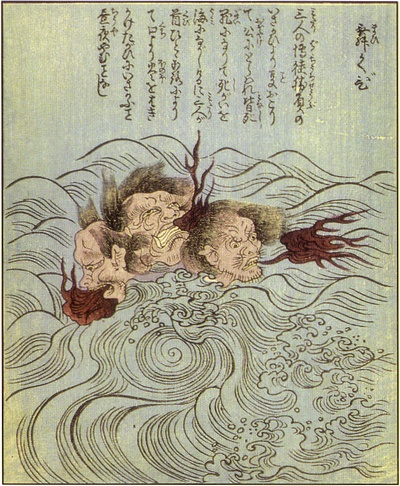
Maikubi: The Legend of Japan’s Dancing Samurai Heads
Japan’s folklore is a labyrinth of the strange and the supernatural, populated by creatures known as yokai. While some yokai are mischievous or misunderstood, others are born from pure, undiluted rage. Among the most chilling of these tales is the story of the Maikubi (舞首), or “Dancing Heads.”
For travelers and culture enthusiasts exploring the darker side of Japanese history, the legend of Maikubi offers a fascinating glimpse into the Edo period’s imagination and the seaside towns that keep these stories alive. In this article, we venture into the waves of Kanagawa Prefecture to uncover the story of three samurai whose feud transcended death itself.
Introduction to the Macabre
The image is visceral: three severed heads floating upon the ocean waves, spinning in a grotesque dance, snapping and biting at one another with eternal hate. This is the Maikubi. Unlike the Rokurokubi (long-necked woman) or the Nukekubi (detachable heads), the Maikubi are not demons by birth. They are ghosts of men—specifically, samurai—who died in a state of such intense anger that their spirits could not pass on.
This legend is particularly famous in the coastal regions of Japan, serving as a cautionary tale about the destructive power of wrath and the consumption of alcohol.
Origins and Etymology
The term Maikubi translates literally to “Dancing Heads” (mai meaning dance, and kubi meaning head or neck). The visual of the “dance” refers to the way the heads bob and circle each other in the water, propelled by the waves and their own supernatural struggle.
The most prominent record of the Maikubi comes from the Edo period master of yokai illustrations, Toriyama Sekien. In his 1779 work, Konjaku Gazu Zoku Hyakki (The Illustrated One Hundred Demons from the Present and the Past), he depicts the three heads amidst splashing waves, breathing fire and biting one another. Sekien’s work was instrumental in cementing the visual identity of many yokai we recognize today.
The Legend of the Three Samurai
The specific tale associated with Maikubi is set in Manazuru, a coastal town in Kanagawa Prefecture, during the mid-Kamakura period. As the story goes, three samurai named Kosanta, Matashige, and Akugoro were attending a local festival.
The Fatal Quarrel
During the festivities, sake flowed freely. What began as a celebration quickly turned sour as the three heavily intoxicated warriors got into a heated argument. The exact cause of the dispute varies by retelling—some say it was over a woman, others claim it was a boast about martial prowess—but the result was catastrophic.
Swords were drawn near the shoreline. In a flurry of steel and drunken rage, the fight reached a bloody crescendo. Remarkably, in a simultaneous clash of blades, all three men decapitated one another at the exact same moment.
The Battle Beyond Death
Typically, death marks the end of a feud. However, the rage of Kosanta, Matashige, and Akugoro was so potent that their severed heads tumbled into the sea and continued the fight. Bystanders watched in horror as the three heads floated on the surface, teeth bared, biting into each other’s flesh and spinning in a circle.
For nights afterward, fishermen reported seeing the glowing heads “dancing” in the waves, gnashing their teeth and causing the sea to churn violently. The locals, terrified of the vengeful spirits, eventually appealed to a high-ranking priest. Through fervent prayers and memorial services, the spirits were eventually pacified, though legends say their rage still lingers beneath the waves during storms.
Modern Culture and Legacy
Today, the Maikubi serves as a niche but fascinating part of Japanese pop culture. They appear in various yokai encyclopedias and have made appearances in manga and anime, most notably in the works of Shigeru Mizuki (GeGeGe no Kitaro), who did much to revive interest in Toriyama Sekien’s creatures.
Culturally, the story acts as a grim reminder of the samurai code gone wrong—where honor is replaced by drunken foolishness, and the warrior spirit is corrupted into an eternal curse.
Traveler’s Tips: Visiting Manazuru
If you are a folklore hunter or a “dark tourism” enthusiast, a trip to Manazuru in Kanagawa Prefecture is a must.
- Location: Manazuru is a beautiful peninsula located south of Odawara. It is easily accessible from Tokyo via the JR Tokaido Line.
- The Kibune Festival: While the Maikubi legend is dark, the town is famous for the Kibune Festival (Kibune Matsuri), designated an Important Intangible Folk Cultural Property. While not celebrating the Maikubi specifically, the festival involves decorated boats and maritime safety prayers, which resonate with the history of spirits in the sea.
- Kibune Shrine: Visit the Kibune Shrine in Manazuru. It is said that the priest who pacified the Maikubi enshrined their spirits nearby to stop the hauntings. You can pay your respects here and enjoy the stunning ocean views.
- Local Seafood: After exploring the spooky history, enjoy the very fresh seafood that Manazuru is famous for—thankfully, free of dancing heads today!
Sources & Further Reading
For those wishing to delve deeper into the textual history of these creatures, the following works are essential:
- Konjaku Gazu Zoku Hyakki (1779) by Toriyama Sekien: The primary visual source for the Maikubi.
- Ehon Hyaku Monogatari (1841): Another Edo-period text that elaborates on strange tales and yokai.
- Japanese Ghost Stories: Works by Lafcadio Hearn often touch upon the atmosphere of such coastal hauntings, though Maikubi is specific to local legends.
While ancient texts like the Kojiki or Nihon Shoki detail the gods and the creation of Japan, it is the Edo-period literature and local town records of Kanagawa that truly bring the terrifying legend of the Maikubi to life.