
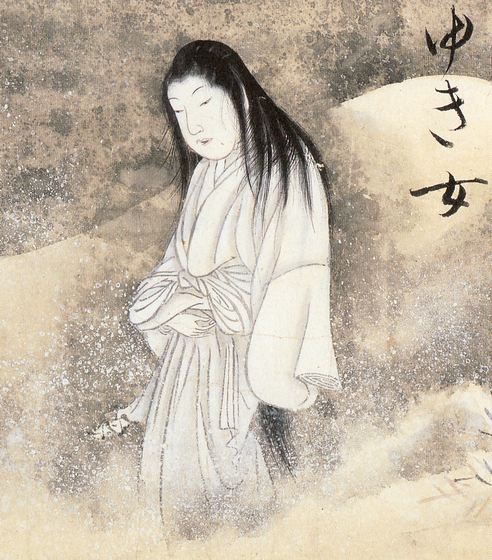
Yuki-onna: The Chilling Legend of Japan’s Snow Spirit
When the winter winds howl through the mountain passes of the Japanese Alps and the snow falls thick enough to silence the world, the locals know not to linger outside. In the deep white void, where the breath freezes instantly, resides one of Japan’s most hauntingly beautiful and deadly yōkai (supernatural spirits): the Yuki-onna, or “Snow Woman.”
Her skin is as white as the drifts she walks upon, her hair long and dark like the winter night, and her touch—or her breath—is instant death. Yet, unlike many monsters that are purely grotesque, the Yuki-onna possesses a captivating allure that has chilled the spines of listeners for centuries. Join us as we trek into the frozen heart of Japanese folklore to uncover the secrets behind the cold aura of the Snow Woman.
Origins: Where the Cold Begins
The origins of the Yuki-onna are as ancient as the fear of hypothermia itself. In a time before central heating, winter in rural Japan was a brutal, often fatal season. The Yuki-onna is widely believed to be the personification of the perils of winter—specifically the confusing, sleepy sensation one feels before freezing to death.
While folklore varies by region, the Yuki-onna is not typically associated with the creation myths found in the Kojiki or Nihon Shoki, which focus on Shinto deities. Instead, she belongs to the realm of yōkai—spirits born from nature, human emotion, or tragedy. The earliest known written record of the Yuki-onna appears in the Sōgi Shokoku Monogatari (Sōgi’s Tales of Many Lands), written in the late Muromachi period (14th–16th century). Here, the author describes seeing a mysterious, white-clad woman in his garden on a snowy morning, who vanished as the sun rose—a fleeting, ghostly presence rather than a violent monster.
However, in regions like Niigata, Aomori, and Akita, where the snowfalls are legendary, her origins are darker. Some legends claim she is the spirit of a woman who perished in the snow, doomed to wander eternally, breathing frost onto lost travelers to steal their life essence, or iki.
The Legend: A Breath of Ice
There are countless variations of the Yuki-onna folktale, but the most famous version was immortalized by the writer Lafcadio Hearn in his 1904 collection, Kwaidan: Stories and Studies of Strange Things.
The story tells of two woodcutters, an old man named Mosaku and his young apprentice, Minokichi. Trapped by a blizzard in a mountain hut, they are visited by a woman in white robes. She breathes a cold, white mist over old Mosaku, freezing him to death instantly. She then turns to Minokichi. Struck by his youth and handsome face, she spares him on one condition: he must never mention this night to anyone. If he breaks his promise, she will kill him.
Years pass. Minokichi meets a beautiful woman named O-Yuki (“Snow”), marries her, and they have children. She is a wonderful wife who strangely never seems to age. One night, in a moment of comfort, Minokichi confides in O-Yuki about the terrifying spirit he saw years ago, noting how much she resembles that ghost.
The illusion shatters. O-Yuki reveals herself as the Yuki-onna. Furious that he broke his vow, she prepares to kill him but hesitates when she looks at their sleeping children. She decides to spare him for their sake, warning him to treat the children well, before dissolving into a mist of white snow and vanishing through the roof vent, never to be seen again.
Modern Culture: From Horror to Romance
Today, the “cold aura” of the Yuki-onna has permeated global pop culture. She is no longer just a symbol of death but often a complex character representing loneliness and unrequited love.
- Anime and Manga: Characters based on Yuki-onna appear in series like Yu Yu Hakusho, Nura: Rise of the Yokai Clan, and InuYasha. They are often depicted as controlling ice and snow, maintaining an aloof, cool personality.
- Video Games: In the Pokémon franchise, the creature Froslass (Yukimenoko in Japanese) is directly inspired by her, described as a spirit that freezes its prey. The Nioh series also features her as a formidable boss fight, beautiful yet lethal.
This shift reflects a modern fascination with the tragic nature of the monster—she is cold because she is the snow, unable to feel warmth without melting away.
Traveler’s Tips: Experiencing the Chill
For travelers brave enough to seek the atmosphere of the Snow Woman, Japan offers several winter destinations that evoke her legend.
1. The Snowy Streets of Tono (Iwate Prefecture)
Known as the “City of Folklore,” Tono is the setting for The Legends of Tono (Tono Monogatari). Here, you can visit the Tono Folktale Museum and listen to local storytellers recount tales of yōkai while surrounded by the deep snows of Tohoku.
2. Ome City (Tokyo)
Surprisingly, Ome City in western Tokyo is the setting for the specific legend Lafcadio Hearn recorded. The city embraces this connection, and you can visit the myriad shrines and temples in the area during winter to feel the quiet isolation that Minokichi might have felt.
3. The Lafcadio Hearn Memorial Museum (Shimane Prefecture)
Located in Matsue, this museum is dedicated to the man who introduced the Yuki-onna to the Western world. It’s a must-visit for literature and folklore enthusiasts.
4. Yuki Matsuri (Snow Festivals)
While not directly celebrating the ghost, the Sapporo Snow Festival and the Yokote Kamakura Festival allow you to experience the beauty of the element she embodies. Standing inside a kamakura (snow hut) at night, with only a lantern for light, gives you a glimpse into the atmosphere where legends are born.
Sources & Further Reading
- Kwaidan: Stories and Studies of Strange Things by Lafcadio Hearn (1904) – The definitive English source for the classic Yuki-onna tale.
- Sōgi Shokoku Monogatari (Tales of Many Lands by Sōgi) – Contains early Muromachi period accounts of the spirit.
- Tono Monogatari (The Legends of Tono) by Yanagita Kunio – A pivotal text in Japanese folklore studies exploring the spirits of the Tohoku region.
- Yōkai Attack! The Japanese Monster Survival Guide by Hiroko Yoda and Matt Alt – A modern, accessible guide to Japanese monsters.