
The Sound of Setsubun: Chasing Demons with Beans
If you walk through a quiet residential neighborhood in Japan on the evening of February 3rd, you might hear a peculiar sound. It is not the wind nor the distant hum of traffic, but a dry, scattering click against pavement and wood, accompanied by shouts of distinct rhythm. This is the sound of Setsubun, the day before the beginning of spring in the old lunar calendar.
While visual spectacles like cherry blossoms often define Japan’s seasons, Setsubun is defined by action and sound. The ritual is called mamemaki (bean scattering), a tradition designed to purge the previous year’s bad luck and welcome fresh fortune. For the cultural traveler, understanding the resonance of these roasted soybeans offers a unique window into how Japan bridges the gap between the harshness of winter and the hope of spring.
Origins: From Court Rituals to Household Noise
The roots of Setsubun date back considerably further than modern Japan. The custom originated from a Chinese purification ritual known as Tsuina (or Nuo in Chinese), which was introduced to Japan in the 8th century during the Nara period. Initially, this was a solemn court event performed on New Year’s Eve to banish pestilence and malevolent spirits.
By the Heian period (794–1185), the rituals began to incorporate local Shinto and Buddhist elements. However, the specific use of roasted soybeans—known as fuku mame (fortune beans)—became popularized during the Muromachi period (1336–1573). What began as an aristocratic ceremony trickled down to the samurai class and eventually the common people, transforming into the raucous, family-centered event observed today. The transition marked a shift from a visual performance of exorcism to a participatory event where the sound of the beans hitting the floor symbolized the physical driving out of evil.
The Legend: Why Beans?
Why do the Japanese throw beans at demons? The answer lies in Japanese wordplay, a common feature in folklore. The word for bean, mame (豆), sounds identical to mame (魔滅), which can be written with characters meaning “destroying demons.” Furthermore, it sounds like mame (魔目), or “demon eye.”
According to legend, an evil ogre once terrorized a village, causing destruction and famine. The gods advised the villagers to throw roasted soybeans at the ogre’s eyes. The hardness of the roasted beans blinded the monster, and the act of throwing them crushed the evil spirit.
Therefore, the beans must be roasted. Throwing raw beans is considered bad luck because if a raw bean were to sprout after being thrown, it would symbolize the evil taking root again. The satisfying crack of the roasted bean hitting a surface is the auditory confirmation that the demon has been vanquished.
Modern Culture: Oni wa Soto, Fuku wa Uchi!
In modern Japan, Setsubun is a beloved chaos. In households, the father typically dons a plastic Oni (demon) mask. The children, armed with roasted soybeans, chase him out of the house, throwing beans while chanting the famous mantra:
“Oni wa soto! Fuku wa uchi!” (Demons out! Fortune in!)
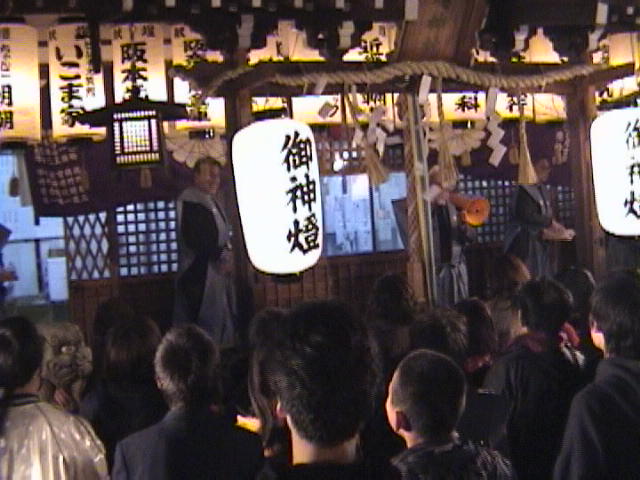
The sensory experience extends beyond the home. At major temples like Senso-ji in Tokyo or Naritasan Shinshoji in Chiba, the atmosphere is electric. Large crowds gather as sumo wrestlers, actors, and local dignitaries stand on high platforms, throwing packets of beans and mochi (rice cakes) into the sea of hands below. The sound here is different—a roar of excitement, the rustling of paper packets, and the collective energy of thousands seeking blessings.
Recently, another quiet tradition has joined the noisy bean throwing: the Ehomaki. This is an uncut sushi roll eaten while facing the year’s lucky compass direction. Unlike the mamemaki, one must eat the Ehomaki in total silence to ensure the luck doesn’t escape, creating a fascinating auditory contrast to the rest of the evening.
Traveler’s Tips: Experiencing the Festival
If you find yourself in Japan in early February, Setsubun is an unmissable cultural immersion. Here is how to participate respectfully:
- Dates: Setsubun usually falls on February 3rd, though it can occasionally shift to the 2nd or 4th depending on the celestial position of the sun.
- Where to Go: For the best atmosphere, visit a large shrine or temple. Zojoji Temple (near Tokyo Tower) and Senso-ji (Asakusa) host massive events. Arrive early, as these areas become incredibly crowded.
- Participate: Convenience stores sell small packets of roasted soybeans with Oni masks included. It is a fun souvenir to take back to your hotel.
- Eating the Beans: It is customary to pick up and eat the number of roasted beans corresponding to your age, plus one extra for the year ahead. They are crunchy, nutty, and said to ensure good health.
Sources & Further Reading
To deepen your understanding of the spiritual context behind Setsubun and the concept of Oni in Japanese history, the following texts and resources are recommended:
- The Kojiki (Records of Ancient Matters): While not mentioning Setsubun specifically, this 8th-century text establishes the foundational mythology of Japan, including the nature of spirits and purification (misogi).
- The Nihon Shoki (The Chronicles of Japan): Provides historical context on the introduction of Chinese rituals like the Tsuina to the Imperial Court.
- Engishiki: A 10th-century book of laws and regulations that details early Shinto rituals and court ceremonies.
Through the simple sound of a bean hitting the floor, a thousand years of history echoes into the present, reminding us that sometimes, chasing away our demons requires a little noise and a lot of conviction.