
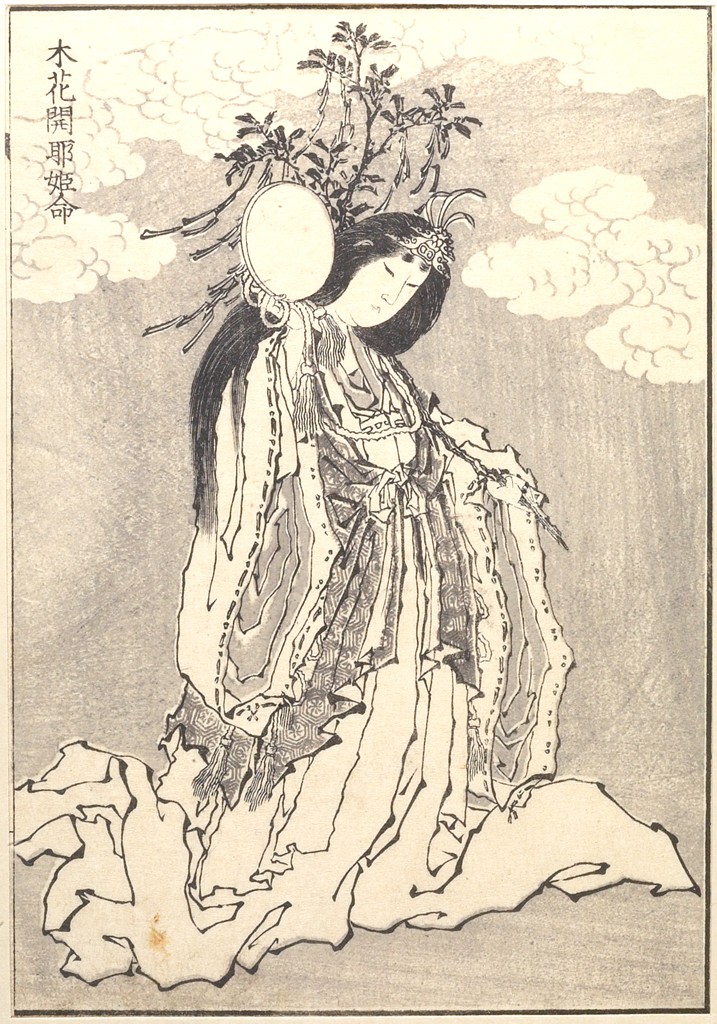
The Divine Beauty of Konohanasakuya-hime: Japan’s Blossom Goddess
Introduction
Japan is a land defined by the juxtaposition of fleeting beauty and enduring strength. Nothing captures this duality better than the image of cherry blossoms drifting before the majestic backdrop of Mount Fuji. At the spiritual heart of this imagery lies Konohanasakuya-hime, the Shinto goddess of Mount Fuji and all volcanoes. She is the avatar of earthly life—breathtakingly beautiful but ultimately transient.
Origins and Etymology
Her name, often shortened to Sakuya-hime, is a mouthful of poetic imagery. Konohanasakuya-hime roughly translates to “Princess of the Flowering Trees” or “The Princess who makes the blossoms of the trees bloom.” In Shinto cosmology, she represents delicate earthly life, functioning as a stark contrast to the eternal, unchanging nature of rocks and stones.
She is the daughter of Oyamatsumi, the Great Mountain God. While she is most famously associated with the Sakura (cherry blossom), her domain extends to the fiery heart of volcanoes. This paradoxical combination of a delicate flower and a destructive volcano makes her one of the most complex figures in Japanese mythology, symbolizing the intense, passionate, yet fleeting nature of existence.
The Legend: Love, Rejection, and Fire
The most famous myth surrounding Konohanasakuya-hime appears in Japan’s oldest chronicles. The story begins when Ninigi-no-Mikoto, the grandson of the Sun Goddess Amaterasu, descended from heaven to rule the earth. Upon meeting Sakuya-hime near the seaside, he was instantly captivated by her radiant beauty and asked for her hand in marriage.
Her father, the Mountain God, was delighted by the proposal. He offered Ninigi both Sakuya-hime and her older sister, Iwanaga-hime (Princess of the Rocks). However, Iwanaga-hime was not beautiful; she was as plain and sturdy as a stone. Ninigi, driven by aesthetics, sent the older sister back to her father and kept only the beautiful Blossom Princess.
The father was displeased by this rejection. He revealed a prophecy: had Ninigi accepted Iwanaga-hime, the lives of his descendants (the emperors and humanity) would have been eternal and unmoving, like rocks. Because he chose only the blossom, human life became short and fleeting, destined to fade quickly like cherry petals falling in the wind.
The Trial by Fire
The legend takes a dramatic turn when Sakuya-hime becomes pregnant after just one night. Suspicious, Ninigi accused her of infidelity with an earthly deity. To prove her purity and divine lineage, she entered a windowless hut and set it on fire before giving birth. She vowed that if the child were not of heavenly descent, they would perish in the flames. Amidst the inferno, she safely gave birth to three healthy sons. This act solidified her status as a goddess of fire, safe childbirth, and protection against volcanic eruption.
Modern Culture and Symbolism
Today, Konohanasakuya-hime is not just a relic of ancient texts; she is a vibrant part of Japanese culture. As the presiding deity of Mount Fuji, she is the primary goddess worshiped at over 1,300 Sengen shrines across the country.
In pop culture, her archetype appears frequently in anime, manga, and video games (such as the Persona series, Okami, or SMITE), often depicted wearing pink kimono with floral motifs. Culturally, she is the spirit of Hanami (flower viewing). Every spring, when millions of Japanese people gather under the trees to drink sake and appreciate the blooms, they are unknowingly paying homage to the fleeting beauty that Sakuya-hime represents—appreciating the moment precisely because it cannot last.
Traveler’s Tips: Paying Respects
If you are planning a trip to Japan, engaging with the legend of Sakuya-hime adds a profound layer to your sightseeing.
- Visit Fujisan Hongu Sengen Taisha: Located in Shizuoka Prefecture at the foot of Mount Fuji, this is the head shrine of all Sengen shrines. It is traditionally the starting point for pilgrims climbing the mountain.
- Climbing Mount Fuji: If you hike the mountain during the summer season, you will find shrines dedicated to her at the summit. Hikers often buy wooden walking sticks branded at these stations as a prayer for safety.
- The Best Time: Visit during early April. The visual contrast of the vermilion shrine buildings, the white snow-capped Fuji, and the pink cherry blossoms is the quintessential image of Sakuya-hime’s domain.
- Etiquette: When visiting these shrines, remember to bow once at the Torii gate and cleanse your hands at the water pavilion (Temizuya) before approaching the main hall to offer a prayer.
Sources & Further Reading
To dive deeper into the mythology of Konohanasakuya-hime, the following historical texts are essential reading:
- The Kojiki (Records of Ancient Matters): Compiled in 712 AD, this text details the genealogy of the gods and the specific story of the rock and flower sisters.
- The Nihon Shoki (The Chronicles of Japan): Completed in 720 AD, this official history offers slightly different variations of the myths regarding her birth and marriage.