
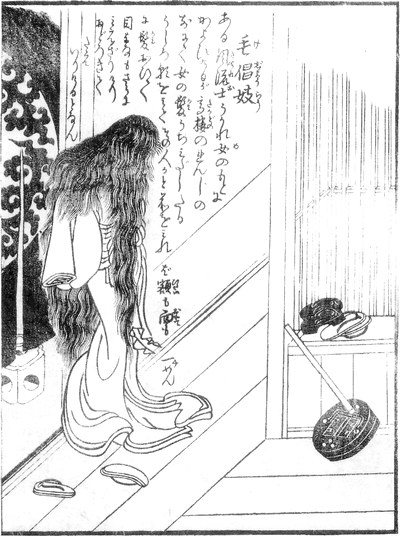
The Legend of Kejoro: Japan’s Hairy Courtesan Yokai
When travelers imagine the supernatural side of Japan, they often picture the fox spirits (Kitsune) or water imps (Kappa). However, diving deeper into the distinct folklore of the Edo period reveals creatures that are far more unsettling and socially complex. One such entity is the Kejoro (毛倡妓), literally translating to the “Hair Prostitute” or “Hairy Courtesan.”
This yokai serves as a fascinating window into the fears, taboos, and nightlife of feudal Japan. Unlike the nature spirits of ancient times, the Kejoro is an urban legend born from the shadowy corners of the pleasure districts, representing a terrifying subversion of beauty.
Unveiling the Origins
To understand the Kejoro, one must understand the environment that created her. During the Edo period, Yoshiwara was the famed red-light district of Tokyo (then Edo). It was a floating world of transient pleasures, but also a place of secrets and entrapment.
The first and most definitive depiction of the Kejoro appears in Toriyama Sekien’s seminal 1779 work, Konjaku Gazu Zoku Hyakki (The Illustrated Hundred Demons from the Present and the Past: Continued). Sekien depicted a woman in a brothel, her face obscured by long, flowing hair that seems to possess a life of its own.
Etymology and Symbolism
The name is a compound of Ke (Hair) and Joro (Prostitute/Courtesan). While some yokai are born from nature, the Kejoro is often interpreted as a manifestation of the anxieties surrounding the pleasure quarters. She represents the fear of the unknown—the idea that beneath the layers of beautiful kimono and makeup lies something bestial or uncontrollable.
The Legend of the Hairy Woman
Folklore surrounding the Kejoro varies, but the core narrative remains consistent: she is a creature of deception.
In the most common variation of the legend, a young man visits a tea house or a brothel and becomes enamored with a mysterious woman. She appears elegant and quiet, often keeping her face partially hidden behind a fan or her sleeves. When the man attempts to get close to her, or when the lights are dimmed, the horrifying reveal occurs.
The Reveal
Unlike other monsters that might bite or claw, the Kejoro’s terror is psychological and physical grotesquerie. In some stories, the man touches her skin only to find her entire body covered in thick, matted hair like that of a wild animal. In other more supernatural versions, her hair grows rapidly, filling the room and entangling the victim like a spider’s web, suffocating him or binding him so he can never leave the establishment.
There is also a tragic interpretation where the Kejoro is the spirit of a woman who suffered in the pleasure quarters, her wild hair representing her chaotic emotions and the loss of her humanity due to her circumstances.
Modern Culture and Pop Media
While not as globally famous as Godzilla or Sadako, the Kejoro has maintained a presence in Japanese pop culture, particularly within the yokai genre.
- Manga and Anime: Shigeru Mizuki, the grandfather of modern yokai manga, featured the Kejoro in his iconic series GeGeGe no Kitaro. In these depictions, she is often less malicious and more of a tragic or mischievous character, using her hair as a weapon to defend herself or her friends.
- Video Games: She appears in various RPGs and folklore-based games like Yokai Watch, where her design is stylized to be more cartoony and palatable for younger audiences.
Despite these modern adaptations, she remains a symbol of the “weird” side of Japanese horror—where the scare comes not from violence, but from the distortion of the human form.
Traveler’s Tips: Seeking the Spirits
If you are a culture enthusiast planning a trip to Japan and want to explore the world of yokai, here are the best places to visit:
1. Mizuki Shigeru Road (Sakaiminato, Tottori)
This is the ultimate pilgrimage for yokai lovers. The street is lined with over 170 bronze statues of spirits from Mizuki Shigeru’s work, including the Kejoro. It is a whimsical, photo-friendly location.
2. Yokai Street (Kyoto)
Located on Ichijo-dori in Kyoto, this shopping street embraces the legend of the Hyakki Yagyo (Night Parade of One Hundred Demons). The shop owners create their own handmade yokai monsters and display them outside their stores. It is a fantastic place to buy unique souvenirs and experience local community culture.
3. Historical Yoshiwara (Tokyo)
While the original buildings are long gone, walking through the area of Senzoku in Taito Ward allows you to trace the history of the old Yoshiwara district. Visiting the Yoshiwara Shrine, where courtesans once prayed, provides a somber and atmospheric connection to the origins of the Kejoro legend.
Sources & Further Reading
For those interested in diving deeper into the textual history of these creatures, the following works are essential:
- Toriyama Sekien’s Konjaku Gazu Zoku Hyakki (1779): The primary visual source for the Kejoro.
- Shigeru Mizuki’s Mujara: A modern encyclopedia of Yokai.
- Note on Ancient Texts: While the Kojiki and Nihon Shoki cover ancient gods and creation myths, the Kejoro is a product of the later Edo period urban culture and does not appear in these ancient divine chronicles.