
Exploring Gongen: Japan’s Divine Shinto-Buddhist Avatars
When travelers first visit Japan, they are often taught to distinguish between the vermilion torii gates of Shinto shrines and the heavy wooden gates of Buddhist temples. We are told these are two separate traditions: Shinto, the indigenous spirituality of nature, and Buddhism, the imported philosophy of enlightenment. However, for over a thousand years, this distinction did not exist in the minds of the Japanese people. This murky, mystical intersection is where we find the Gongen.
Introduction: The Sacred Blend
The term Gongen (権現) literally translates to “incarnation” or “provisional manifestation.” It is the cornerstone of Shinbutsu-shugo, the syncretism of Shinto and Buddhism that defined Japanese religion until the late 19th century.
In this system, Buddhist deities (Buddhas and Bodhisattvas) were considered the “true nature” (Honji), while Japanese Kami (spirits) were viewed as their “avatars” (Suijaku) sent to save sentient beings in Japan. Understanding Gongen is essential for any cultural traveler, as it unlocks the hidden history behind some of Japan’s most spectacular architecture and festivals.
Origins: The Theory of Original Ground
To understand the Gongen, one must look back to the Heian period (794–1185). When Buddhism arrived in Japan from China and Korea in the 6th century, it initially clashed with the local worship of Kami. To reconcile these faiths, monks developed the Honji Suijaku theory.
The logic was elegant: The absolute truth is universal (Buddhism), but it manifests differently depending on the culture and time. Therefore, the great Sun Goddess Amaterasu was declared to be a manifestation of Dainichi Nyorai (the Cosmic Buddha). This allowed people to worship their ancestral gods while embracing the new metaphysics of Buddhism.
This theological merger gave rise to “Gongen” deities—hybrid gods that possessed the raw, elemental power of nature spirits and the salvific mercy of Buddhas.
Legend: The Mountain King and the Shogun
The lore of Gongen is filled with dramatic revelations and political power plays. Two legends stand out, representing the spiritual and political spectrums of this concept.
The Fury of Zaō Gongen
One of the most fearsome figures in Japanese asceticism is Zaō Gongen. According to legend, En no Gyoja, the founder of the Shugendo mountain sect, prayed on Mount Kimpusen for a deity to protect the land during a time of chaos. First, Kannon Bodhisattva appeared, but she was too gentle. Then Maitreya Buddha appeared, but he was too passive. Finally, Zaō Gongen burst forth from the rock—blue-skinned, three-eyed, and furious, pulsating with energy to crush evil desires. He became the protector of the sacred mountains of Yoshino.
The Deification of Ieyasu
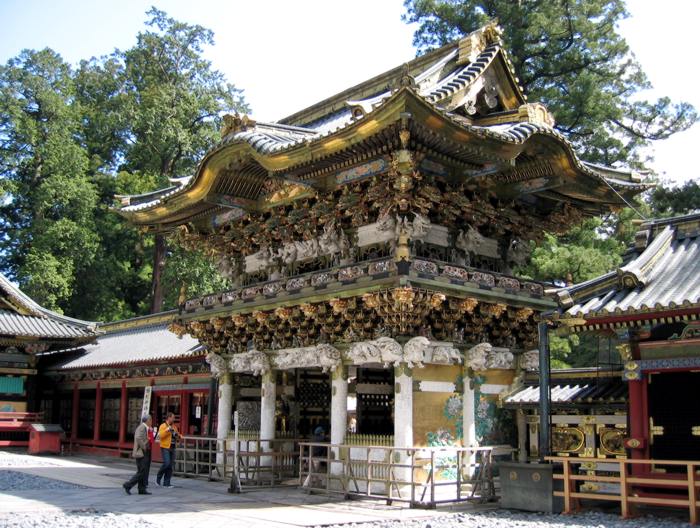
On the political side, the most famous Gongen is Tosho Daigongen (“The Great Gongen Illuminating the East”). This is the posthumous title of Tokugawa Ieyasu, the warlord who unified Japan in the early 1600s. Unlike ancient myths, this was a calculated move. By becoming a Gongen, Ieyasu elevated himself to the status of a deity to protect the Tokugawa Shogunate eternally. His mausoleum in Nikko is a testament to this status, blending Shinto architecture with Buddhist ornamentation.
Modern Culture: The Great Separation
If Gongen was so integral to Japan, why do we see Shinto and Buddhism as separate today? The answer lies in the Meiji Restoration of 1868. In a rush to modernize and centralize power around the Emperor (the highest Shinto priest), the government issued the Shinbutsu Bunri order—the separation of Kami and Buddhas.
“Gongen” titles were stripped from shrines, Buddhist statues were removed from shrine grounds, and monks were forced to return to secular life. However, the cultural DNA remains.
- Architecture: The Gongen-zukuri style, characterized by a complex roof structure connecting the worship hall and main sanctuary, remains a staple of Japanese design (most famously at Nikko Tosho-gu).
- Festivals: Many “Shinto” festivals still utilize floats and imagery that betray their Buddhist Gongen roots.
- Pop Culture: The concept of an avatar revealing a true, more powerful form is a recurring trope in anime and manga, a direct legacy of the Honji Suijaku philosophy.
Traveler’s Tips: Seeking the Avatars
To truly appreciate the legacy of the Gongen, travelers should look beyond the surface level of sightseeing.
- Visit Nikko Tosho-gu: This is the ultimate Gongen site. Look for the lavish wood carvings. It is neither purely Shinto (usually simple and unpainted) nor purely Buddhist, but a lavish hybrid.
- Hike the Kumano Kodo: This pilgrimage route is dedicated to the Kumano Gongen. Here, the three mountains are worshipped as the physical homes of three Buddhas manifesting as Kami.
- Mount Yoshino: Visit in spring for the cherry blossoms, but stay to see the massive blue statue of Zaō Gongen at Kinpusen-ji Temple. It is a rare glimpse into the fierce aesthetic of syncretic mountain worship.
- Observe Etiquette: When visiting these sites, the lines blur. It is generally acceptable to bow and clap (Shinto style) or bow silently (Buddhist style). Watch what the locals do; often, at Gongen sites, you will see grandmothers doing both!
Sources & Further Reading
For those interested in the deep historical context of Japanese deities, the following texts and concepts are essential:
- The Kojiki & Nihon Shoki: While these 8th-century texts predate the full Honji Suijaku theory, they provide the foundational mythology of the Kami that were later identified as avatars.
- The Lotus Sutra: Central to the Mahayana Buddhism that facilitated these syncretic adaptations.
- Historical Analysis: “The Catalpa Bow: A Study of Shamanistic Practices in Japan” by Carmen Blacker offers insight into the mystic connection between humans, kami, and buddhas.
By understanding the Gongen, you see Japan not as a land of two religions, but as a complex spiritual tapestry where gods wear many faces.