
Utaki: The Sacred Groves of Ryukyu Spirit
When travelers imagine Okinawa, images of turquoise waters and white sandy beaches often dominate their thoughts. However, beneath the tropical veneer lies a profound spiritual landscape distinct from mainland Japan. This is the world of the Utaki (御嶽), the sacred groves that serve as the heart of the indigenous Ryukyuan religion. Unlike the ornate shrines found in Kyoto or Tokyo, Utaki are subtle, elemental, and deeply connected to nature.
Introduction: The Sanctuary of Nature
In mainland Japanese Shinto, a shrine (jinja) is often marked by a vermilion torii gate and an elaborate wooden structure housing the deity. In the Ryukyu Islands, however, the gods do not dwell in houses built by hands. An Utaki is typically a natural formation—a dense grove of trees, a limestone cave, or a unique rock formation.
These sites act as portals where deities (kami) descend to hear prayers and receive offerings. For centuries, these spaces have been the focal point of community life, serving as venues for harvest rituals, ancestor worship, and rites of passage. Visiting an Utaki offers a glimpse into an ancient form of animism where the line between the physical landscape and the spiritual realm is nonexistent.
Origins: The Way of the Priestess
To understand the Utaki, one must understand the religious hierarchy of the Ryukyu Kingdom. Ryukyuan spirituality is distinctively matriarchal. Historically, spiritual power was believed to be the domain of women, a concept known as Onarigami.
The rituals within the Utaki were—and often still are—conducted by Noro (priestesses) or Yuta (spirit mediums). In the era of the Ryukyu Kingdom, the Noro were appointed by the government to manage the spiritual affairs of the village, protecting the community from disasters and ensuring bountiful harvests. The Utaki was their domain, a restricted sanctuary where men were traditionally forbidden to enter.
The structure of an Utaki is simple yet symbolic. The innermost sanctuary, known as the Ibi, is the holiest spot where the deity resides. In many traditional Utaki, an incense burner stands before a rock or tree, marking the threshold between the human and the divine.
Legend: The Creation of the Islands
The most famous of these sacred sites is Sefa-Utaki, a UNESCO World Heritage site located on the Chinen Peninsula. Its significance is rooted in the Ryukyuan creation myth.
According to legend, the creation goddess Amamikyu descended from the heavens (Nirai Kanai) to build the islands of the Ryukyus. She created seven sacred groves, with Sefa-Utaki being the holiest among them. It was here that the inauguration ceremonies for the supreme priestess, the Kikoe-Ogimi, took place.
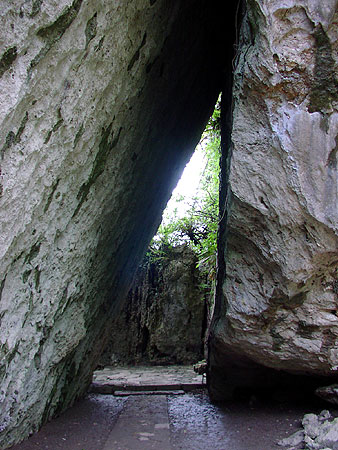
The most iconic feature of Sefa-Utaki is the Sangui formation—two massive limestone rocks leaning against each other to form a triangular tunnel. Local folklore suggests that passing through this tunnel signifies a spiritual rebirth. The site is oriented in such a way that worshippers can pray toward Kudaka Island, the legendary landing spot of Amamikyu, further linking the physical geography with mythological history.
Modern Culture: A Living Faith
While the Ryukyu Kingdom was dissolved in the late 19th century, the faith surrounding Utaki persists. These are not merely archaeological ruins or tourist attractions; they remain active places of worship. On specific days of the lunar calendar, you will see locals leaving offerings of incense, alcohol, and rice.
However, the modernization of Okinawa and the influx of tourism have created friction. As travelers flock to power spots for selfies or spiritual energy, the solemnity of the Utaki is sometimes compromised. This has led to restricted access in certain areas, such as the inner sanctuaries of Sefa-Utaki, to protect the site from spiritual pollution and physical erosion.
Traveler’s Tips: Etiquette in the Sacred Grove
Visiting an Utaki requires a high level of cultural sensitivity. These are not parks; they are the equivalent of a cathedral’s altar. Here are essential rules to follow:
- Do Not Enter Restricted Areas: If a rope or sign blocks a path, do not cross it. The Ibi (inner sanctuary) is strictly off-limits.
- No Taking: Never remove stones, leaves, or shells from an Utaki. It is believed that everything within the grove belongs to the kami, and taking them brings bad luck.
- Dress Modestly: Avoid beachwear. Cover your shoulders and knees as a sign of respect.
- Silence is Golden: Keep your voice down. These are places for silent prayer and introspection.
- Do Not Disturb Offerings: If you see incense or food left on a stone altar, do not touch it.
Sources & Further Reading
For those interested in delving deeper into the mythology and history comparing mainland Japan and the Ryukyus, the following texts are recommended:
- The Omoro Soshi: An ancient compilation of Ryukyuan poems and songs, serving a similar historical role to Japan’s Manyoshu, detailing the divine origins of the islands.
- Kojiki (Records of Ancient Matters): While primarily about mainland Shinto, reading the Kojiki offers a fascinating comparative study between the goddess Amaterasu and the Ryukyuan goddess Amamikyu.
- Okinawa: The History of an Island People by George H. Kerr: The definitive English-language history of the Ryukyu Kingdom.