
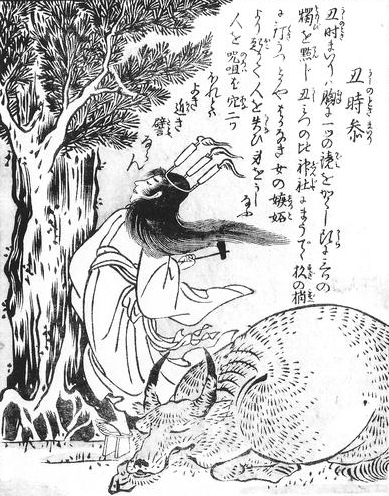
Ushi no Toki Mairi: Unveiling Japan’s Darkest Curse Ritual
Deep within the ancient cedar forests of Japan, long after the last train has departed and the shrine gates have closed, a rhythmic sound occasionally breaks the silence: con, con, con. It is the sound of a hammer striking a nail. In the realm of Japanese folklore and the occult, few rituals are as visually striking or as terrifying as Ushi no Toki Mairi (丑の刻参り), translated literally as the “Shrine Visit at the Hour of the Ox.”
While Japan is often celebrated for its harmonious temples and serene tea ceremonies, this ritual highlights the darker, more passionate side of human emotion found in its cultural history. From jealous lovers to vengeful rivals, Ushi no Toki Mairi is the ultimate expression of a grudge.
Origins of the Midnight Visit
The ritual takes its name from the traditional Japanese timekeeping system based on the Chinese Zodiac. The “Hour of the Ox” corresponds to the dead of night, roughly between 1:00 AM and 3:00 AM. This period is believed to be the time when the barrier between the world of the living and the spirit world is thinnest, allowing humans to channel dark spiritual energy.
While curses (noroi) have existed in Japanese history since the Jomon period, the specific imagery associated with Ushi no Toki Mairi solidified during the Edo period, though its roots trace back to the Heian era. Originally, visiting a shrine at this hour was not strictly for cursing; it was simply a time for intense prayer. However, over centuries, the solitude and darkness of the hour became inextricably linked with malevolent intent.
The Legend of Hashihime
The most famous origin story for this ritual involves Hashihime (The Princess of the Bridge). According to legend—specifically noted in variations of The Tale of the Heike and the Noh play Kanawa—Hashihime was a woman consumed by jealousy after her husband left her for another.
Desperate for revenge, she visited Kifune Shrine in Kyoto for seven consecutive nights. She prayed to the resident deity to turn her into a powerful demon so she could kill her ex-husband and his new lover. The deity took pity on her intensity and instructed her to dress in red, smear her face with vermilion, and immerse herself in the Uji River for twenty-one days.
She followed the instructions and transformed into a fearsome Kijin (demon), exacting her revenge. This legend established the visual archetype for the ritual: a woman transformation through pure rage.
The Ritual Attire and Method
Historically, the practitioner must dress in a specific manner to ensure the curse’s success:
- White Kimono: Signifying purity or death.
- The Iron Ring (Gotoku): An inverted iron trivet is worn on the head, holding three burning candles to light the darkness.
- The Wara Ningyo: A straw doll representing the victim, often containing a piece of their hair, fingernails, or name.
- The Sacred Tree: The doll is nailed to a shinboku (sacred tree) at the shrine using long iron spikes (five-inch nails).
If the practitioner is witnessed during the act, the curse is said to rebound (noroi-gaeshi), killing the caster instead. Thus, absolute secrecy is paramount.
Modern Culture and Pop Media
Today, Ushi no Toki Mairi remains a potent symbol in Japanese horror and pop culture. It appears frequently in anime, manga, and video games. For instance, in the hit series Jujutsu Kaisen, the character Nobara Kugisaki uses a technique called “Resonance” that utilizes a straw doll and hammer, a direct homage to this folklore.
Despite the modernity of 21st-century Japan, evidence of the ritual still appears. Shrine priests occasionally find straw dolls nailed to trees in the morning, particularly at secluded shrines. It serves as a chilling reminder that the superstitious nature of the human heart persists even in the digital age.
Traveler’s Tips: Respecting the Sacred
For travelers interested in the mystical side of Japan, visiting the sites associated with these legends can be a fascinating experience. However, caution and respect are required.
- Kifune Shrine (Kyoto): This is the most famous location associated with the ritual. It is a stunning shrine dedicated to the god of water. While beautiful by day, it holds a heavy atmosphere at night.
- Jishu Shrine (Kyoto): Located within the Kiyomizu-dera complex, this shrine also features trees that bear the scars of nail holes from centuries past.
- Do Not Touch: If you are hiking near a shrine and stumble upon a straw doll nailed to a tree, do not touch it. In local belief, the curse is still active, and interfering with it invites bad luck. Treat it as a historical artifact to be observed from a distance.
Sources & Further Reading
- The Tale of the Heike (Heike Monogatari): For the foundational legends of Hashihime and the chaotic spiritual energy of the Genpei War era.
- Nihon Shoki (Chronicles of Japan): Provides context on early Japanese shamanism, the significance of nature worship, and the roots of Shinto rituals.
- Konjaku Monogatarishu: A collection of tales from the late Heian period that often depicts the supernatural intersection of human life and demons.