
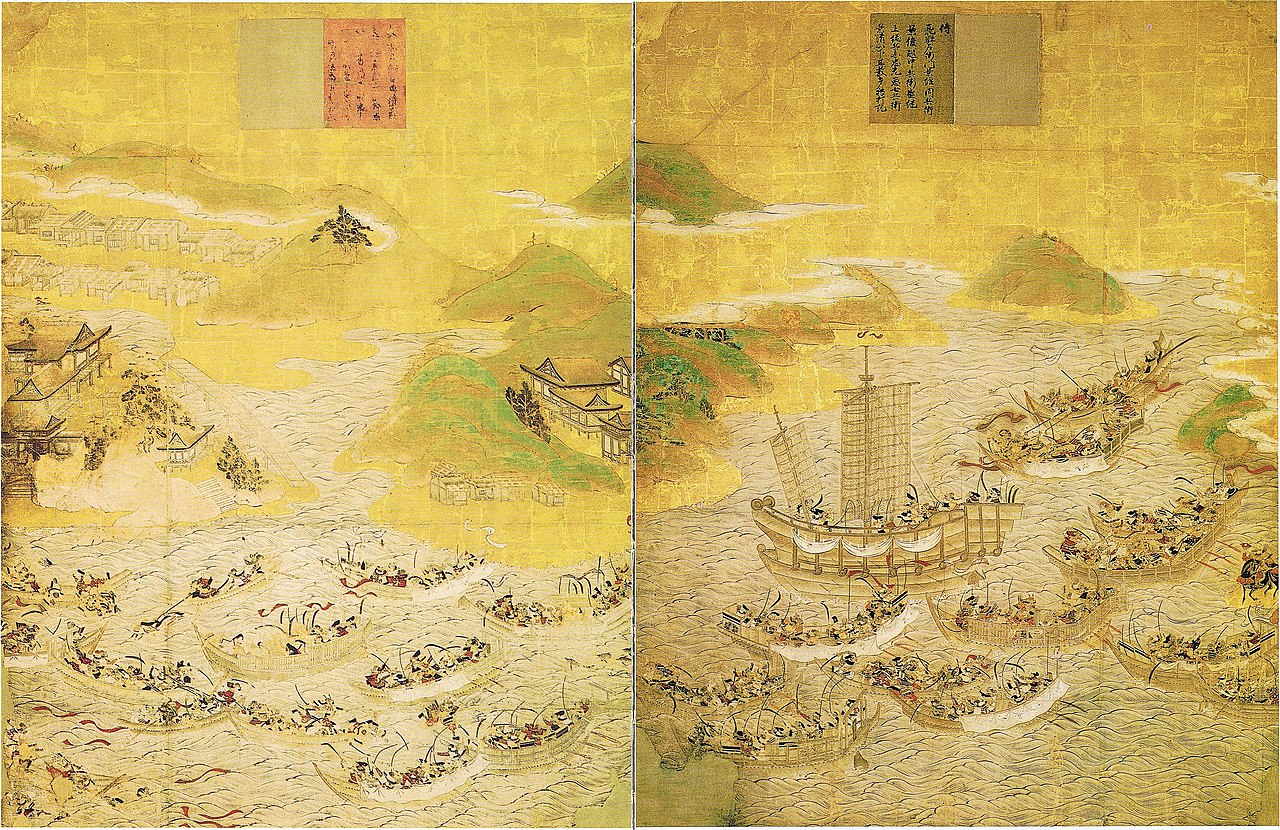
Battle of Dan-no-ura: The Clash That Forged Samurai Japan
The waters of the Shimonoseki Strait, a narrow turbulent passage separating Japan’s main islands of Honshu and Kyushu, hold a secret history beneath their waves. It was here, on April 25, 1185, that the sea reportedly turned red with blood during the Battle of Dan-no-ura. This wasn’t just a naval skirmish; it was the catastrophic finale of the Genpei War, a conflict that ended the Imperial court’s domination and ushered in seven centuries of samurai rule.
For travelers and history enthusiasts, Dan-no-ura is more than a geographical coordinate. It is a place where history blurs with mythology, where the souls of fallen warriors are said to inhabit the local wildlife, and where the course of Japanese history changed forever.
Origins: The Genpei War
To understand the gravity of Dan-no-ura, one must look at the bitter rivalry that preceded it. The late 12th century in Japan was defined by the struggle between two powerful warrior clans: the Taira (Heike) and the Minamoto (Genji).
The Taira clan, who flew red banners, had risen to immense power, effectively controlling the imperial court in Kyoto. The Minamoto clan, flying white banners, had been exiled but returned with a vengeance. The Genpei War (1180–1185) was a series of conflicts across Japan, pushing the Taira further and further west.
By the spring of 1185, the Taira had been backed into a corner. They took to their ships in the Shimonoseki Strait, bringing with them the child Emperor Antoku and the Three Sacred Treasures (the Imperial Regalia), believing their superior naval skills would save them. The Minamoto, led by the brilliant tactical genius Minamoto no Yoshitsune, pursued them for one final, decisive engagement.
The Battle and the Great Fall
The battle began in the morning, with the Taira initially gaining the upper hand. They were intimate with the treacherous currents of the strait and used the tides to shower the Minamoto fleet with arrows. However, history turned with the tide.
As the currents shifted in the afternoon, flowing against the Taira ships, the Minamoto seized the advantage. Furthermore, a defection by a Taira general revealed which ship was harboring the six-year-old Emperor Antoku. Recognizing that defeat was imminent, the Taira refused to surrender.
The Tragic Plunge
In one of the most poignant moments in Japanese history, the Emperor’s grandmother, Nii no Ama, took the child Emperor in her arms. According to the historical epic The Tale of the Heike, she told the boy that “paradise is beneath the waves.” Clutching the sacred sword and the jewel, she jumped into the ocean, taking the child and the regalia with her to the bottom of the sea. Following this, hundreds of Taira samurai, unwilling to face the shame of capture, committed mass suicide by drowning.
Legend: Ghost Stories and Heike Crabs
The violent end of the Taira clan birthed chilling legends that permeate Japanese culture to this day. The locals believed that the vengeful spirits of the Taira warriors remained in the strait, causing storms and shipwrecks.
Heikegani (Heike Crabs)
Perhaps the most fascinating biological legend is that of the Heikegani. These are a species of crab found in the Shimonoseki Strait with shells that bear a startling resemblance to the grimacing face of an angry samurai. Local folklore claims these crabs are the reincarnated souls of the Taira warriors who died at Dan-no-ura. For centuries, fishermen threw these crabs back, inadvertently engaging in artificial selection that preserved the crab lineages with face-like patterns.
Hoichi the Earless
Another famous tale, popularized by Lafcadio Hearn, is the ghost story of Hoichi the Earless. It tells of a blind biwa (lute) player at a temple near the battle site who is tricked by the ghosts of the Taira court into performing for them every night in a cemetery, draining his life force. It is a haunting reminder of the deep cultural scar left by the battle.
Modern Culture and Memory
The Battle of Dan-no-ura is not forgotten. It is a staple in Kabuki and Noh theater and is frequently depicted in Taiga dramas (historical TV series) in Japan. The tragic hero Minamoto no Yoshitsune remains one of Japan’s most beloved historical figures, while the fall of the Taira serves as a Buddhist lesson on mujo—the impermanence of all things.
Every year in early May, the Shimonoseki Kaikyo Festival is held. The highlight is the Sentei-sai, a procession commemorating Emperor Antoku, and a reenactment of the naval battle, complete with period costumes and flagged boats.
Traveler’s Tips: Visiting Shimonoseki
If you wish to stand where history was made, head to Mimosusogawa Park in Shimonoseki, Yamaguchi Prefecture.
- The Statues: The park features dramatic life-sized statues of Minamoto no Yoshitsune and Taira no Tomomori. You can also see replicas of the cannons used in later historical periods.
- The View: The park sits right by the Kanmon Bridge. Looking out at the rushing water, you can witness the speed of the currents that decided the battle’s outcome.
- Akama Shrine: Located nearby, this shrine is dedicated to the drowned Emperor Antoku. It features a unique design resembling the Dragon Palace of the sea, honoring the legend that the Emperor rules a kingdom beneath the waves. The grounds also contain the tomb of the Heike clan.
- Access: You can reach the park by bus from JR Shimonoseki Station. For a unique experience, you can walk between Honshu and Kyushu via the Kanmon Pedestrian Tunnel, which surfaces near the battle site.
Sources & Further Reading
For those interested in delving deeper into the history and mythology of this era, the following texts are essential:
- The Tale of the Heike (Heike Monogatari): The primary source for the events of the Genpei War. It blends history with Buddhist parables and is the source of the “paradise beneath the waves” quote.
- Azuma Kagami: A historical chronicle of the Kamakura Shogunate that provides a more military-focused record of the events.
- Nihon Shoki & Kojiki: While these ancient texts predate the battle by centuries, they establish the lineage of the Imperial family and the significance of the Imperial Regalia (Mirror, Sword, and Jewel) lost during the battle.