
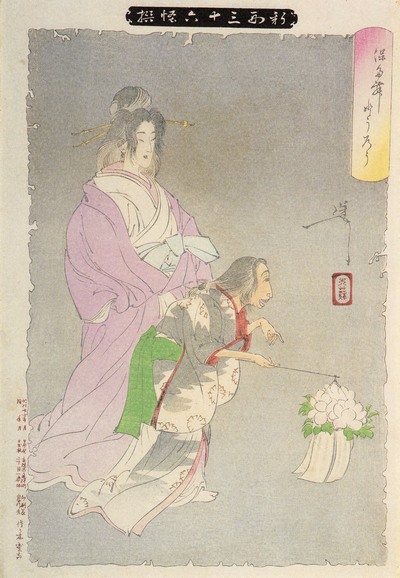
The Peony Lantern: Unveiling Japan’s Haunting Love Story
In the sweltering humidity of a Japanese summer, there is a distinct cultural tradition known as Kaidan—the telling of ghost stories. The belief is that a spine-tingling tale can physically cool the body down. Among these tales, few are as beloved, tragic, and terrifying as Botan Doro, or “The Peony Lantern.”
Considered one of Japan’s three great ghost stories (alongside Yotsuya Kaidan and Bancho Sarayashiki), Botan Doro is a masterpiece of romance and horror. For travelers fascinated by the darker side of folklore, understanding this legend offers a unique window into the Edo period’s psyche and the Japanese view of the afterlife.
The Origins of a Ghostly Masterpiece
Unlike many ancient myths rooted in Shinto antiquity, Botan Doro has a clear literary lineage, though its most famous iteration is a product of oral tradition.
From China to Rakugo
The core narrative was originally adapted from a 14th-century Chinese collection titled Jiandeng Xinhua (New Tales for the Trimmed Lamp Lamp). It was brought to Japan and localized by Asai Ryoi in his 1666 work, Otogi Boko (Hand Puppets). However, the version that cemented the story in the Japanese consciousness was crafted by Sanyutei Encho I, the supreme master of Rakugo (comic storytelling), in the late 19th century. Encho expanded the simple ghost story into a complex melodrama filled with subplots of betrayal, karma, and human greed, performing it over several nights to captivated audiences.
The Legend of Otsuyu and Shinzaburo
The story centers on a young, masterless samurai (ronin) named Hagiwara Shinzaburo. He lives a quiet, reclusive life until he meets a beautiful woman named Otsuyu. They fall deeply in love, but circumstances force them apart. Shinzaburo is eventually told that Otsuyu has died of lovesickness.
The Nightly Visitations
During the Obon season—the time when spirits return to the living world—Shinzaburo is sitting on his veranda when he sees two women approaching through the darkness. One holds a lantern shaped like a peony flower. To his shock and joy, it is Otsuyu, accompanied by her maid. She claims she is not dead, but merely ran away to be with him.
For several nights, the lovers are reunited. However, a suspicious neighbor peeps through a crack in the shutters one evening. Instead of seeing a young woman, he sees Shinzaburo embracing a rotting skeleton, the spectral light of the peony lantern casting an eerie glow over the macabre scene.
Betrayal and Demise
Warned by the neighbor, a terrified Shinzaburo seeks help from a Buddhist priest, who gives him ofuda (protective talismans) to paste on his doors and windows to keep the spirits out. For a time, it works. Otsuyu calls to him from outside, weeping, unable to enter.
However, the story takes a dark turn into human evil. Shinzaburo’s servants, a couple named Tomizo and Omine, are bribed by the ghosts (who offer gold) to remove the talismans. Greed wins over loyalty. The servants peel away the holy paper. The next morning, Shinzaburo is found dead, his body entwined with a skeleton.
Modern Culture and Adaptation
Today, Botan Doro remains a staple of Japanese horror entertainment. It has transcended its Rakugo roots to become a fixture in Kabuki theater and cinema.
In modern pop culture, the imagery of the “Peony Lantern” is instantly recognizable. If you visit a haunted house attraction in Japan during summer, you may see a woman in a kimono holding a glowing lantern; this is a direct homage to Otsuyu. The story serves as a cautionary tale not just about ghosts, but about the fragility of human loyalty when money is involved.
Traveler’s Tips: Experiencing the Legend
If you are visiting Tokyo and want to walk the path of this ghostly legend, there are specific sites you can visit that are steeped in the history of Botan Doro.
1. Zensho-an Temple (Yanaka)
Located in the historic Yanaka district, this temple houses the grave of Sanyutei Encho. Every August, the temple hosts a ghost festival displaying Encho’s personal collection of yurei-ga (ghost paintings). These scrolls are chillingly realistic and are rarely shown to the public outside this festival.
2. The Atmosphere of Asakusa
While the original setting is arguably rooted in older Edo geography, the classic Rakugo theaters of Asakusa still perform tales like Botan Doro in the summer. Catching a performance, even if you don’t speak fluent Japanese, allows you to experience the cadence and atmosphere of traditional storytelling.
3. Kabuki-za Theatre
Check the schedule for the Kabuki-za in Ginza. Summer programs often feature Kaidan plays. Seeing Botan Doro performed with the elaborate stagecraft of Kabuki—including quick costume changes and trapdoors—is an unforgettable experience.
Sources & Further Reading
For those interested in diving deeper into Japanese mythology and literature, consider the following texts:
- Otogi Boko by Asai Ryoi: The 17th-century adaptation that brought the tale to Japan.
- The Peony Lantern (translated editions of Sanyutei Encho’s Rakugo): Essential for understanding the full narrative arc.
- Kwaidan by Lafcadio Hearn: While it features different tales, it provides excellent context for the genre.
- Note on Historical Texts: While the Kojiki and Nihon Shoki are the primary sources for ancient Japanese creation myths and Shinto kami, ghost stories like Botan Doro belong to the later Edo period Kaidan tradition, focusing more on Buddhist themes of karma and the restless dead rather than divine origin stories.