
Unveiling Kakushi-gami: Japan’s Mysterious Hidden Gods
Japan is famously known as the land of Yaoyorozu no Kami—the Eight Million Gods. From the majestic sun goddess Amaterasu to the humble spirits dwelling in mountains and rivers, the divine is everywhere. However, lurking in the shadows of this pantheon exists a more obscure, enigmatic category of spirits known as Kakushi-gami (隠し神), or “Hidden Gods.” These are not the benevolent deities enshrined in grand temples, but rather the elusive forces associated with disappearance, boundaries, and the eerie transition between the known and unknown worlds.
The Origins: Rituals of Concealment
The concept of Kakushi-gami is deeply intertwined with ancient Japanese cosmology regarding the visible world (utsushiyo) and the concealed world (kakuriyo). Historians and folklorists believe that the roots of the Hidden God lie in primal rituals of seclusion.
In ancient Japan, “hiding” was not merely a physical act but a spiritual one. To hide was to remove oneself from the community of the living, mimicking death or entering a sacred state of incubation. This is historically evident in the practice of katatagae (changing direction to avoid bad luck) or the seclusion of women during childbirth. The entity that presided over these hidden spaces, or the spirit that one became while hidden, was often referred to as a manifestation of Kakushi-gami.
Furthermore, the origins of the innocent children’s game Kakurenbo (hide-and-seek) are surprisingly dark. Folklore suggests that the game began as a ritual to invite a deity. The “demon” (seeker) in the game represented the visitor from the other world, while the hiding children mimicked spirits awaiting discovery. The phrase “Mou ii kai?” (Are you ready?) was essentially a call across the veil between worlds.
Legend and Folklore: The Spirit of Disappearance
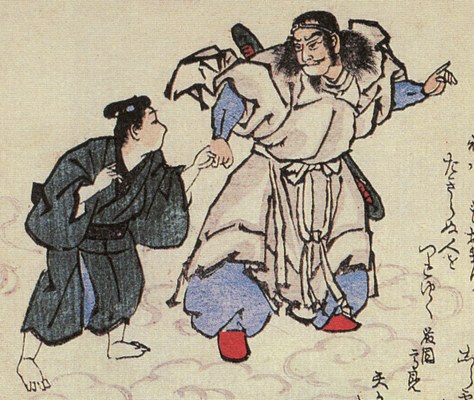
The most pervasive legend associated with Kakushi-gami is the phenomenon of Kamikakushi (literally “hidden by god” or “spirited away”). In rural folklore, particularly during the Edo and Meiji periods, if a person—usually a child—vanished without a trace, it was believed that a Kakushi-gami or a Tengu (mountain goblin) had taken them.
These disappearances often occurred during O-magatoki, the “time of disaster,” which corresponds to twilight. As the sun sets and shadows lengthen, the boundary between the human world and the spirit world blurs. Legends warn that playing hide-and-seek at this hour is dangerous; if a child hides too well, the Kakushi-gami might claim them as one of their own, and they will never be found by human eyes again.
In the folklore rich region of Tono, stories abound of individuals returning from Kamikakushi decades later, unaged and disoriented, or being found in remote locations in a trance-like state, claiming to have been entertained by invisible hosts.
Modern Culture: From Anime to Urban Legends
The archetype of the Hidden God has left an indelible mark on modern Japanese pop culture. The most famous example is Studio Ghibli’s masterpiece, Spirited Away (titled Sen to Chihiro no Kamikakushi in Japanese). The protagonist, Chihiro, wanders into a hidden bathhouse for the gods—a classic realm of the Kakushi-gami—after her parents violate a sacred boundary.
Beyond anime, the concept has evolved into modern horror. The urban legend of “Hitori Kakurenbo” (One-Man Hide and Seek) is a necromantic ritual that circulated on Japanese internet forums in the 2000s. It involves summoning a spirit into a doll, effectively inviting a Kakushi-gami into one’s home. These modern iterations prove that the fear and fascination with hidden entities remain potent in the Japanese psyche.
Traveler’s Tips: Where to Feel the Presence
For travelers fascinated by the eerie and the mystical, you cannot visit a specific “Kakushi-gami Shrine” as these deities are, by definition, obscure. However, you can visit places where the atmosphere of the hidden world is palpable:
- Tono, Iwate Prefecture: Known as the “City of Folklore,” this is the setting of the Tono Monogatari (Legends of Tono). Visit the mystical Kappa-buchi Pool or the deep forests where Tengu are said to dwell. The museums here offer deep dives into Kamikakushi stories.
- Mount Kurama, Kyoto: A spiritual mountain famous for Tengu legends. The hike from Kibune to Kurama is filled with ancient cedars and shadowed paths that feel like portals to another world.
- Twilight Shrine Visits: To understand the atmosphere of O-magatoki, visit a quiet, rural Shinto shrine (like Kamishikimi Kumanoimasu Shrine in Kumamoto) right at dusk. The shift in lighting creates the perfect ambiance to understand why the ancients feared the “Hidden Gods.”
Note: Always stick to marked trails. The legends of being spirited away often started as warnings against wandering off into dangerous terrain!
Sources & Further Reading
- The Tono Monogatari (Tales of Tono) by Kunio Yanagita – The seminal text on Japanese rural folklore and disappearances.
- Kojiki and Nihon Shoki – For context on the general distinction between earthly (Kunitsu-kami) and heavenly (Amatsu-kami) gods.
- Spirits and Animism in Contemporary Japan – Various anthropological essays by Kazuhiko Komatsu regarding boundaries and the “other world.”