
Amefuri-kozo: The Rain-Bringing Child Spirit of Japan
For many travelers, rain is the enemy of a good vacation. However, in the rich tapestry of Japanese folklore, rain is often accompanied by the supernatural. Among the myriad of yokai (spirits and monsters) that populate Japan’s cultural imagination, few are as distinct—or as shy—as the Amefuri-kozo (雨降小僧).
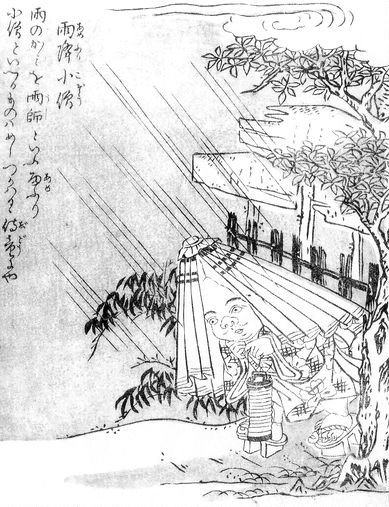
If you find yourself wandering through a misty forest or a quiet alleyway during a sudden downpour in Japan, keep an eye out. You might just spot a small, childlike figure donning a straw hat and holding a lantern. This is the Amefuri-kozo, the Rain-Bringing Priest Boy, a spirit that serves as a fascinating entry point into the world of Japanese mythology.
Origins and Etymology
The name Amefuri-kozo translates quite literally. Ame means rain, furi comes from the verb to fall (rainfall), and kozo refers to a young Buddhist priest in training, or simply a young boy.
Like many famous yokai, the Amefuri-kozo was solidified in the public consciousness during the Edo period by the renowned folklore artist Toriyama Sekien. He featured this spirit in his 1779 collection, Konjaku Gazu Zoku Hyakki (The Illustrated One Hundred Demons from the Present and the Past, Continued).
In Sekien’s illustration, the Amefuri-kozo is depicted as a young boy wearing a kimono and a kasa (a broad-brimmed Japanese umbrella/hat) on his head. He holds a paper lantern and appears to be playing in the rain. Scholars believe that Sekien may have drawn inspiration from the U-shi (Yu-shi), a Chinese god of rain, suggesting that the Amefuri-kozo acts as a servant to greater weather deities, tasked with regulating the rainfall required for agriculture.
The Legend of the Rain Boy
Unlike the Kappa (which can drown people) or the Oni (which are ogre-like demons), the Amefuri-kozo is classified as relatively harmless. He is not malicious; rather, he is mischievous and inextricably linked to nature.
The Umbrella Snatcher
According to folklore, the Amefuri-kozo delights in seeing people troubled by the rain. A common superstition suggests that if you walk outside wearing a Japanese umbrella (kasa) on your head without a handle—mimicking his appearance—you might attract his attention. He might try to pull the umbrella off your head or simply follow you, ensuring that the rain never stops falling wherever you go.
Servant of the Rain God
In more spiritual interpretations, the Amefuri-kozo is a vital functionary of the weather systems. In rural Japan, where rice farming is life, rain is a blessing. Therefore, while travelers might find him annoying, farmers historically viewed the presence of this spirit as a sign of a good harvest. He is often said to carry a lantern that aids the U-shi (Rain Master) in navigating the night sky to pour water upon the earth.
There is also a connection to the Kitsunebi (Fox Fire). In Sekien’s drawings, the lantern implies a connection to mysterious lights seen in the rain, blurring the lines between weather phenomena and animal spirits.
Amefuri-kozo in Modern Culture
In contemporary Japan, the scary edges of yokai folklore have been softened, transforming creatures like the Amefuri-kozo into cute mascots.
- Anime and Manga: The character appears in various forms in pop culture, most notably in the Yokai Watch franchise and Mizuki Shigeru’s GeGeGe no Kitaro. In these iterations, he is often depicted as a shy, sad-looking boy who unintentionally ruins picnics.
- Literature: He remains a staple in children’s books about weather, teaching kids not to fear the rain but to respect the spirits that bring it.
Because of his connection to rain, he is a popular motif during the Tsuyu (Plum Rain) season in June and July, often appearing on seasonal merchandise.
Traveler’s Tips: Finding the Rain Spirit
If you are a folklore enthusiast visiting Japan, you won’t find the Amefuri-kozo in the neon lights of Shinjuku. You need to look where the old stories are kept alive.
1. Mizuki Shigeru Road (Sakaiminato)
Located in Tottori Prefecture, this town is the birthplace of the manga artist Mizuki Shigeru. The street is lined with over 170 bronze statues of yokai, including the Amefuri-kozo. It is the ultimate pilgrimage site for yokai lovers.
2. Yokai Street (Kyoto)
Ichijo-dori in Kyoto is known as “Yokai Street.” Local shopkeepers have embraced the legends of the Hyakki Yagyo (Night Parade of One Hundred Demons). You can find homemade statues and mascots of various spirits here. Visit during a rainy evening for the full atmospheric effect.
3. Rainy Season (Tsuyu)
Travelers usually avoid June and early July due to the rain. However, if you want to channel the spirit of the Amefuri-kozo, visiting huge hydrangea gardens (like those at Meigetsu-in in Kamakura) during the rain offers a mystical, photographic beauty that sunny days cannot provide.
Sources & Further Reading
To deepen your understanding of the Amefuri-kozo and Japanese mythology, the following texts are essential:
- Konjaku Gazu Zoku Hyakki (1779) by Toriyama Sekien – The visual origin of the modern Amefuri-kozo.
- The Encyclopedia of Yokai by Shigeru Mizuki – A comprehensive modern guide.
- Nihon Shoki and Kojiki – While these ancient texts focus on major deities (Kami), they provide the foundational animistic context of nature worship that allowed yokai folklore to thrive later in the Edo period.