
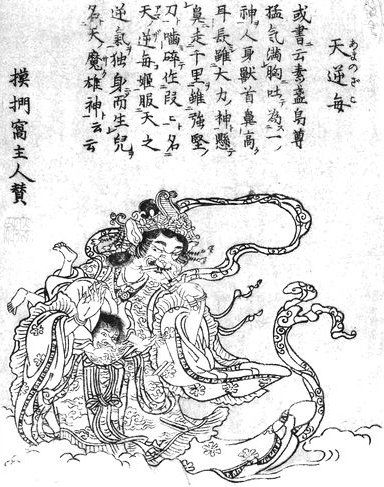
The Legend of Amanosaku: Japan’s Deity of Defiance
When travelers think of Japanese mythology, their minds often wander to Amaterasu, the benevolent Sun Goddess, or the playful Inari foxes guarding the gates of Fushimi Inari. However, the Shinto pantheon is vast and complex, containing deities that represent the darker, more turbulent aspects of human nature. Among these lies Amanosaku (天逆毎), a fearsome and fascinating figure known as the god of contradiction and the ancestor of the mischievous Amanojaku.
For cultural enthusiasts and travelers looking to understand the depths of Japanese folklore, understanding Amanosaku offers a glimpse into the ancient explanations for defiance, chaos, and the rebellious spirit.
Origins: Born from Fury
Unlike the major deities enshrined in grand temples, Amanosaku has a more obscure and visceral origin story. While the Kojiki and Nihon Shoki are the standard texts for Japanese creation myths, Amanosaku appears prominently in the Sendai Kuji Hongi (often simply called the Kujiki), an ancient historical text.
According to the texts, Amanosaku is the offspring of Susanoo-no-Mikoto, the storm god known for his tempestuous temper. The legend states that Susanoo, harboring intense, pent-up energy and ferocious spirit (aragami), vomited this power out. From this expulsion of raw, chaotic emotion, Amanosaku was born.
The name itself breaks down into meanings that reflect this nature: “Ama” (Heaven) and “Saku” (Opposing or Tearing). This etymology cements the deity’s role as one who stands in opposition to the order of the heavens.
The Legend of the Contrarian God
The Anatomy of Contradiction
Amanosaku is often depicted as a monstrous female deity with a terrifying appearance—a bestial face, a long nose, and immense physical strength. However, the defining trait of Amanosaku is not physical power, but psychological perversity.
The legends describe Amanosaku as the ultimate contrarian. If told to look left, this deity would look right. If instructed to move forward, Amanosaku would move backward. If something was wise, the deity would destroy it; if something was foolish, the deity would praise it. This figure represents the embodiment of obstinacy—the uncontrollable urge to defy authority and logic purely for the sake of defiance.
The Progenitor of the Amanojaku
While Amanosaku is a deity, modern pop culture is often more familiar with the Amanojaku, a small, imp-like yokai (demon). Folklore scholars consider Amanosaku to be the ancestor or spiritual predecessor of the Amanojaku. Over centuries, the terrifying power of the god Amanosaku was distilled into the smaller, trickster figure of the Amanojaku, who is famous for inciting humans to act on their darkest, most perverse desires.
Amanosaku in Modern Culture
The legacy of Amanosaku permeates modern Japanese society, shifting from ancient religious texts to anime, video games, and language.
The Linguistic Legacy
In modern Japanese, the word amanojaku is used to describe a person who is argumentative, perverse, or contrarian. If you have a friend who always plays “devil’s advocate” or refuses to follow the crowd simply to be different, a Japanese speaker might playfully call them an amanojaku. This is a direct linguistic inheritance from the legend of Amanosaku.
Pop Culture Appearances
Fans of Japanese media will recognize the influence of this deity:
- Shin Megami Tensei & Persona Series: Amanosaku often appears as a summonable demon, depicted with accurate mythological traits—ferocious and powerful.
- Yo-kai Watch: The character typically represents the mischievous side of the legend, causing characters to say the opposite of what they mean.
- Anime: Various supernatural series utilize the trope of the contrarian demon, tracing the lineage back to this storm-born deity.
Traveler’s Tips: Seeking the Myth
Unlike the popular Seven Lucky Gods, you will rarely find a shrine dedicated solely to worshiping Amanosaku. The deity is viewed more as a force of nature or a warning rather than a figure to pray to for blessings. However, travelers can still immerse themselves in the lore.
1. Visit Izumo (Shimane Prefecture)
As Amanosaku is the child of Susanoo, visiting the Izumo Taisha area is essential. This region is the heartland of Susanoo’s legends. While there, visit the smaller shrines along the coast related to the storm god to understand the wild environment that inspired such fierce mythology.
2. Kyoto’s Yokai Street
Visit Ichijo-dori in Kyoto, known as “Yokai Street.” Here, shopkeepers display homemade monsters outside their stores. It is a fantastic place to see the evolution of Japanese monsters, from terrifying gods like Amanosaku to the cute mascots of today.
3. Setsubun Festivals
During the Setsubun festival in February, people throw beans to drive away Oni (demons). The imagery of the red and blue demons often shares visual DNA with the ancient depictions of Amanosaku and her kin. Major temples in Tokyo (like Senso-ji) or Kyoto have massive celebrations.
Sources & Further Reading
For those wishing to dive deeper into the ancient texts and the lineage of Susanoo, the following historical records are recommended:
- Sendai Kuji Hongi (Kujiki): The primary source for the specific birth story of Amanosaku.
- The Kojiki: For context on Susanoo and the establishment of the Shinto pantheon.
- The Nihon Shoki: Chronicles the history and myths of Japan, providing alternative versions of Susanoo’s exploits.
- Encyclopedia of Japanese Spirits: Works by Shigeru Mizuki provide excellent visual and historical context for yokai evolution.