
Inasa Beach: Gateway to the Gods in Mythical Izumo
When standing upon the fine, silvery sands of Inasa Beach (Inasa-no-Hama), looking out toward the Sea of Japan, it is easy to feel a profound sense of antiquity. Located in Izumo, Shimane Prefecture, this is not merely a scenic coastline famous for its sunsets; it is one of the most spiritually significant sites in all of Japan. Known as the gateway for the Shinto deities, Inasa Beach bridges the gap between the mortal world and the divine realm of myths.
The Origins: A Landscape Shaped by Divinity
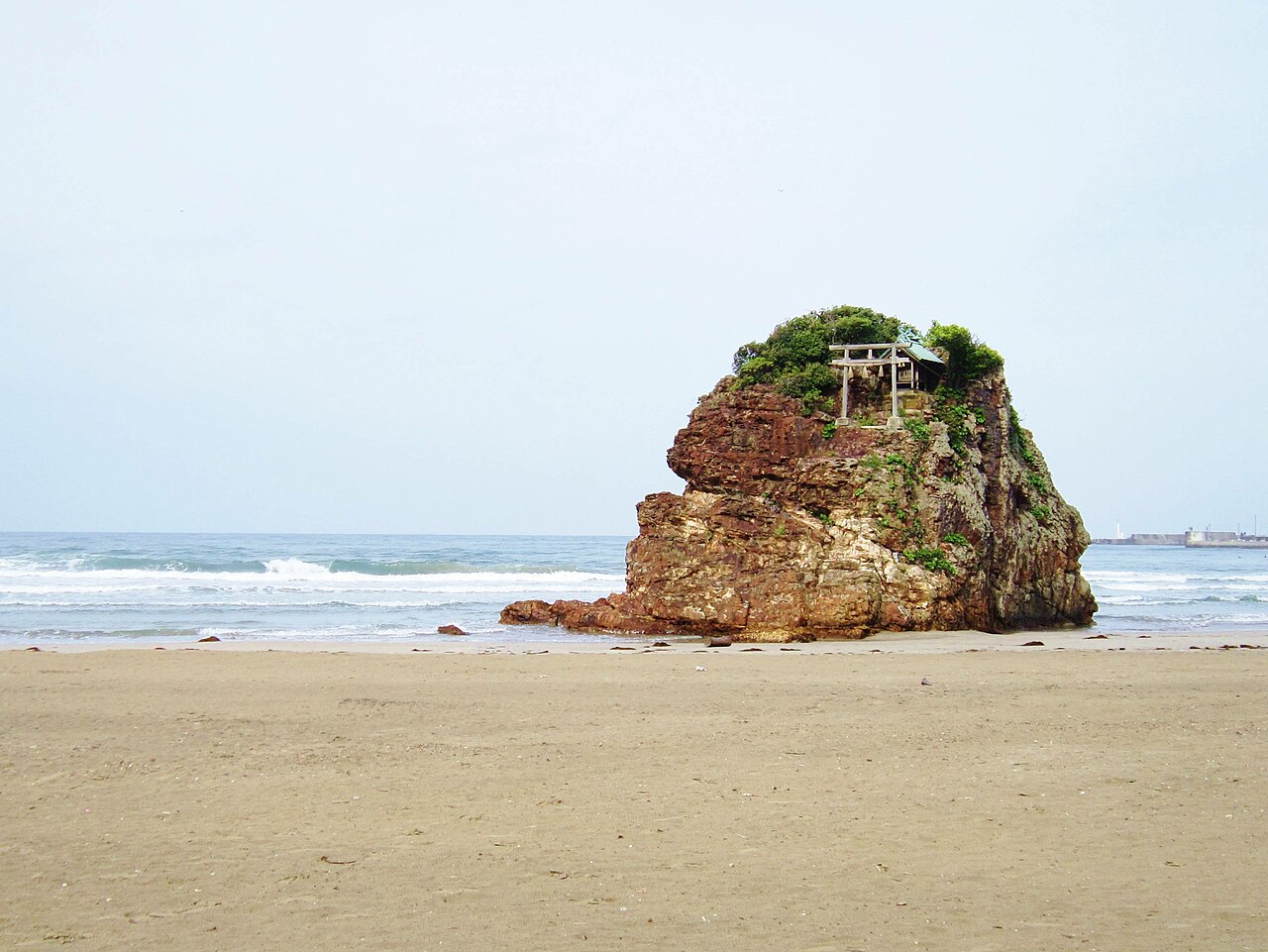
Inasa Beach is a sweeping arc of coastline located roughly one kilometer west of the famous Izumo Taisha (Izumo Grand Shrine). While the beach itself offers a stunning panorama of the horizon, its defining feature is the majestic rock formation known as Bentenjima.
Historically, Bentenjima was an island located far off the coast. However, as the centuries passed, shifting tides and sand accumulation connected the rock to the mainland, creating the landscape visible today. Perched atop this craggy islet is a small shrine torii gate and a hokora (small shrine). While it was once dedicated to Benzaiten (the goddess of water and music), it now enshrines Toyotamahime-no-Mikoto, the grandmother of Japan’s first emperor, Jimmu, and a deity of the sea. The silhouette of Bentenjima against a burning orange sunset is one of the most iconic images of the San’in region.
The Legend: Where Heaven Met Earth
To understand the gravity of Inasa Beach, one must delve into the Kojiki (Records of Ancient Matters) and the Nihon Shoki (Chronicles of Japan), the oldest historical records of the nation.
The Myth of Kuniyuzuri
In Shinto mythology, Inasa Beach is the stage for the Kuniyuzuri (Transfer of the Land). It is said that the heavenly deities, led by the Sun Goddess Amaterasu, sent the warrior god Takemikazuchi to negotiate with the earthly ruler, Okuninushi-no-Okami.
Legend dictates that Takemikazuchi descended from the High Plain of Heaven and landed at Inasa Beach. He plunged his giant sword hilt-deep into the waves, sat cross-legged upon its tip, and demanded that Okuninushi surrender stewardship of the land to the heavenly descendants. After a series of trials and consultations with his sons, Okuninushi agreed, on the condition that a magnificent palace (Izumo Taisha) be built for him to reside in eternal spirit. This mythological negotiation, which unified the spiritual and physical realms of Japan, took place right on these sands.
The Gathering of the Eight Million Gods
Perhaps the most enduring legend is that of Kamiari-zuki (The Month of the Gods). In the traditional lunar calendar, the 10th month is known as Kannazuki (The Month Without Gods) throughout most of Japan, because the deities leave their local shrines. However, in Izumo, this month is called Kamiari-zuki because the gods are actually present there.
Every year, the Yaoyorozu no Kami (Eight Million Gods) travel to Izumo to hold meetings regarding the fate of humanity and the ties between people (En-musubi). Inasa Beach serves as the sacred port of entry. During the Kamiari-sai festival, usually held in November, priests light sacred bonfires on the beach to welcome the deities as they arrive from the sea.
Modern Culture: The Sand Ritual
For modern visitors and pilgrims, Inasa Beach offers a unique interactive tradition connected to Izumo Taisha. This practice involves collecting sacred sand.
Locals and travelers visit Inasa Beach to scoop up a small amount of sand into a bag. They then carry this sand to Izumo Taisha, specifically to the Soga-no-Yashiro shrine located at the very back of the main precinct. Here, wooden boxes are filled with sand. The custom is to deposit the sand you brought from the beach and, in exchange, take a small amount of the shrine’s sand home. This exchanged sand is believed to possess powerful protective qualities and is often sprinkled around the perimeter of one’s home or garden to ward off evil and invite good fortune.
Traveler’s Tips
Visiting Inasa Beach requires a blend of logistical planning and cultural respect. Here is how to make the most of your trip:
- Access: The beach is approximately a 15-20 minute walk from the main gate of Izumo Taisha. It is a pleasant walk through quiet neighborhoods. Alternatively, local buses run from Izumo Taisha to the Inasa-no-Hama bus stop.
- Best Time to Visit: While the beach is spiritual at any hour, the sunset is breathtaking. As the sun dips below the horizon behind Bentenjima, the view is considered one of the “Top 100 Sunsets in Japan.”
- Respect: Remember that the small shrine on the rock is active. Do not climb the rock face or disturb the offerings. If you participate in the sand ritual, do so with reverence.
- Kamiari-sai: If you visit during the lunar 10th month (usually November), anticipate large crowds. The “Kamimukaesai” (Welcoming of the Gods) ceremony takes place on the beach in the evening and is a solemn, magical experience lit by paper lanterns.
Sources & Further Reading
For those interested in the textual history behind Inasa Beach, the following classical texts provide the foundational myths:
- The Kojiki (Records of Ancient Matters): Specifically the chapters detailing the Kuniyuzuri (Transfer of the Land).
- The Nihon Shoki (The Chronicles of Japan): Offers a parallel, slightly varying account of the negotiations between Takemikazuchi and Okuninushi.
- Izumo no Kuni Fudoki: An ancient record of the culture and geography specific to the Izumo province, offering a local perspective distinct from the central court’s narrative.