
Takamagahara: Exploring Japan’s High Plain of Heaven
In the intricate tapestry of Japanese spirituality, few concepts are as ethereal and revered as Takamagahara. Often translated as the “High Plain of Heaven,” this celestial realm serves as the dwelling place of the Kami (gods) in Shinto mythology. For the cultural traveler and the mythology enthusiast, understanding Takamagahara is the key to unlocking the spiritual heart of Japan.
While the concept may seem abstract, it remains deeply rooted in the physical landscape of the country, influencing everything from shrine architecture to modern pop culture. Join us as we ascend the Floating Bridge of Heaven to explore the origins, legends, and enduring legacy of Takamagahara.
The Origins of the Celestial Realm
The term Takamagahara (高天原) literally breaks down to “High” (Taka), “Heaven” (Ama), and “Plain/Field” (Hara). In the cosmology of ancient Japan, the universe was divided into three distinct vertical planes:
- Takamagahara: The upper world, the abode of the heavenly gods (Amatsukami).
- Ashihara no Nakatsukuni: The Central Land of Reed Plains (the human world/Japan).
- Yomi no Kuni: The underworld or the land of the dead.
According to Japan’s oldest historical records, the realm came into existence spontaneously at the beginning of time. It is depicted not merely as a cloud-filled paradise but as a reflection of the human world, complete with rice fields, weaving halls, and riverbeds. This mirroring suggests that the divine and the mundane are intrinsically linked, a core tenet of Shinto belief where nature itself is sacred.
The Legend of the Gods
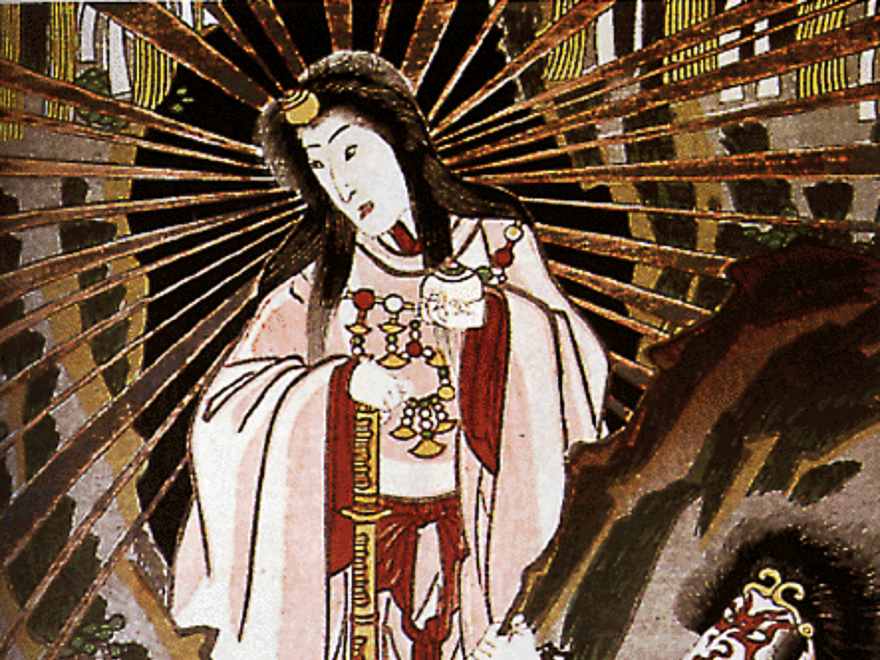
The most famous narratives involving Takamagahara revolve around the ruling deity, Amaterasu Omikami (the Sun Goddess). It is said that she governs this high plain, illuminating both heaven and earth.
The Descent of the Grandson
One of the most pivotal myths in Japanese history is Tenson Korin, the descent of Amaterasu’s grandson, Ninigi-no-Mikoto. Amaterasu sent him from Takamagahara down to the mountaintops of Kyushu to rule over the Central Land of Reed Plains. He brought with him the Three Sacred Treasures (the mirror, the jewel, and the sword), which remain the regalia of the Japanese Imperial Family today. This myth establishes the divine lineage of the Emperor, directly connecting the political history of Japan to the High Plain of Heaven.
The Cave of Heaven
Perhaps the most dramatic story set in Takamagahara is the episode of the Amano-Iwato (Heavenly Rock Cave). When Amaterasu’s brother, the storm god Susanoo, wreaked havoc across the heavenly rice fields, the Sun Goddess hid herself in a cave in grief, plunging both Takamagahara and the earth into darkness.
The other eight million gods gathered in the heavenly riverbed to lure her out. Through a raucous dance performed by the goddess Ame-no-Uzume, curiosity drew Amaterasu out, restoring light to the universe. This myth is often cited as the origin of Shinto rituals and Kagura dance.
Takamagahara in Modern Culture
While ancient, the concept of Takamagahara is far from forgotten. It permeates modern Japanese media and storytelling. Anime and manga fans might recognize the term from series like Noragami or Naruto, where it is often depicted as a source of ultimate power or a literal dimension where spirits reside.
Furthermore, the structure of Sumo wrestling reflects this cosmology. The roof suspended over the dohyo (ring) resembles a shrine, symbolizing that the match is taking place under the gaze of heaven, turning the sport into a ritual dedicated to the gods of Takamagahara.
Traveler’s Tips: Finding Heaven on Earth
While Takamagahara is a mythological place, several locations in Japan claim a physical connection to these legends. Visiting these spots offers a palpable sense of the ancient world.
1. Takachiho (Miyazaki Prefecture)
This is the most significant destination for those seeking the High Plain of Heaven. Takachiho is believed to be the site of Tenson Korin (the descent).
- Amano-Iwato Shrine: Here, you can view the cave where Amaterasu is said to have hidden. The atmosphere is thick with spiritual energy.
- Takachiho Gorge: While geological in nature, the ethereal beauty of the gorge feels otherworldly.
2. Ise Grand Shrine (Mie Prefecture)
As the most sacred Shinto shrine, Ise Jingu is dedicated to Amaterasu. While it is located in the “middle world,” it is the primary spiritual conduit to Takamagahara. Walking through the gravel paths of the Inner Shrine (Naiku) is the closest one can get to experiencing the solemn purity of the heavenly plains.
3. Mount Takamagahara (Gunma Prefecture)
For hikers, there is a mountain actually named Takamagahara. While it is likely not the location referenced in ancient texts, the hike offers stunning vistas and a chance to meditate on the vastness of nature.
Sources & Further Reading
To deepen your understanding of Japanese mythology, the following classical texts are essential reading:
- The Kojiki (Records of Ancient Matters): Translated by Basil Hall Chamberlain or Donald L. Philippi. This is the oldest extant chronicle in Japan (712 AD) and the primary source for the Takamagahara creation myths.
- The Nihon Shoki (The Chronicles of Japan): Translated by W.G. Aston. Finished in 720 AD, this text offers slightly different variations of the myths and focuses more on history.
- Shinto: The Kami Way by Sokyo Ono: A great primer for understanding the philosophy behind the mythology.