
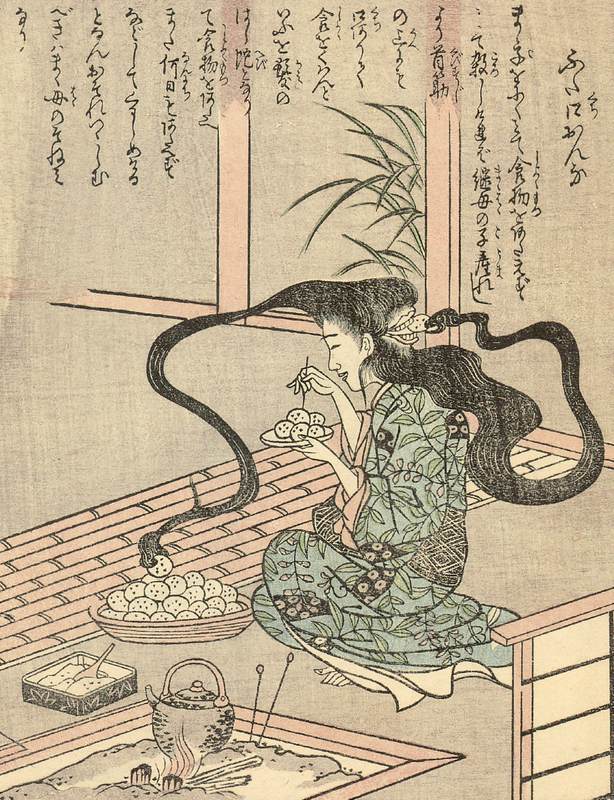
The Legend of Futakuchi-onna: Japan’s Two-Mouthed Woman
Japan is a country of breathtaking contrasts. For every serene Zen garden and vibrant cherry blossom festival, there lies a shadow world deeply embedded in the cultural psyche: the world of yokai. These strange apparitions, monsters, and spirits range from the mischievous to the malevolent. Among the most unsettling of these legends is the Futakuchi-onna (二口女), or “The Two-Mouthed Woman.”
To the untrained eye, she appears to be a dutiful, quiet, and notably light-eating wife. But beneath her hair lies a terrifying secret that has haunted Japanese folklore for centuries. Join us as we peel back the layers of this macabre legend.
Origins of the Monstrosity
The Futakuchi-onna is a staple of Edo-period folklore, famously appearing in the Ehon Hyaku Monogatari (Picture Book of a Hundred Stories), published in 1841. Unlike the ancient gods of Shinto mythology, yokai like the Futakuchi-onna often serve as cautionary tales or manifestations of human vices—specifically greed, stinginess, and cruelty.
The name translates literally: Futakuchi (two mouths) and onna (woman). While she possesses a normal human face, the back of her skull houses a second, ravenous mouth. This secondary maw is fully functional, possessing lips, teeth, and a tongue. Perhaps most disturbing is its ability to control the woman’s hair, using the strands like tentacles or chopsticks to shovel food into itself while the woman sleeps or pretends to be occupied.
The Legend: A Tale of Greed and Retribution
There are several variations of the Futakuchi-onna legend, but the most enduring version is a parable about a miserly man.
The Stingy Miser
Long ago, in a small village, there lived a man who was notorious for his stinginess. Despite having the means to marry, he refused to take a wife because he could not bear the thought of paying for another person’s food. Eventually, he met a woman who claimed she barely ate anything at all. Delighted by the prospect of a cheap spouse, he married her immediately.
True to her word, the woman ate only a few grains of rice at dinner. Yet, strangely, the miser’s rice stores began to plummet at an alarming rate. Suspicious and confused, the husband decided to pretend to leave for work one day, only to loop back and spy on his wife.
What he saw froze the blood in his veins. His wife let her hair down, revealing a gaping mouth on the back of her head. Her hair animated into tendrils, grabbing giant rice balls and feeding the ravenous second mouth, which shrieked and muttered demands for more. The mouth was consuming double what a normal person would eat, punishing the miser for his greed.
The Wicked Stepmother
A darker, more tragic origin story links the Futakuchi-onna to child abuse. In this version, a wicked stepmother starves her stepchild to death to ensure there is enough food for her own biological child. The spirit of the neglected child attaches itself to the stepmother’s body, splitting the back of her head open to form a mouth that screams for food—an eternal reminder of the hunger she inflicted upon the innocent.
Modern Culture: From Woodblock to Anime
The image of the Futakuchi-onna has proven resilient, transitioning from terrifying woodblock prints to modern pop culture. The concept of a hidden, voracious nature hidden behind a polite exterior resonates with contemporary themes of body horror and hidden identities.
In the world of anime and gaming, the influence is undeniable. The Pokémon Mawile (known as Kucheat in Japanese) is directly inspired by this yokai. It appears cute from the front but has a massive set of jaws formed by its “hair” at the back. Horror manga artist Junji Ito and various survival horror video games have also utilized the trope of the two-mouthed woman to induce fear, proving that this Edo-period nightmare still has the power to terrify.
Traveler’s Tips: Experiencing Yokai Culture
If you are a folklore enthusiast traveling to Japan, you can immerse yourself in the world of the Futakuchi-onna and other monsters at several unique destinations:
- Sakaiminato, Tottori Prefecture: This is the hometown of Shigeru Mizuki, the creator of GeGeGe no Kitaro. The Mizuki Shigeru Road is lined with over 170 bronze statues of yokai, providing a perfect photo op with Japan’s most famous monsters.
- Kyoto Yokai Street (Ichijo-dori): Legend has it that this street was the path for the “Night Parade of One Hundred Demons.” Today, local shops decorate their storefronts with handmade yokai monsters.
- The Miyoshi Mononoke Museum (Hiroshima): This is Japan’s first museum dedicated entirely to yokai, housing a vast collection of historical scrolls and artifacts depicting creatures like the Futakuchi-onna.
Sources & Further Reading
For those wishing to dive deeper into the historical context of Japanese mythology and folklore, the following texts provide the foundation:
- Ehon Hyaku Monogatari (Picture Book of a Hundred Stories): The primary Edo-period source for the visual and narrative description of the Futakuchi-onna.
- The Kojiki and Nihon Shoki: While these 8th-century texts focus on the creation myths and major deities (Kami) rather than later folk monsters like the Futakuchi-onna, they are essential reading to understand the spiritual foundation of Japan where the natural and supernatural coexist.
- Kwaidan: Stories and Studies of Strange Things by Lafcadio Hearn.
The Futakuchi-onna remains a potent symbol of the secrets we keep and the consequences of our vices. Next time you see someone who claims they aren’t hungry, perhaps you should check the back of their head—just to be safe.