
Kusanagi no Tsurugi: The Legend of Japan’s Sacred Sword
When travelers think of legendary blades, King Arthur’s Excalibur often springs to mind. However, across the Pacific, Japan holds a sword of equal mystery and perhaps even greater spiritual significance: the Kusanagi no Tsurugi (草薙剣). Known as the “Grass-Cutting Sword,” it is one of the Three Imperial Regalia of Japan, items that confirm the legitimacy of the Emperor.
Unlike artifacts displayed in museums, Kusanagi remains hidden from the public eye, shrouded in Shinto rituals and centuries of secrecy. For culture enthusiasts and history buffs exploring Japan, understanding the Kusanagi is essential to grasping the country’s deep-rooted connection between mythology and the Imperial throne.
The Origins: A Blade Born from Chaos
The story of Kusanagi begins not in a forge, but in the body of a monster. According to Japan’s oldest historical records, the Kojiki and the Nihon Shoki, the sword dates back to the Age of the Gods.
The storm god, Susanoo-no-Mikoto, had been banished from the heavens. Upon arriving in the province of Izumo, he encountered a weeping elderly couple who explained that the fearsome eight-headed, eight-tailed serpent, Yamata no Orochi, had devoured seven of their daughters and was coming for the eighth, Princess Kushinada.
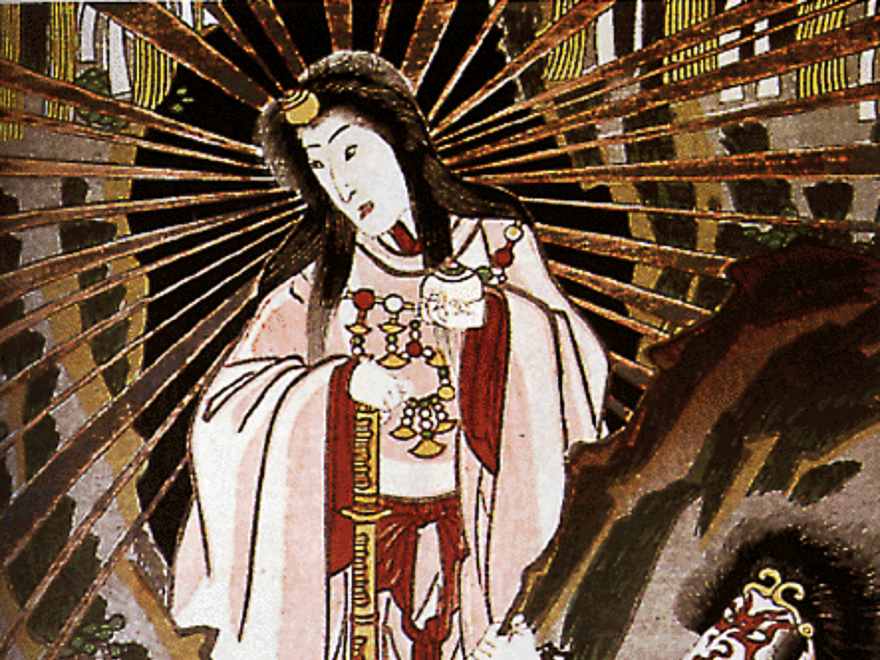
Susanoo struck a deal: he would slay the beast in exchange for the princess’s hand in marriage. He tricked the serpent into drinking eight vats of strong sake. Once the monster passed out, Susanoo hacked it to pieces. When he cut into the fourth tail, his own blade chipped. He sliced open the flesh to reveal a magnificent sword hidden inside. This was the Ame-no-Murakumo-no-Tsurugi (Sword of the Gathering Clouds of Heaven). Susanoo gifted this divine blade to his sister, the Sun Goddess Amaterasu, to settle an old grievance.
The Legend: How It Became the “Grass-Cutter”
Generations later, the sword was passed down to the great warrior Yamato Takeru. It is here that the blade received its current name.
During a treacherous expedition to the east, Yamato Takeru was lured into an open field by a warlord who then set the grass on fire, intending to burn the hero alive. Desperate and surrounded by flames, Takeru used the divine sword to cut away the burning grass. Miraculously, the sword was said to control the wind, sending the fire back toward his enemies.
In honor of this salvation, he renamed the weapon Kusanagi no Tsurugi—the Grass-Cutting Sword. It became a symbol not just of divine right, but of tactical brilliance and survival.
Modern Culture: From Shinto to Screens
While the physical sword is allegedly housed within the inner sanctum of the Atsuta Shrine in Nagoya, its influence permeates modern Japanese culture.
The Imperial Succession
The sword’s most critical role is in the ascension of a new Emperor. During the enthronement ceremonies, the Three Sacred Treasures (the mirror, the jewel, and the sword) are presented to the new monarch. However, the sword remains in a box, unseen. Even the Emperor himself is not permitted to view the naked blade, preserving its sanctity and mystery.
Pop Culture Iconography
For younger generations and international fans, Kusanagi is a familiar term found in anime, manga, and video games.
- Naruto: The character Orochimaru seeks the Kusanagi sword, a direct nod to the serpent myth.
- One Piece: Various techniques and items reference the Imperial Regalia.
- Video Games: From Final Fantasy to Okami, the sword often appears as an ultimate weapon, bridging the gap between ancient folklore and digital entertainment.
Traveler’s Tips: Visiting the Sword’s Resting Place
While you cannot see the Kusanagi no Tsurugi, you can visit its reported home: Atsuta Shrine (Atsuta Jingu) in Nagoya. It is the second most important shrine in Japan after Ise Jingu.
What to Do at Atsuta Shrine
- Soak in the Atmosphere: The shrine is located in a dense, sacred forest (Chinju-no-Mori). The transition from the bustling city of Nagoya to the silent, camphor-tree-lined paths is spiritual in itself.
- The Treasure Hall: While the Kusanagi is hidden, the shrine’s Bunkaden (Treasure Hall) displays thousands of other historical swords, mirrors, and masks, giving you a glimpse into the craftsmanship of the eras associated with the legend.
- Eat Kishimen: Don’t leave without trying the shrine’s famous Kishimen noodles (flat udon) served at the restaurant on the grounds. It is a local Nagoya delicacy.
- Respect the Space: Remember to bow once at the Torii gate before entering and wash your hands at the temizuya (water pavilion) before approaching the main altar.
Best Time to Visit
Try to time your visit during the Atsuta Festival (June 5th). It is the shrine’s biggest event, featuring martial arts demonstrations, lantern displays, and fireworks, bringing the history of the location to life.
Sources & Further Reading
To deepen your understanding of Japanese mythology and the Kusanagi sword, the following classical texts are essential reading:
- The Kojiki (Records of Ancient Matters): The oldest extant chronicle in Japan, detailing the creation myths and the story of Susanoo.
- The Nihon Shoki (The Chronicles of Japan): Provides a more detailed, historical account of the imperial lineage and the exploits of Yamato Takeru.
- The Tale of the Heike: Contains legends regarding the sword’s potential loss at the Battle of Dan-no-ura (though Shinto priests maintain the true sword was never lost, or that a replica was lost in the sea).
Whether you are a pilgrim of history or a fan of folklore, the legend of Kusanagi no Tsurugi remains one of Japan’s most captivating mysteries, proving that some things are more powerful because they remain unseen.