
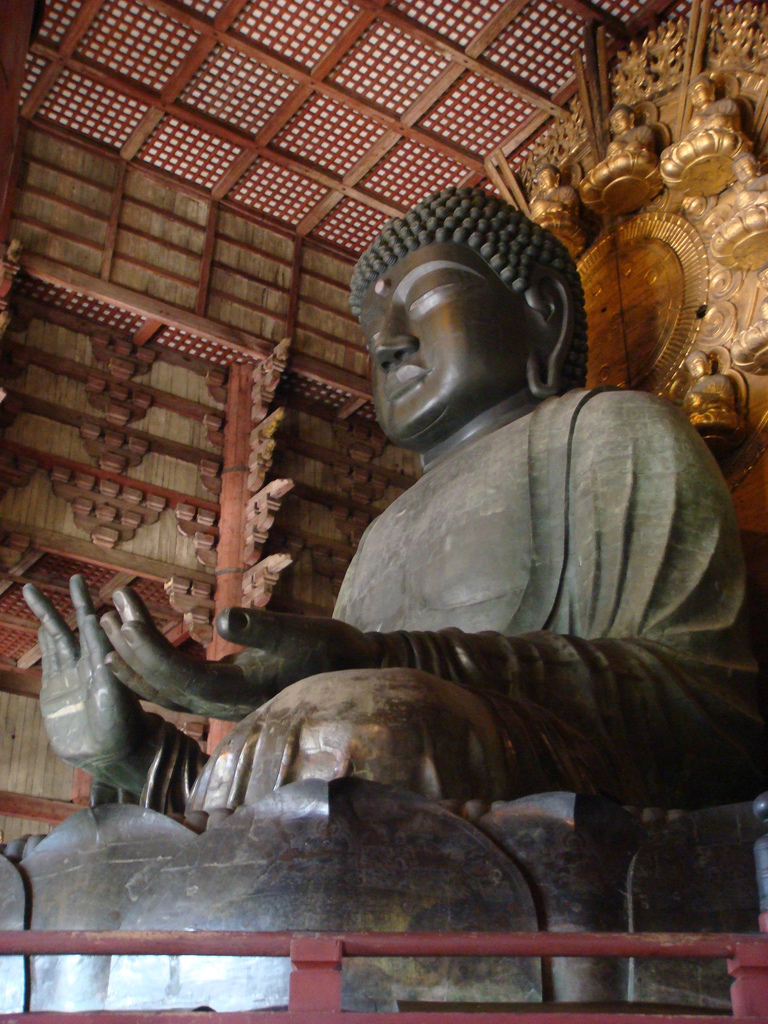
The Great Buddha of Todai-ji: A Journey into Nara’s Spiritual Heart
When you step through the massive Nandaimon Gate and behold the Daibutsuden (Great Buddha Hall) in Nara, Japan, the scale of the architecture immediately commands silence. Yet, what lies within is even more breathtaking. The Daibutsu, or Great Buddha of Todai-ji, is not merely a statue; it is a colossal testament to faith, engineering, and history that has watched over Japan for over a millennium. For travelers seeking the spiritual core of the Kansai region, a pilgrimage to face this bronze giant is an absolute necessity.
Origins: A Vow to Save a Nation
The creation of the Great Buddha, formally known as Rushana Butsu (Vairocana Buddha), was not born out of peace, but out of desperation. In the mid-8th century, during the Nara Period, Japan was plagued by a series of disasters. The country faced smallpox epidemics, crop failures, and political unrest that threatened the stability of the Imperial court.
In 743 AD, Emperor Shomu issued a decree to construct a magnificent Buddha statue. His vision was to harness the power of Buddhism to protect the state and bring spiritual unity to the fractured nation. This was a massive undertaking that nearly bankrupted the country’s economy. According to historical records, the project required the mobilization of over 2.6 million people—roughly half of Japan’s population at the time—who contributed labor, materials, or funds. The statue was finally cast in bronze, consuming most of the domestic production of copper and tin for several years.
Legend: The Eye-Opening Ceremony
While the construction is a matter of history, the legends surrounding the statue’s consecration add a layer of mystical allure. The most famous event in the statue’s history is the Kaigen Kuyo, or the “Eye-Opening Ceremony,” held in 752 AD. This ceremony symbolically gave the statue its soul.
Legend tells of the international nature of this event. It was presided over by Bodhisena, a monk from India, highlighting the reach of the Silk Road which terminated in Nara. During the ceremony, the Emperor himself took the brush to paint the pupils of the Great Buddha, though strings were attached to the brush so that thousands of attendees in the courtyard could hold on, effectively participating in the act of awakening the Buddha together.
Furthermore, stories persist about the statue’s resilience. The Great Buddha sits in the position of expounding the law, his hand raised in a gesture of protection (abhaya mudra). Throughout history, the hall and the head of the Buddha have been damaged by earthquakes and fires during civil wars, most notably during the Genpei War. The current head dates largely from the Edo period, yet the body remains a patchwork of eras, symbolizing the enduring spirit of Japanese restoration.
Modern Culture: The Symbol of Nara
Today, the Great Buddha is more than a religious icon; it is the cultural anchor of Nara. It represents the Tenpyo culture, a flowering of arts and Buddhism in classical Japan. The statue stands 15 meters (49 feet) tall and weighs approximately 500 tonnes, making it one of the largest bronze statues in the world.
In modern Japanese culture, the Daibutsu serves as a reminder of peace. It is a UNESCO World Heritage site that draws millions of visitors annually. It also plays a central role in local festivities, such as the Omizutori (Water-Drawing Festival) held at the nearby Nigatsu-do hall, which signals the coming of spring. The sheer size of the Buddha continues to influence pop culture, appearing in anime and literature as a symbol of ancient power and tranquility.
Traveler’s Tips
Visiting Todai-ji can be overwhelming due to the crowds, but these tips will ensure you have a profound experience:
- The Pillar with a Hole: Inside the Great Buddha Hall, behind the statue to the right, look for a massive wooden pillar with a hole at its base. Legend says the hole is the same size as the Great Buddha’s nostril. It is believed that if you can squeeze through this hole, you will be granted enlightenment (or at least good luck) in your next life. It is a tight squeeze, so assess your size carefully!
- Timing is Key: Arrive as soon as the gates open (usually 7:30 AM or 8:00 AM depending on the season) to experience the hall in relative silence. The morning light hitting the bronze face is spectacular.
- Nara Deer: The park surrounding the temple is famous for its bowing deer. While they are considered messengers of the gods, they can be aggressive if you have food. Buy a pack of shika-senbei (deer crackers) to feed them, but be prepared to be swarmed.
- Look at the Lotus Petals: Don’t just look at the face; look at the base. The bronze lotus petals the Buddha sits on contain engravings of Buddhist cosmology that are original to the 8th century, surviving the fires that destroyed the upper parts.
Sources & Further Reading
For those interested in the deep historical context of the introduction of Buddhism to Japan and the lineage of the Emperors who commissioned such works, the following classical texts are essential:
- The Shoku Nihongi: This imperial chronicle continues where the Nihon Shoki left off and provides the most direct records of Emperor Shomu’s decree and the construction of the Great Buddha.
- The Nihon Shoki (Chronicles of Japan): While it predates the completion of the Daibutsu, it offers the critical backstory on the initial arrival of Buddhism in Japan and the tension between native Kami worship and the new religion.