
Onbashira: The Dangerous Thrill of Suwa Taisha’s Sacred Pillars
Deep in the mountainous heart of Nagano Prefecture, a silence usually hangs over the ancient cedar forests surrounding Lake Suwa. However, once every six years, this silence is shattered by the roar of thousands of men, the thud of massive timber hitting the earth, and the blaring of trumpets. This is the Onbashira Festival (formal name: Shikinen Zōei Mihashira Taisai), widely regarded as one of Japan’s most dangerous and spirited events.
Hosted by the Suwa Taisha (Suwa Grand Shrine), one of the oldest shrine complexes in the country, the festival involves replacing the four wooden pillars standing at the corners of the shrine buildings. While this sounds like simple maintenance, the execution is a spectacle of bravery, faith, and sheer adrenaline that attracts tourists from around the globe.
Origins of the Sacred Pillars
The tradition of Onbashira has continued uninterrupted for over 1,200 years. Historical records suggest the festival has been held since the Heian period, though its roots likely dig even deeper into prehistoric nature worship. The festival takes place in the Year of the Monkey and the Year of the Tiger according to the Chinese zodiac, resulting in a six-year cycle (though locals count the current year, often calling it a “seven-year” cycle).
The core purpose of the festival is spiritual renewal. Just as the Ise Grand Shrine is rebuilt every 20 years, Suwa Taisha symbolically renews its sanctuary by replacing the Onbashira—huge momi fir trees that act as spiritual boundaries or conductors. 16 massive fir trees are selected from the mountains, some weighing up to 12 tons and measuring over 17 meters in length. The sheer physical effort required to move these logs from the forest to the shrines without heavy machinery is a testament to the community’s dedication.
Legend: The God of Wind and Water
To understand the intensity of Onbashira, one must look to the deity enshrined at Suwa Taisha: Takeminakata-no-Kami.
According to Japanese mythology, Takeminakata is a god of wind, water, and agriculture, but also a god of war. Legend tells that he originally resided in Izumo but was defeated in a sumo match by a messenger of the Sun Goddess Amaterasu. Defeated, he fled across Japan until he reached the basin of Lake Suwa, where he pledged never to leave the region again.
The four pillars erected around his shrines are shrouded in mystery. Some scholars believe they represent a barrier sealing the sacred ground, while others argue they act as himorogi—antennae that invite the spirit of the gods down to earth. The violent energy of the festival, particularly the log-riding, is often interpreted as a display of strength to honor this warrior deity, ensuring a bountiful harvest and protection for the coming years.
Modern Culture: The Kiotoshi and Satobiki
Modern Onbashira is divided into two main parts: the Yamadashi (Mountain Opening) in April and the Satobiki (Village Pulling) in May.
The Yamadashi and Kiotoshi
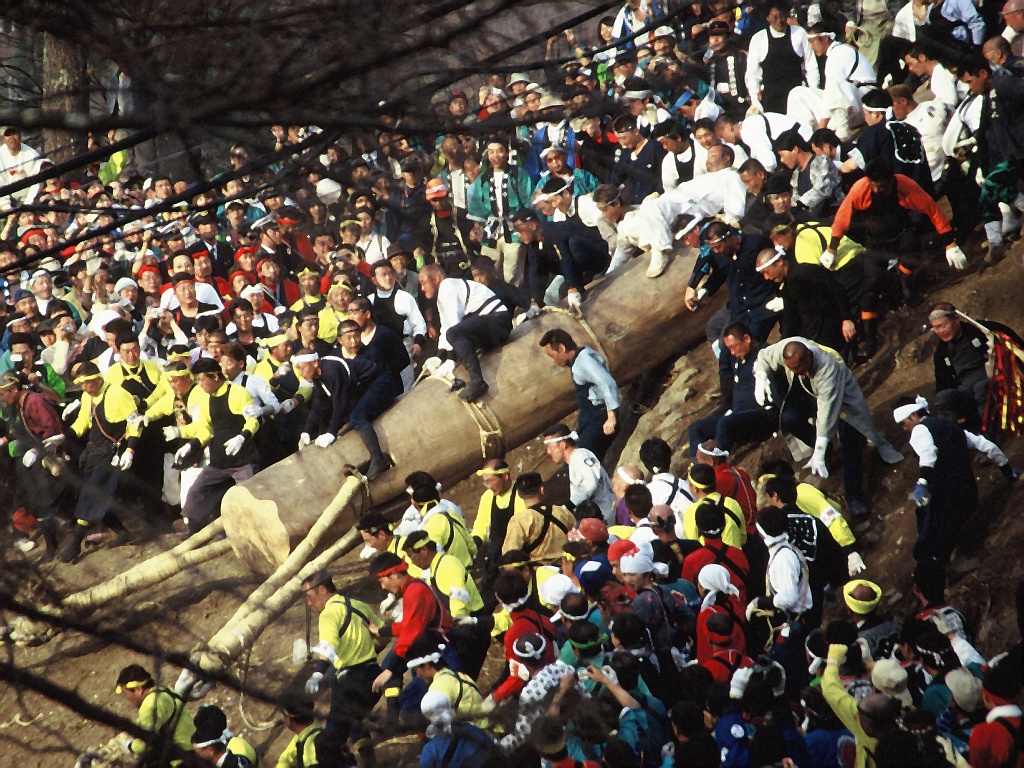
The most iconic image of Onbashira comes from the Yamadashi. After the trees are felled, teams of parishioners, known as ujiko, drag the logs using thick ropes. The climax is the Kiotoshi (Log Drop). The massive logs must be moved down steep, muddy slopes. Rather than lowering them gently, young men hop onto the logs as they careen down the hill at terrifying speeds. It is a rite of passage and a display of extreme bravery. Tragically, injuries are common, and fatalities have occurred, cementing the festival’s reputation as one of Japan’s deadliest.
The Satobiki
A month later, the Satobiki takes place. The logs are paraded through the streets to the shrine grounds. The final event is the Tateonbashira, where the pillars are raised upright. Ujiko ride the log as it is hoisted vertically, performing dances and tossing mochi (rice cakes) from the top once it is secured. This marks the successful renewal of the god’s dwelling.
Traveler’s Tips for Visiting Suwa
If you plan to witness this spectacle or visit the historic site, here is what you need to know:
- Timing is Everything: The next festivals will follow the six-year cycle (e.g., 2022, 2028, 2034). If you visit during an “off” year, you can still see the magnificent pillars standing at the four shrines of Suwa Taisha (Maemiya, Honmiya, Harumiya, and Akimiya).
- Getting There: Take the JR Azusa Limited Express from Shinjuku (Tokyo) to Kami-Suwa Station or Shimo-Suwa Station. The trip takes roughly 2.5 hours.
- Crowd Control: During the festival, the town of Suwa swells with hundreds of thousands of visitors. Book accommodation a year in advance if possible. For the Kiotoshi, paid seating is often required for the best views, as free spots are extremely crowded.
- Local Delicacies: While in Nagano, try the local soba noodles and sake. The clean water of the region makes for excellent brewing.
Sources & Further Reading
- The Kojiki (Records of Ancient Matters): For the mythological background of Takeminakata-no-Kami and his exile to Suwa.
- The Nihon Shoki (The Chronicles of Japan): Provides supplementary mythological context regarding the Shinto pantheon.
- Suwa City Museum: Local archives providing detailed historical records of previous festivals and pillar measurements.