
Unveiling the Waira: Japan’s Enigmatic Beast Yōkai
Japan’s folklore is a tapestry woven with threads of the divine, the ghostly, and the grotesque. While many travelers are familiar with the mischievous Kappa or the red-faced Tengu, the world of yōkai (supernatural monsters) runs much deeper, hiding creatures that defy easy explanation. One such entity is the Waira (わいら), a hulking, terrifying beast that has lurked in the shadows of Japanese art and imagination for centuries.
For the culture-focused traveler and the folklore enthusiast, the Waira represents the “deep cuts” of Japanese mythology—a creature that embodies the fear of the wild and the unknown. In this guide, we strip away the mystery to explore the origins, legends, and cultural footprint of this formidable earth spirit.
The Origins: Ink, Paper, and Mystery
Unlike creatures born from ancient oral traditions or religious texts, the Waira’s most definitive entry into history comes from the brush of Toriyama Sekien. Sekien was a scholar and ukiyo-e artist of the Edo period who essentially cataloged the supernatural world. In 1776, he published Gazu Hyakki Yagyō (The Illustrated Night Parade of a Hundred Demons), a seminal work that visualized the monsters haunting the Japanese psyche.
The Etymology of Fear
The Waira appears in this collection, yet Sekien provided no backstory—only an image. This has led to centuries of speculation. The name itself is a puzzle. Linguistic historians suggest that “Wai” (畏) relates to fear or awe, while the suffix “-ra” is often used for pluralization or as a diminutive for creatures. Therefore, Waira could be roughly translated as “The Frightful Ones.”
Because Sekien did not cite a specific older legend, some scholars believe the Waira might have been an original creation, or perhaps a visual pun based on a now-forgotten word. However, its persistent presence in later scrolls suggests it struck a chord with the people of the Edo period.
The Legend: A Beast of the Earth
Since the Waira lacks a specific narrative in ancient chronicles like the Kojiki, its “legend” is derived from visual analysis and the embellishments of later storytellers, particularly in the Showa era by folklore giants like Shigeru Mizuki.
Appearance and Behavior
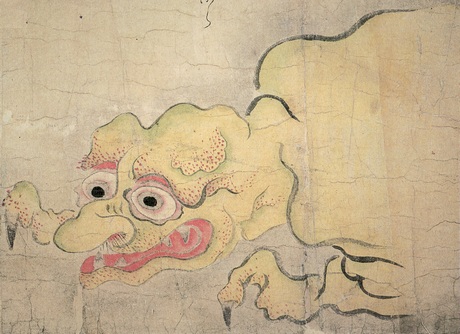
Visually, the Waira is the stuff of nightmares. It is typically depicted as a massive, quadrupedal beast with a spotted, toad-like body and large, singular claws on its front limbs. In Sekien’s illustration, only the upper half of the body is visible, emerging from the darkness or the ground, which suggests it is an ambush predator.
Traditional descriptions often associate the Waira with the mountains (yama) and the earth. Legend says it dwells deep within the mountains, using its powerful single claw on each foot to dig through soil as easily as water. Some folklore interpretations suggest the Waira eats moles (mogura), while others paint a darker picture of a monster that lies in wait for travelers who stray off the mountain paths, dragging them underground.
There is a primal