
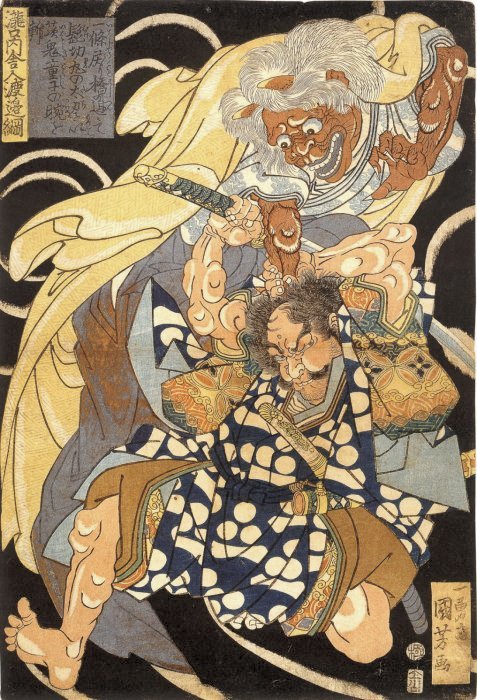
The Legend of Ibaraki-doji: Japan’s Famous Demon Arm
Japanese folklore is a tapestry woven with threads of heroism, tragedy, and the supernatural. Among the myriad of yokai (spirits) and oni (demons) that populate these stories, few are as renowned as Ibaraki-doji. While many demons are known for their brute strength, Ibaraki-doji is famous for a specific, gruesome encounter involving a legendary samurai and a severed arm.
For travelers exploring the cultural depths of Kyoto and Osaka, understanding the tale of “Ibaraki-doji’s Arm” adds a layer of mystical intrigue to historical sites. This is the story of a sword, a disguise, and a demon’s undying loyalty.
Origins of the Demon Lieutenant
To understand the significance of the arm, one must first understand the demon. Ibaraki-doji was not a lone wolf; he was the lieutenant and most trusted companion of Shuten-doji, the infamous Demon King of Mount Oe. Operating during the Heian period (794–1185), a time when the veil between the human and spirit worlds was believed to be thin, this pair terrorized the imperial capital of Kyoto.
While Shuten-doji is often depicted as a gluttonous drinker and brute, Ibaraki-doji is frequently portrayed with a more cunning, and sometimes androgynous, beauty. Some regional legends in Osaka (specifically Ibaraki City) claim the demon was originally a human child who transformed after consuming blood, while others suggest he was born a demon. Regardless of his origin, his fate became inextricably linked to the samurai Watanabe no Tsuna.
The Legend of the Severed Arm
The most famous account of Ibaraki-doji revolves around a chance encounter at night. There are two primary variations of the setting—the Rashomon Gate or the Ichijo Modoribashi Bridge—but the core narrative remains the same.
Watanabe no Tsuna was one of the “Four Heavenly Kings” (Shitenno), the elite retainers of the legendary warrior Minamoto no Raiko. One stormy night, Tsuna was crossing the Ichijo Modoribashi Bridge in Kyoto when he encountered a beautiful young woman traveling alone. Being a chivalrous samurai, he offered to escort her.
However, as they approached a secluded spot, the “woman” transformed into a terrifying demon—Ibaraki-doji—and seized Tsuna, attempting to drag him into the sky. Unflinching, Tsuna drew his masterfully crafted sword, Higekiri (Beard Cutter), and slashed at the demon. The strike was true; it severed the demon’s arm at the shoulder. Howling in pain, Ibaraki-doji fled into the night clouds, leaving the massive, hairy arm behind.
The Deceptive Retrieval
The story does not end there. Tsuna took the arm as a trophy and locked it in a strongbox, following the advice of an onmyoji (fortune teller) to keep it sealed for seven days and to let no one into his home.
On the sixth night, an elderly woman claiming to be Tsuna’s aunt (or wet nurse) arrived at his gate. She pleaded to see her nephew, eventually guilt-tripping him into letting her in. Once inside, she expressed awe at his feat and begged to see the demon’s arm. Reluctantly, Tsuna opened the box.
In a flash, the “aunt” transformed back into Ibaraki-doji, snatched the severed arm, and flew out through the gable of the roof, disappearing into the darkness of Mount Oe to be reunited with the limb.
Ibaraki-doji in Modern Culture
Today, the legend of the arm lives on far beyond ancient scrolls. Ibaraki-doji has become a staple in Japanese pop culture, particularly in anime and video games.
In the massive franchise Fate/Grand Order, Ibaraki-doji is a Berserker-class servant, depicted as a chaotic but loyal oni whose character design heavily features the thematic elements of the severed arm and fire. Similarly, in the Nura: Rise of the Yokai Clan series and the game Onmyoji, the character appears as a powerful force. These modern adaptations often romanticize the bond between Ibaraki and Shuten-doji, turning a terrifying monster into a symbol of fierce loyalty.
Traveler’s Tips: Tracing the Demon’s Path
If you are visiting the Kansai region, you can visit the actual sites mentioned in this legend. It is a thrilling way to connect with Heian-era history.
1. Ichijo Modoribashi Bridge (Kyoto)
Located near the Seimei Shrine, this bridge is the setting for the famous encounter. While the current bridge is a modern reconstruction, elements of the original are preserved at the nearby Seimei Shrine. Locals still say the bridge is a gateway to the supernatural.
2. Kitano Tenmangu Shrine (Kyoto)
This famous shrine is the current home of the Onikiri Maru (Demon Slayer), the sword said to be the very weapon Watanabe no Tsuna used to cut off Ibaraki-doji’s arm. The sword is occasionally put on public display in the shrine’s treasure house—check the schedule before you go.
3. Ibaraki City (Osaka)
Ibaraki City embraces its namesake demon. You can find statues of Ibaraki-doji throughout the city, and they even host the “Ibaraki Festival,” which celebrates the local folklore regarding the demon’s childhood.
Sources & Further Reading
For those interested in diving deeper into the classical texts that preserve these myths, consider exploring the following:
- The Tale of the Heike (Heike Monogatari): Specifically the Tsurugi-no-maki (Scroll of Swords), which details the history of the famous swords of the Minamoto clan, including the cutting of the demon’s arm.
- Otogizoshi: A collection of medieval short stories that popularized the legends of Shuten-doji and his lieutenants.
- Kojiki & Nihon Shoki: While these ancient texts (dating to the 8th century) focus on the creation myths and gods like Susanoo and Amaterasu, they establish the foundational concept of oni and the chaotic forces that samurai like Tsuna were destined to quell.