
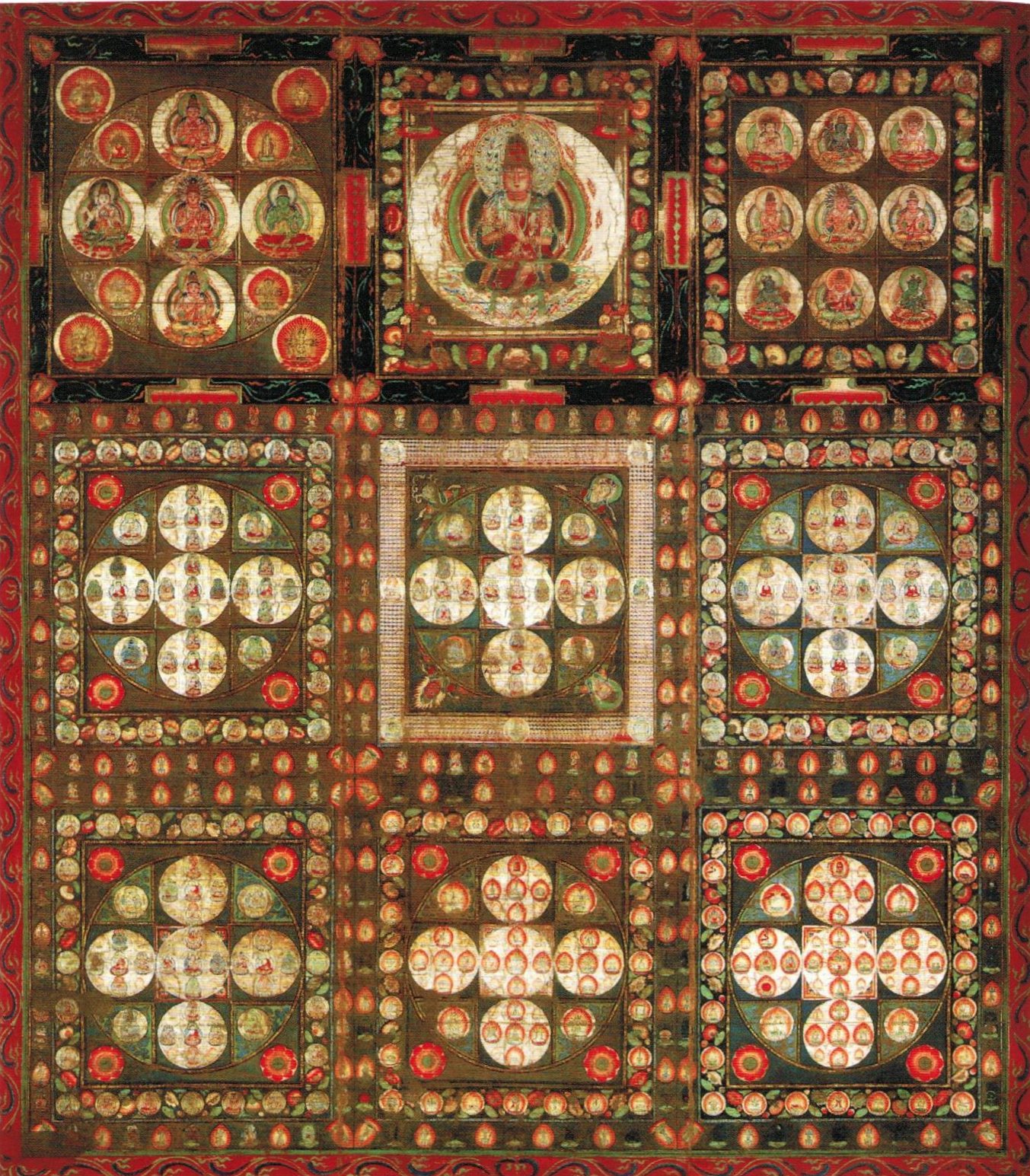
The Diamond World Mandala: Japan’s Esoteric Buddhist Art
When travelers step into the dim, incense-laden halls of Japan’s oldest Shingon temples, they are often confronted by two massive, complex paintings flanking the altar. These are the Ryokai Mandara, or “Mandala of the Two Realms.” While one represents the nurturing compassion of the Womb World, the other stands for indestructible wisdom and clarity: the Diamond World Mandala (Kongokai Mandara).
For cultural enthusiasts and spiritual seekers alike, understanding this geometric map of the cosmos is key to unlocking the secrets of Japanese Esoteric Buddhism. It is not merely a painting; it is a visual guide to enlightenment.
Origins of the Indestructible
The Diamond World Mandala (Sanskrit: Vajradhatu Mandala) traces its lineage back to India, based specifically on the Vajrasekhara Sutra. However, the version most famous in Japan today is the result of a grand cultural transmission across Asia.
In the early 9th century, the Japanese monk Kukai (posthumously known as Kobo Daishi) traveled to Tang Dynasty China. There, he studied under Master Huiguo at Qinglong Temple in Chang’an. Huiguo bestowed upon Kukai the lineage of Esoteric Buddhism, including the two great mandalas. Kukai returned to Japan in 806 AD, bringing these visual tools with him to found the Shingon school.
Unlike the earlier forms of Buddhism in Japan, which focused heavily on text and scripture, Shingon emphasized that the ultimate truth (Dharma) is beyond words and must be visualized. The Diamond World Mandala was created to help monks visualize the structure of the universe and the mind of the Buddha.
Legend and Symbolism: The Nine Assemblies
The term “Diamond” (Japanese: Kongo) refers to the Vajra—a mythical weapon symbolizing a substance so hard it can cut through anything but cannot be cut itself. In a spiritual context, this represents wisdom that destroys all illusions and ignorance.
The Structure of Wisdom
Unlike the swirling, organic nature of the Womb World Mandala, the Diamond World Mandala is strictly geometric and hierarchical. It is typically divided into nine squares, known as the Nine Assemblies.
- The Central Assembly (Jojin-ne): At the very center sits Dainichi Nyorai (Vairocana), the Cosmic Buddha. He forms the “wisdom fist” mudra, symbolizing the unity of the individual and the universal.
- Surrounding Squares: The surrounding panels depict various other Buddhas, Bodhisattvas, and deities, totaling 1,461 figures in a full depiction. They represent different aspects of Dainichi’s wisdom, radiating outward like light from a diamond.
The layout is designed to be read from the center outward (representing the Buddha’s compassion reaching the world) or from the outside in (representing the practitioner’s journey toward enlightenment).
Modern Culture and Relevance
While the Diamond World Mandala is an ancient artifact, its influence permeates modern Japanese culture. It remains a central tool in the training of Shingon monks today. During the Kanjo (consecration) ritual, a blindfolded initiate throws a flower onto the mandala to determine their patron deity—a ceremony that has been performed for emperors and commoners alike for over a millennium.
In the realm of art and psychology, the mandala is viewed as a representation of the subconscious. The stark geometric order of the Diamond World continues to inspire modern graphic design and tattoo artistry in Japan, representing mental fortitude and clarity amidst the chaos of modern life.
Traveler’s Tips: Where to See the Mandala
Viewing a real Diamond World Mandala is a highlight of any cultural trip to Japan. However, distinct etiquette and locations apply.
Top Locations
- Toji Temple (Kyoto): This temple contains the famous Lecture Hall (Kodo), where Kukai arranged 21 massive statues in a 3D mandala formation. While not a painting, it is a physical manifestation of the Diamond World.
- Koyasan (Wakayama): The headquarters of Shingon Buddhism. The Reihokan Museum on Mount Koya often displays historic mandalas, including the famous “Blood Mandala” (though displays rotate for preservation).
- Jingo-ji (Kyoto): Located in the mountains north of Kyoto, this temple holds the oldest existing purple-and-gold damask mandalas (National Treasures), usually shown only during special airings in May or October.
Etiquette
- Silence: These are sacred religious objects. Keep your voice low.
- No Photography: Almost all temple halls prohibit photography of the Buddhas and Mandalas to preserve the pigments and sanctity.
- Binoculars: If allowed, bring a small pair of monoculars or opera glasses. The details on the nine assemblies are incredibly minute and worth close inspection.
Sources & Further Reading
For those wishing to delve deeper into the historical and textual foundations of the Diamond World Mandala, the following texts and historical records are essential:
- The Vajrasekhara Sutra (Diamond Peak Sutra): The primary scriptural source for the Diamond World Mandala.
- Kukai’s Goshorai Mokuroku: The “Memorial on the Presentation of the List of Newly Imported Sutras,” written by Kukai upon his return from China, detailing the artifacts he brought back.
- Ryokai Mandara no Kairisettsu: Various commentaries on the Two Realms Mandala found in the Taisho Tripitaka.
While the Kojiki and Nihon Shoki cover Japan’s indigenous Shinto creation myths, the Diamond World Mandala represents the importation of complex Continental metaphysics, marking a pivotal evolution in Japanese religious history.