
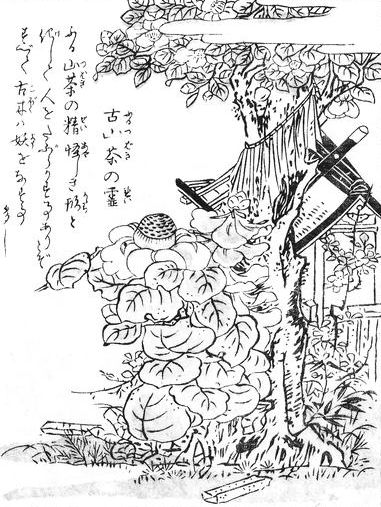
The Legend of Furutsubaki no Rei: When Flowers Turn to Spirits
Japan is a land where the line between the physical and the spiritual is often blurred. While the world looks to the cherry blossom for symbols of fleeting life, the winter blooming Camellia—known as Tsubaki—holds a darker, more mysterious place in Japanese folklore. Specifically, the legend of the Furutsubaki no Rei (古椿の霊), or the “Spirit of the Old Camellia,” serves as a fascinating reminder of the ancient animistic belief that nature, when left undisturbed for centuries, gains a soul of its own.
The Origins of the Belief
The concept of Furutsubaki no Rei is rooted in the broader Japanese belief in Tsukumogami—the idea that tools and objects acquire a spirit after existing for 100 years. However, trees are considered even more potent. In Japanese folklore, it is believed that once a camellia tree survives for a significant amount of time, it transforms into a yokai (supernatural apparition).
The camellia’s reputation is inextricably linked to the way its flowers die. Unlike cherry blossoms, which flutter away petal by petal, the heavy head of the camellia flower drops in its entirety. For the samurai class of the Edo period, this sudden drop too closely resembled a beheading. Consequently, the flower became a symbol of bad luck for warriors, representing a sudden, gruesome death. This cultural anxiety fed into the lore, birthing the idea that old camellia trees absorbed the sorrow and spirits of the earth, eventually gaining the ability to bewitch humans.
The Legend: Shape-Shifting and Sorcery
The Furutsubaki no Rei is not merely a haunted tree; it is an active entity. According to folklore recorded by Edo-period scholar and artist Toriyama Sekien, old camellia trees possess mysterious powers to shape-shift and deceive.
One of the most enduring legends tells of camellia trees turning into beautiful women to trick travelers or lure men away during the night. In other tales, the spirit manifests more subtly. It is said that passing by an ancient camellia tree at night might result in a sudden, inexplicable rain of flowers, or the sensation of being watched. Some stories from the Akita Prefecture describe a phenomenon where the tree would groan or weep when cut, bleeding sap that resembled human blood.
Toriyama Sekien depicted the spirit in his famous work, Konjaku Gazu Zoku Hyakki (The Illustrated One Hundred Demons from the Present and the Past), showing the spirit manifesting from the trunk of the tree, solidifying its place in the pantheon of classic Japanese monsters.
Modern Culture and Symbolism
Today, the fear of the Furutsubaki no Rei has largely faded, replaced by an appreciation for the camellia’s resilience and beauty. The Tsubaki is now celebrated as the “Queen of Winter,” blooming when the rest of the landscape is barren and gray.
However, the echoes of the legend remain in pop culture. In various anime and manga that deal with the occult, camellias often appear as backdrops for scenes involving death or spirits, paying homage to their historical association with the afterlife. The duality of the flower—representing both noble beauty and sudden death—makes it a favorite motif for modern storytellers in Japan.
Traveler’s Tips: Experiencing the Camellia
For travelers fascinated by this blend of botanical beauty and spooky folklore, there are specific places and times to experience the Camellia in Japan.
- When to Visit: The Camellia season typically runs from January to March, bridging the gap between the snowy winter and the arrival of spring.
- Where to Go:
- Izu Oshima: This volcanic island is famous for its vast camellia forests and produces high-quality camellia oil (Tsubaki-yu). The island hosts a Camellia Festival annually, where you can walk through tunnels of these ancient trees.
- Reikan-ji Temple (Kyoto): Often called the “Camellia Temple,” this location opens to the public only during the camellia blooming season. It is home to many rare and ancient varieties, offering a serene atmosphere to contemplate the legends.
- Etiquette: While beautiful, remember the old superstitions. It is still considered a faux pas to bring camellia flowers as a gift to someone in the hospital, as the “falling head” symbolism implies a shorter life.
Sources & Further Reading
To dive deeper into the world of Japanese nature spirits and yokai, the following texts and historical records provide essential context:
- Konjaku Gazu Zoku Hyakki (1779) by Toriyama Sekien: The primary visual source for the Old Camellia Spirit.
- Tono Monogatari (Tales of Tono) by Kunio Yanagita: A collection of folk tales that explores the spiritual life of rural Japan.
- Nihon Shoki (Chronicles of Japan): For foundational understanding of early Japanese animism and nature worship.