
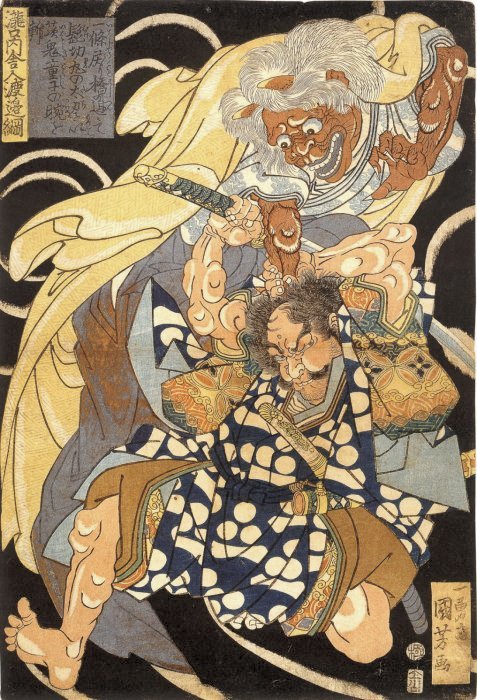
The Legend of Watanabe no Tsuna: Japan’s Original Demon Slayer
When travelers walk the historic streets of Kyoto, they often admire the serene temples and manicured gardens. However, beneath the calm aesthetic lies a history steeped in blood, steel, and the supernatural. Among the pantheon of Japanese heroes, few shine as brightly as Watanabe no Tsuna, a Heian-period samurai whose exploits have inspired centuries of art, theater, and folklore. Best known for his encounter with a terrifying oni (demon) at a bridge in Kyoto, Tsuna is the archetype of the monster-slaying warrior.
Origins: The First of the Watanabe
Watanabe no Tsuna (953–1025) was a real historical figure, born into the Minamoto clan, specifically the Saga Genji branch. He is traditionally credited as the founder of the Watanabe surname—one of the most common names in modern Japan. If you meet a Watanabe today, folklore suggests they might be a distant descendant of this legendary warrior.
Tsuna served as a retainer to Minamoto no Yorimitsu (also known as Raiko), a renowned regent and warrior. Along with three other legendary samurai, Tsuna was a member of the Shitenno (The Four Guardian Kings), a group celebrated for their martial prowess and loyalty. While historical records confirm his status as a powerful warrior and provincial governor, it is the layer of myth added during the Kamakura and Muromachi periods that cemented his status as a cultural icon.
The Legend of the Demon’s Arm
The most famous tale involving Watanabe no Tsuna centers on his encounter with Ibaraki-doji, the lieutenant of the fearsome demon king Shuten-doji.
The Encounter at Ichijo Modori-bashi
According to the Heike Monogatari (The Tale of the Heike) and later Otogizoshi texts, Tsuna was crossing the Ichijo Modori-bashi bridge in Kyoto late one night. He encountered a beautiful young woman traveling alone. Being a chivalrous samurai, he offered to escort her home. However, as they approached the destination, the woman transformed into a hideous demon, grabbing Tsuna by his helmet and attempting to fly away with him into the sky.
Tsuna remained calm. He drew his celebrated sword, the Higekiri (Beard Cutter), and in mid-air, severed the demon’s arm. The demon, howling in pain, fled into the night, leaving the severed limb behind.
The Aftermath
Tsuna locked the demon’s arm in a chest for safekeeping. Days later, an elderly woman claiming to be his aunt (or wet nurse) came to visit. She begged to see the trophy he had taken from the monster. Reluctantly, Tsuna opened the chest. The old woman immediately revealed herself to be the demon Ibaraki-doji in disguise, snatched the arm, and flew away, never to be seen again. Following this event, Tsuna’s sword was renamed Onikiri (The Demon Slayer).
Modern Culture and Legacy
Watanabe no Tsuna’s legend is deeply woven into the fabric of Japanese culture. His battle is a staple in classical Japanese performing arts:
- Noh and Kabuki: The play Ibaraki is a classic piece depicting the demon’s attempt to retrieve its arm. The tension between the disguised demon and the samurai is a highlight of the dramatic repertoire.
- Gion Festival: During Kyoto’s massive Gion Festival in July, one of the famous floats is the Tourouyama (Mantis Mountain). It is surmounted by a mechanical praying mantis, but the float itself is often associated with the bravery required to face overwhelming odds, echoing the spirit of warriors like Tsuna.
- Pop Culture: In modern anime and video games (such as the Fate series), Tsuna often appears as a character, typically wielding his famous sword, keeping the Heian legend alive for a global youth audience.
Traveler’s Tips: Tracing the Legend in Kyoto
For history buffs and folklore enthusiasts, Kyoto offers several spots to connect with the legend of Watanabe no Tsuna:
- Ichijo Modori-bashi Bridge: While the current bridge is a modern concrete reconstruction, it sits on the exact spot of the legendary encounter. It is located just north of Nijo Castle.
- Seimei Shrine: Located very close to the bridge, this shrine is dedicated to Abe no Seimei, the famous Onmyoji (spiritual advisor) who advised Tsuna on how to handle the demon. The shrine grounds contain a small replica of the original bridge and statues representing the mystic arts.
- Kitano Tenmangu Shrine: This famous shrine houses distinct treasure halls where one can sometimes view historic blades. While the specific Onikiri sword is held at Kitano Tenmangu, it is only displayed on special occasions. Seeing the steel that allegedly cut a demon is a chilling experience.
Sources & Further Reading
To dive deeper into the historical and mythological context of Watanabe no Tsuna, consider exploring the following texts:
- The Tale of the Heike (Heike Monogatari): An epic account of the struggle between the Taira and Minamoto clans, which contains early references to the martial prowess of the Minamoto warriors.
- Konjaku Monogatarishu (Anthology of Tales from the Past): A collection of stories from the late Heian period that blends Buddhism with folklore, often featuring encounters with the supernatural.
- Otogizoshi: A collection of short stories from the Muromachi period that fleshed out many of the specific details regarding Raiko and his Four Guardian Kings battling demons.
While ancient chronicles like the Kojiki establish the mythological foundation of Japan, it is within these medieval warrior tales that Watanabe no Tsuna truly comes to life.