
Momotaro: Unveiling the Legend of Japan’s Peach Boy
If you walk out of the main station in Okayama City, one of the first things you will greet is a statue of a young boy held aloft by a dog, a monkey, and a pheasant. This is Momotaro, or “Peach Boy,” the protagonist of perhaps the most famous folktale in all of Japan. For travelers and culture enthusiasts, understanding Momotaro is essential to understanding the spirit of the Japanese countryside and the values of bravery, filial piety, and teamwork.
While the story is often read as a simple children’s fairy tale, its roots run deep into Japanese history and Shinto mythology. Join us as we peel back the layers of the Peach Boy legend and discover where you can walk in his footsteps today.
The Origins of the Myth
Although the story of Momotaro is known throughout the Japanese archipelago, it is most strongly associated with Okayama Prefecture (formerly Kibi Province). Scholars believe the folklore figure of Momotaro is likely derived from a semi-historical figure named Kibitsuhiko-no-mikoto.
According to ancient records, Kibitsuhiko was an imperial prince sent to the Kibi region to defeat a tyrannical ogre or warlord named Ura. Ura was said to live in a castle atop a mountain (essentially the real-world equivalent of the demon island). The mythologizing of this historical conquest likely evolved over centuries, transforming a military campaign into the magical tale of the Peach Boy we know today.
The version of the story most people know was standardized during the Edo Period (1603–1867), where Momotaro became a national icon representing youthful strength and virtue.
The Legend of the Peach Boy
The tale begins in a small village where an elderly childless couple lived. One day, while the old woman was washing clothes in the river, a giant peach came floating downstream. Astonished, she brought it home to her husband. When they cut the peach open to eat it, they found a healthy baby boy inside. They named him Momotaro (Momo meaning peach, Taro being a common suffix for eldest sons).
Momotaro grew up rapidly, becoming strong and kind. When he reached adolescence, he heard rumors of Oni (demons/ogres) living on Onigashima (Demon Island) who were terrorizing the land. He asked his parents for permission to defeat them.
The Journey and the Millet Dumplings
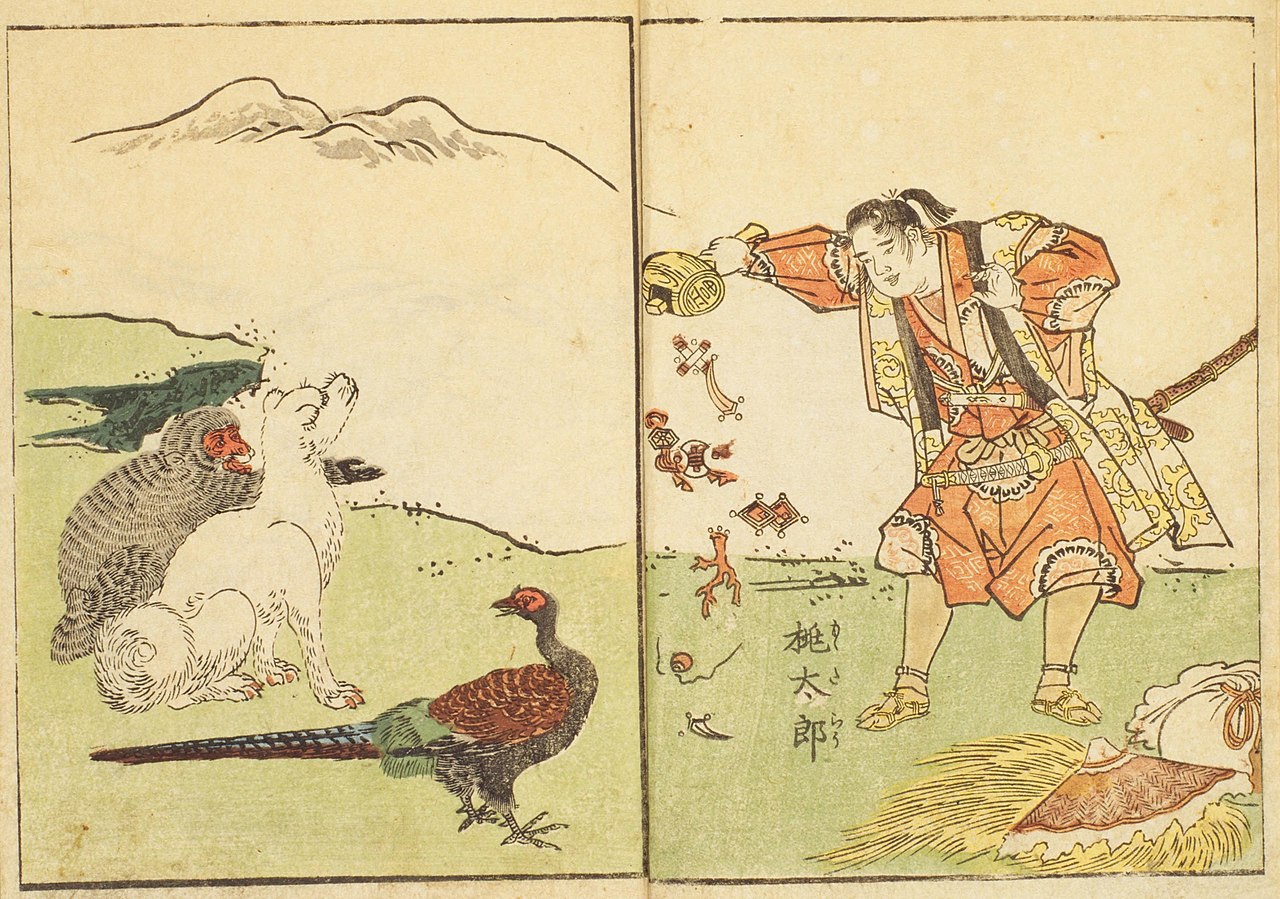
Before he left, his grandmother gave him a pouch of kibi dango (millet dumplings), said to give the eater the strength of 100 men. On his journey toward the sea, Momotaro met three animals: a Spotted Dog, a Monkey, and a Pheasant. In exchange for a share of his delicious dumplings, each animal pledged their loyalty to him.
Together, the group sailed to Onigashima. Using the dog’s bite, the monkey’s scratches, the pheasant’s aerial attacks, and Momotaro’s sword, they forced the demons to surrender. The group returned to the village with the demons’ plundered treasure, returning it to the people and living happily ever after.
Momotaro in Modern Culture
Momotaro is ubiquitous in modern Japan. He is the ultimate symbol of the “good conquering evil” trope.
- Pop Culture: You can find references to Momotaro in anime series like One Piece (where the Wano arc draws heavy inspiration from the legend) and video games like Momotaro Dentetsu.
- Advertising: He is frequently used in commercials to represent reliability.
- Values: The story is often used in education to teach children that success is rarely achieved alone; the dog, monkey, and pheasant represent different virtues (loyalty, wisdom, and bravery) coming together for a common cause.
Traveler’s Tips: Following the Footsteps
If you are visiting Japan, Okayama is the pilgrimage site for Momotaro fans. Here is how you can experience the legend firsthand:
1. Kibitsu Shrine
This is the most historically significant site related to the legend. It enshrines Kibitsuhiko-no-mikoto, the model for Momotaro. The shrine features a stunning 400-meter-long wooden corridor and is said to be the site where the prince defeated the ogre Ura.
2. Megijima Island (Kagawa Prefecture)
Across the Seto Inland Sea from Okayama lies Megijima, often marketed as the real-world Onigashima. Visitors can explore a large cave system at the top of the island, which features statues of demons and reenactments of the legend. It is a fantastic day trip, especially during the Setouchi Triennale art festival.
3. Taste the Legend: Kibi Dango
You cannot leave Okayama without buying kibi dango. While they won’t give you the strength of 100 men, these sweet millet flour dumplings are a delicious souvenir (omiyage). They are sold everywhere, often in packaging featuring the cute animal sidekicks.
Sources & Further Reading
For those interested in the historical roots of the Momotaro legend, the following texts provide the foundation of the mythology:
- The Kojiki (Records of Ancient Matters, 712 AD): Chronicles the lineage of the Imperial family, including the line of Kibitsuhiko-no-mikoto.
- The Nihon Shoki (The Chronicles of Japan, 720 AD): Provides more detailed historical accounts of the Yamato court’s expansion and the suppression of regional powers like those in Kibi.
- Japanese Fairy Tales by Yei Theodora Ozaki: An excellent English translation of the standard folklore version.