
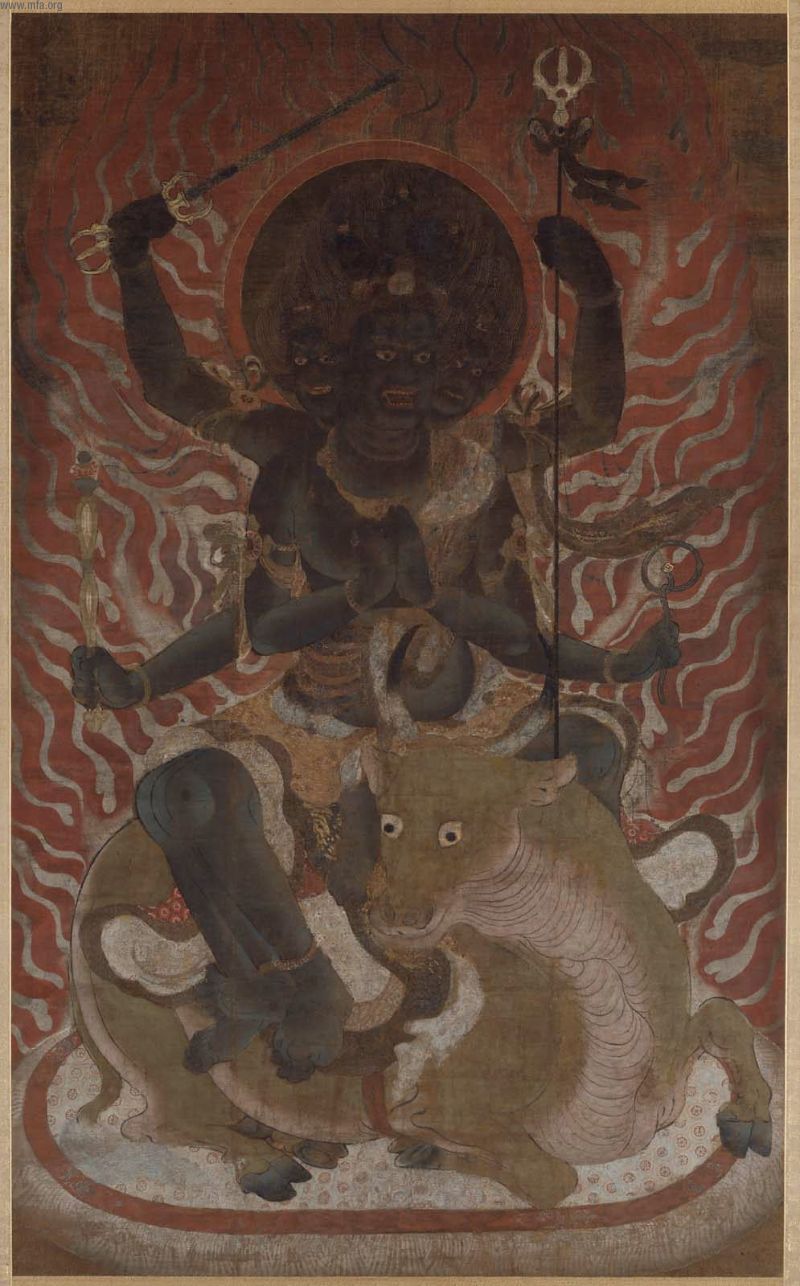
Unveiling Daiitoku Myoo: The Defeater of Death
Introduction
Step into the dimly lit Kodo (Lecture Hall) of Kyoto’s Toji Temple, and you will be met with a silent, imposing army of statues. Among them stands a figure that defies the standard symmetry of human form. He has six faces, six arms, and, most uniquely, six legs, all while straddling a massive white buffalo. This is Daiitoku Myoo (大威徳明王), the Wisdom King of Great Awe and Virtue.
While many travelers are familiar with the gentle serenity of the Buddha or the compassionate gaze of Kannon, the Wisdom Kings (Myoo) represent a fiercer aspect of Japanese Buddhism. They are the wrathful guardians who frighten non-believers into faith and protect the teachings. Daiitoku Myoo, specifically, holds the distinct title of the “Defeater of Death,” making him one of the most powerful and visually complex figures in the pantheon of Esoteric Buddhism.
Origins: The Wisdom King of the West
Daiitoku Myoo is the Japanese manifestation of the Sanskrit deity Yamantaka. The name is a compound of Yama (the Lord of Death) and antaka (the terminator or destroyer). Thus, his primary spiritual function is the subjugation of death and evil. In the hierarchy of the Godai Myoo (Five Wisdom Kings), he presides over the West, a direction traditionally associated with the setting sun and the transition into the afterlife.
Introduced to Japan largely through the teachings of Kukai (Kobo Daishi) and the Shingon sect in the 9th century, Daiitoku is considered a manifestation of Amida Nyorai (the Buddha of Infinite Light). While Amida welcomes souls to the Pure Land with compassion, Daiitoku aggressively destroys the obstacles and karma that prevent that journey. He is the forceful counterpart to Amida’s gentle grace.
Iconography and Legend: The Power of Six
Daiitoku Myoo is instantly recognizable due to his unique iconography. While multi-armed deities are common in Hindu and Buddhist lore, Daiitoku is the only major figure depicted with six legs. This is not merely an artistic choice but a deep theological symbol.
The Symbolism of Six
In Buddhist numerology, the number six is significant. Daiitoku’s six legs represent his ability to traverse and save sentient beings across the Six Realms of Existence (Rokudo)—from the hell realms to the realm of the gods. They also symbolize the Six Paramitas (perfections) required to attain enlightenment: charity, morality, patience, effort, meditation, and wisdom.
The Buffalo Mount
He is almost always depicted riding a water buffalo or cow. In ancient Indian mythology, the buffalo is the mount of Yama, the God of Death. By standing upon or riding the buffalo, Daiitoku visually demonstrates his dominion over death itself. The animal is often depicted lying down, symbolizing the suppression of the ego and the taming of chaotic passions.
The Six Faces
His six faces allow him to gaze in all directions—North, South, East, West, Up, and Down—ensuring that no evil escapes his sight. His expressions are wrathful, with bulging eyes and fangs, designed to terrify demons into submission.
Daiitoku Myoo in Modern Culture
While Daiitoku Myoo remains a solemn figure in religious practice, his fearsome image has permeated Japanese pop culture and art.
In the world of traditional Japanese tattooing (Irezumi), Daiitoku is a favored subject for back pieces. His image represents protection, power, and the overcoming of mortality, making it a popular choice for those seeking spiritual guardianship.
Furthermore, fans of Japanese role-playing games (JRPGs) may recognize him. In the Shin Megami Tensei and Persona series, Daiitoku Myoo often appears as a high-level “Persona” or demon. These modern depictions usually remain faithful to his six-legged, buffalo-riding design, introducing the ancient deity to a global generation of gamers who may be unaware of his theological roots.
Traveler’s Tips: Where to Find Him
For travelers seeking to view Daiitoku Myoo in person, Kyoto is the spiritual heartland of Esoteric Buddhism.
- Toji Temple (Kyoto): This is the most essential stop. The Kodo (Lecture Hall) houses the oldest surviving set of the Five Wisdom Kings in Japan, dating back to 839 AD. Seeing the wooden statue of Daiitoku here, surrounded by his peers in the atmospheric gloom, is a hauntingly beautiful experience.
- Daigo-ji Temple (Kyoto): A massive temple complex that is a World Heritage Site. It holds significant paintings and statues of the Godai Myoo.
- Tofuku-ji Temple (Kyoto): While famous for autumn leaves, this temple also houses impressive statuary often overlooked by the casual tourist.
Best Time to Visit: Early mornings are best for Toji Temple. The Kodo hall is dark, and the morning light filtering in can create a mystical atmosphere around the statues.
Sources & Further Reading
To deepen your understanding of Daiitoku Myoo and the context of Japanese Buddhism, consider consulting the following texts and resources:
- The Dainichi-kyo (Mahavairocana Sutra): The foundational text for Shingon Buddhism, detailing the mandalas where Daiitoku appears.
- The Mandala of the Two Realms: Study the Womb World Mandala (Taizokai) to see Daiitoku’s placement in the Quarter of Universal Knowledge.
- Japanese Buddhist Statuary: Various academic resources by the Japanese Architecture and Art Net Users System (JAANUS) provide excellent glossary definitions.
- Note regarding historical texts: While the Kojiki and Nihon Shoki cover the Shinto creation myths of Japan, deities like Daiitoku arrived later from India via China. Therefore, Buddhist sutras and the writings of Kukai are the primary historical sources for this subject.