
Izanami: Exploring the Legend of Japan’s Mother Goddess
Japan is a land deeply rooted in mythology, where the line between the physical world and the spiritual realm is often blurred by ancient shrines and misty mountains. At the heart of Shinto, Japan’s indigenous spirituality, lies the dramatic and tragic tale of Izanami-no-Mikoto. Known as the goddess of both creation and death, her story explains the very existence of the Japanese archipelago and the cycle of mortality that defines human existence.
For cultural travelers and mythology enthusiasts, understanding Izanami is essential to understanding the soul of Japan. Her legend is not just a story of the past; it is etched into the landscape, from the rocks of Onogoro to the caves of the underworld.
Origins: The Creation of Japan
According to Japan’s oldest historical chronicles, the Kojiki and the Nihon Shoki, the universe was once a chaotic, oily mass. From this chaos, the first gods appeared. The primitive gods summoned Izanami and her brother-husband, Izanagi, and tasked them with solidifying the drifting land.
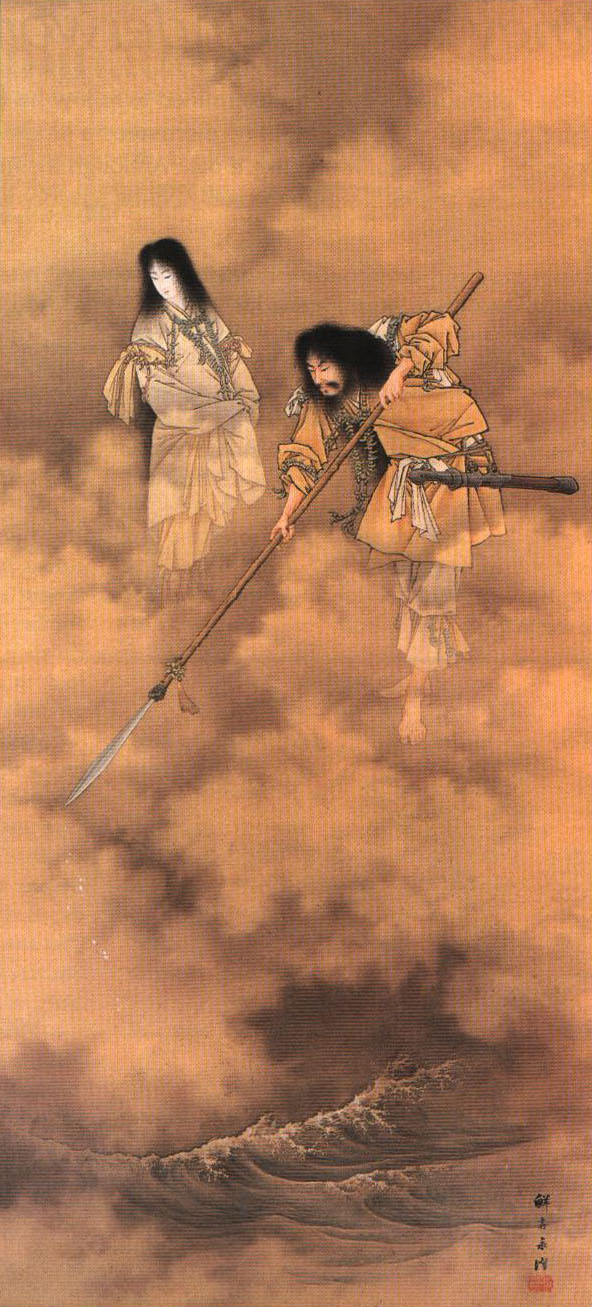
Standing upon the Ame-no-ukihashi (the Floating Bridge of Heaven), the divine couple dipped a jeweled spear, the Ame-no-nuboko, into the ocean below. When they lifted the spear, the salty drops that fell from its tip coagulated to form the island of Onogoro. Descending to this island, they built a pillar and performed a wedding ritual.
Through their union, they birthed the islands of Japan (the Kuniumi) and a pantheon of deities (Kamiumi) representing the sea, wind, mountains, and trees. This act established the divine nature of the Japanese landscape, suggesting that the rivers, mountains, and islands are literally the children of the gods.
The Legend: Descent into Yomi
Izanami’s role shifts dramatically from a life-giver to a harbinger of death in the second half of her myth. Her life ended tragically while giving birth to Kagutsuchi, the god of fire. The birthing burns proved fatal, and the mother goddess descended into Yomi-no-kuni, the Land of the Dead.
Grief-stricken, Izanagi journeyed to the underworld to retrieve his wife. In the darkness, he pleaded with her to return. Izanami agreed to ask the gods of the underworld for permission but warned him not to look at her. Overcome by impatience, Izanagi lit a tooth of his comb to see in the dark. The flame revealed a horrifying sight: Izanami’s once-beautiful body was rotting and infested with maggots.
Shamed and enraged that her husband had seen her in such a state, Izanami chased him out of the underworld. Izanagi sealed the entrance with a massive boulder, separating the land of the living from the land of the dead forever. From behind the rock, Izanami vowed to kill 1,000 of his people every day. In response, Izanagi vowed to birth 1,500 new lives daily. Thus, the cycle of life and death was established, with Izanami reigning as the Queen of the Underworld.
Izanami in Modern Culture
While Izanami is an ancient deity, her presence resonates in modern Japanese culture. She is often depicted in pop culture, appearing in video games like Persona and Smite, and anime series like Noragami, usually representing powerful, chthonic forces.
However, beyond entertainment, she represents the Shinto acceptance of impurity (kegare) associated with death. In traditional thought, death is not evil, but it is a source of pollution that requires ritual purification (harae). Izanagi’s washing of his body after returning from Yomi is the mythological origin of the purification rituals seen at every Shinto shrine today.
Traveler’s Tips: Visiting Sacred Sites
For travelers wishing to pay respects to the Mother Goddess, there are specific sites in Japan deeply connected to her legend. Unlike major tourist hubs in Tokyo or Kyoto, these locations offer a glimpse into the mystical side of rural Japan.
1. Hana-no-Iwaya Shrine (Mie Prefecture)
Considered one of the oldest shrines in Japan, this site does not have a traditional wooden building. Instead, the object of worship is a massive rock face believed to be the grave of Izanami. It is a powerful “power spot” located in the World Heritage Kumano region.
2. Iya Shrine (Shimane Prefecture)
Shimane is known as the land of the gods. Iya Shrine acts as the entrance to Yomi (the underworld). It is a solemn place, distinct from the bright vermilion of other shrines, acknowledging the darker aspect of Izanami’s domain.
3. Awaji Island (Hyogo Prefecture)
According to legend, this was the first island created by the couple. The Izanagi Jingu here is dedicated to the couple, focusing on their role as creators rather than the tragedy of death.
Travel Etiquette: When visiting these shrines, remember to bow at the Torii gate, wash your hands at the temizuya, and follow the nirei-nihakushu-ichirei (two bows, two claps, one bow) prayer custom.
Sources & Further Reading
To delve deeper into the mythology of Izanami and the Shinto pantheon, the following historical texts and translations are recommended:
- The Kojiki (Records of Ancient Matters): Translated by Basil Hall Chamberlain or Donald L. Philippi. This is the oldest chronicle in Japan (712 AD) and contains the most detailed account of the creation myth.
- The Nihon Shoki (The Chronicles of Japan): Completed in 720 AD, this text offers slightly different variations of the myth and focuses more on history.
- Guide to Japanese Mythology: Various academic commentaries provide context on how these myths influenced the Imperial court and modern Shinto practices.