
Izanagi: The Father of Japan and the Roots of Shinto
When travelers step foot into the serene atmosphere of a Shinto shrine, clapping their hands in prayer, they are participating in a tradition that stretches back to the dawn of time—at least, according to Japanese mythology. At the center of this ancient cosmology stands Izanagi-no-Mikoto, the deity credited with creating the Japanese archipelago and fathering the most significant gods in the Shinto pantheon.
Understanding Izanagi is essential for any cultural traveler wanting to grasp the soul of Japan. His story is not just a dusty myth; it is the narrative foundation of the Imperial line, the geography of the nation, and the rituals that define Japanese spirituality.
The Origins of the Creator
Izanagi, whose name roughly translates to “He Who Invites,” is one of the primordial gods described in Japan’s oldest historical records. In the Shinto creation myth, the universe began as a chaotic, oily mass. From this chaos, several generations of deities appeared, culminating in the emergence of the divine couple: Izanagi and his younger sister-wife, Izanami (“She Who Invites”).
Unlike the abstract deities that came before them, Izanagi and Izanami were anthropomorphic creator gods tasked with a physical mission: to solidify the drifting land and create a country. They represent the duality of nature—male and female, creation and destruction, life and death.
The Legend: Creation, Tragedy, and Purification
The story of Izanagi is a dramatic saga filled with romance, horror, and redemption. It serves as the bedrock for many Shinto beliefs.
The Birth of the Land
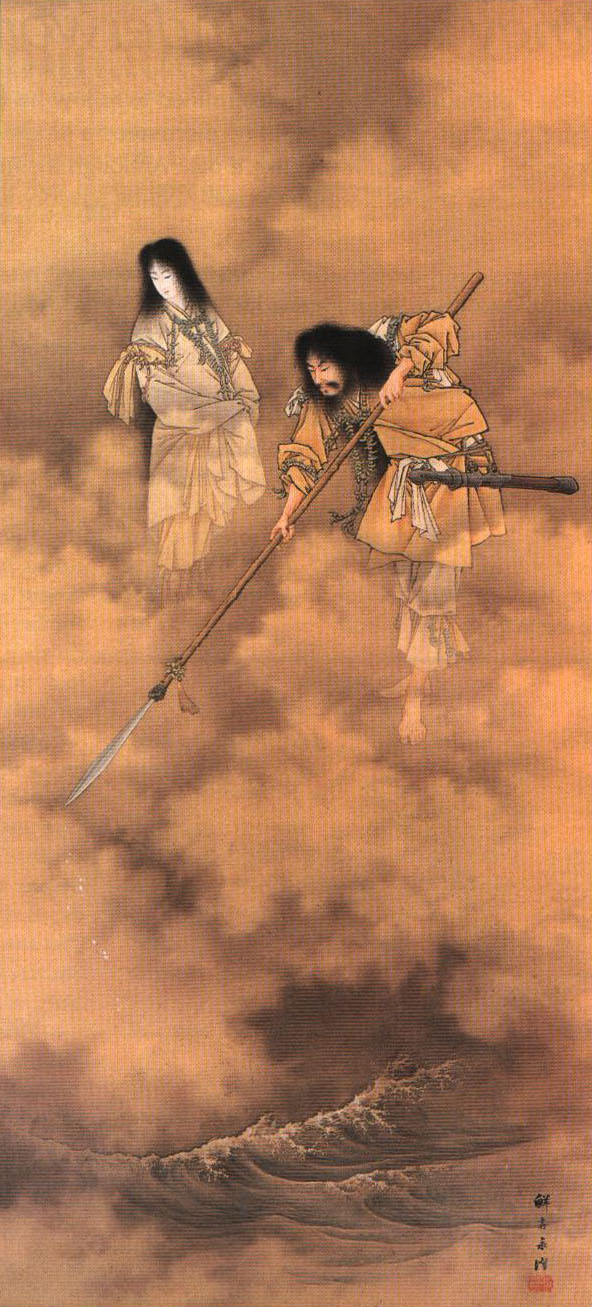
According to legend, the couple stood on the Floating Bridge of Heaven and stirred the chaotic ocean below with a jeweled spear. Brine dripping from the spear tip coagulated to form Onogoro, the first island. Descending to this island, they erected a pillar and performed a marriage ritual. Consequently, Izanami gave birth to the eight main islands of Japan, followed by hundreds of nature deities representing the wind, mountains, and trees.
Tragedy and the Underworld (Yomi)
The myth takes a dark turn when Izanami gives birth to Kagutsuchi, the Fire God. The flames burn her fatally, sending her soul to Yomi-no-Kuni (the Land of the Dead). Grief-stricken, Izanagi journeys to the underworld to retrieve her, echoing the Greek myth of Orpheus and Eurydice.
However, he breaks a taboo by lighting a fire to see her in the darkness. He is horrified to find her body rotting and infested with maggots. Ashamed and enraged, Izanami sends demonic hags to chase him. Izanagi barely escapes, sealing the entrance to Yomi with a massive boulder. From behind the rock, Izanami vows to kill 1,000 people a day in revenge. Izanagi retorts that he will create 1,500 new lives daily, establishing the cycle of human life and death.
The Noble Children
Feeling polluted by his contact with death, Izanagi performs a purification ritual (misogi) in a river. As he washes his face, three paramount deities are born:
- Amaterasu (Sun Goddess): Born from his left eye.
- Tsukuyomi (Moon God): Born from his right eye.
- Susanoo (Storm God): Born from his nose.
This act of cleansing is the origin of the purification rituals seen at every Shinto shrine today.
Izanagi in Modern Culture
Izanagi’s influence permeates modern Japan, often in ways visitors might not immediately recognize.
- Imperial Lineage: The Japanese Imperial Family claims direct descent from Amaterasu, Izanagi’s daughter, making Izanagi the ancestral patriarch of the Chrysanthemum Throne.
- Pop Culture: The name appears frequently in anime and video games. In the popular Persona series, Izanagi is a powerful persona, and in Naruto, “Izanagi” is a technique capable of rewriting reality. These references keep the name alive for younger generations, even if the context differs from the original myth.
- Shinto Rituals: The concept of kegare (spiritual pollution) and the need for misogi (purification) stems directly from Izanagi’s flight from the underworld. Every time you wash your hands at a temizuya pavilion before entering a shrine, you are reenacting Izanagi’s cleansing.
Traveler’s Tips: Visiting the Sacred Sites
For those wishing to connect with this legend physically, several sites in Japan are deeply associated with Izanagi.
- Izanagi Jingu (Awaji Island): Located on Awaji Island (mythologically the first island created), this is the oldest shrine dedicated to Izanagi. It is said to be the site of his dwelling after he retired from divine duties.
- Onokoro Island Shrine (Awaji Island): While the exact location of the mythical Onokoro is debated, this shrine claims to be the spot. It features a massive red torii gate that is a favorite for photographers.
- Taga Taisha (Shiga Prefecture): A major shrine dedicated to both Izanagi and Izanami, believed to grant long life and successful matchmaking. It is affectionately known as “Otaga-san” by locals.
- Meoto Iwa (The Wedded Rocks): Located in Mie Prefecture, these two sacred rocks in the ocean are tied together by a shimenawa rope, symbolizing the union of Izanagi and Izanami. It is a stunning spot for sunrise viewing.
Sources & Further Reading
To dive deeper into the fascinating world of Japanese mythology, consider exploring these primary historical texts:
- The Kojiki (Records of Ancient Matters): Compiled in 712 AD, this is the oldest surviving chronicle in Japan and the primary source for the Izanagi myths.
- The Nihon Shoki (The Chronicles of Japan): Finished in 720 AD, this text provides a slightly more historical perspective and alternative versions of the creation myths.
By understanding Izanagi, you do not just learn a story; you unlock the spiritual geography of the Land of the Rising Sun.