
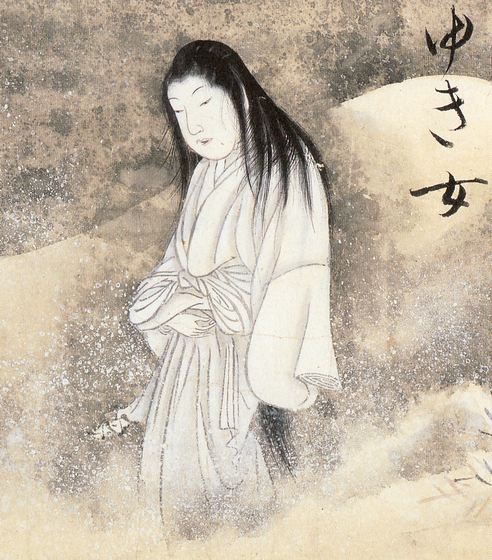
The Legend of Yuki-onna: Japan’s Beautiful Ice Woman
When winter descends upon the Japanese archipelago, transforming the landscape into a painting of white silence, the line between the physical world and the supernatural begins to blur. Among the pantheon of Japanese yōkai (spirits/monsters), few are as hauntingly beautiful or as universally feared as the Yuki-onna (雪女), often translated as the Snow Woman or the Ice Woman.
For cultural travelers and folklore enthusiasts, understanding the Yuki-onna offers a chilling glimpse into how Japan viewed the brutality of winter and the mysteries of death.
Origins of the Ice Spirit
The Yuki-onna is not a singular entity but a class of spirit that appears on snowy nights. Her origins are ancient, dating back to a time when freezing to death was a common and terrified reality for inhabitants of the Japanese Alps and Tohoku region.
The first known written appearance of the Yuki-onna is found in the Sogi Shokoku Monogatari (Tales of Sogi from Many Lands), written in the Muromachi period (late 15th century). In this text, the author describes seeing a mysterious woman in his garden after a heavy snowfall—a figure who vanished as the sun rose.
Unlike the deities found in the creation myths of the Kojiki, the Yuki-onna is often categorized as a yōkai or a yūrei (ghost). Folklore scholars suggest she represents the spirit of someone who perished in the snow, or perhaps the personification of the snow itself: beautiful, pale, and coldly indifferent to human life.
The Legend: A Promise Broken
While there are many regional variations of the Ice Woman’s tale, the most famous version comes from the Kwaidan collection. It tells the story of two woodcutters, an old man named Mosaku and his young apprentice, Minokichi.
Trapped by a blizzard in a mountain hut, the two men fall asleep. Minokichi wakes to find the door blown open and a woman in white robes standing over Mosaku, blowing her icy breath onto him, freezing him to death. She turns to Minokichi but pauses. Struck by his youth and handsomeness, she decides to spare him on one condition: he must never mention this night to anyone.
Years pass. Minokichi meets a beautiful woman named Oyuki. They marry, have children, and live happily. One winter night, as the light hits Oyuki’s face, Minokichi is reminded of the terrifying encounter from his youth. Forgetful of his promise, he tells his wife the story of the Ice Woman who spared him.
Oyuki’s expression changes instantly. She reveals herself to be the Yuki-onna. Because of their children, she refuses to kill him, but she abandons him instantly, dissolving into a mist of snow and ice, never to return. This tragic ending underscores a common theme in Japanese folklore: the fragility of trust between the human and spirit worlds.
Modern Culture: From Horror to Heroine
In contemporary Japan, the image of the Yuki-onna has shifted. While she remains a staple of horror, pop culture has softened her icy edges.
- Anime and Manga: In series like Yu Yu Hakusho or Nura: Rise of the Yokai Clan, Yuki-onna characters are often depicted as loyal guardians or tragic romantic interests rather than mindless killers. In Pokémon, the creature Froslass is directly inspired by the legend.
- Cinema: The 1964 anthology film Kwaidan features a visually stunning and terrifying adaptation of the legend, which introduced the story to a global audience.
- Video Games: From Nioh to Shin Megami Tensei, the Ice Woman appears frequently as a formidable boss or a summonable ally, often utilizing high-level ice magic.
Traveler’s Tips: Chasing the Myth
If you are planning a trip to Japan and wish to explore the roots of this chilly legend, here are the best places to visit:
Ome City, Tokyo
Surprisingly, one of the most famous connections to the Yuki-onna legend is in Ome City, on the outskirts of Tokyo. The area claims to be the setting of the version recorded by Lafcadio Hearn. You can visit the Suganami Shrine, near where the mythical encounter was said to take place. The city occasionally embraces this heritage with folklore events.
Tono City, Iwate Prefecture
Known as the “City of Folklore,” Tono is famous for the Tono Monogatari (Legends of Tono). The Tono City Museum is a must-visit for anyone interested in yōkai. While the Kappa is the star here, the harsh winters of Iwate make it the perfect atmospheric setting to understand the fear of the Snow Woman.
Snow Festivals
To truly feel the presence of the Ice Woman, visit during February. The Sapporo Snow Festival in Hokkaido or the Yokote Kamakura Festival in Akita provides the snowy backdrop where one could easily imagine a woman in white vanishing into the drift.
Sources & Further Reading
For those looking to dive deeper into the historical texts and translations regarding Japanese spirits:
- Kwaidan: Stories and Studies of Strange Things by Lafcadio Hearn (1904) – The seminal English text that popularized the specific narrative of Minokichi and Oyuki.
- Sogi Shokoku Monogatari – The historical text containing the first written record of the Yuki-onna.
- Tono Monogatari by Kunio Yanagita – A pivotal collection of Japanese folk legends.
- Note on Classics: While the Kojiki and Nihon Shoki are essential for understanding Shinto gods (Kami), the Yuki-onna belongs to the later traditions of yōkai folklore, originating from the oral traditions of the Muromachi and Edo periods.