
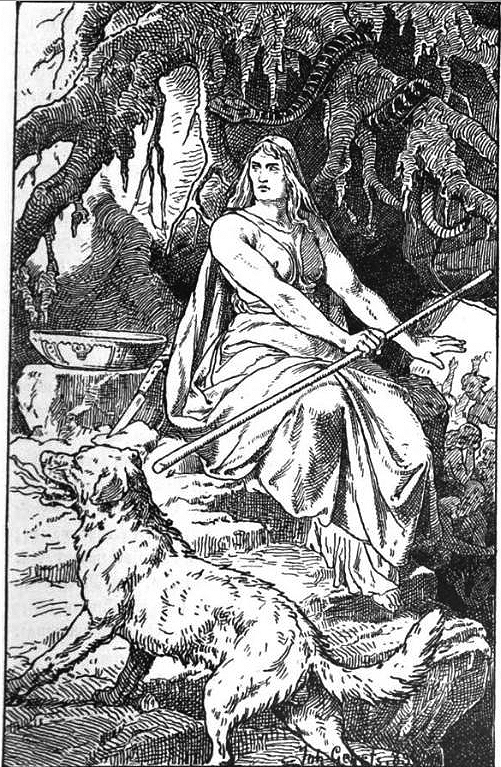
The Japanese “Hell Hound”: Okuri-inu, Inugami, and Supernatural Canines
When we hear the term “Hell Hound,” our minds often drift to Western mythology—the three-headed Cerberus guarding the Greek underworld, or the spectral Black Shuck of English folklore. However, Japan possesses its own rich, terrifying, and fascinating tapestry of supernatural canines. While the direct translation Jigoku-ken (地獄犬) is often used to describe Western monsters, Japanese folklore offers entities that fit the archetype of the “Hell Hound” in spirit, if not in name: the stalking Okuri-inu and the cursed Inugami.
Introduction
In the misty mountains of ancient Japan, the line between the physical world and the spiritual realm was often thin. Dogs and wolves were not merely pets or predators; they were messengers of the gods and guardians of the threshold. Unlike the Western Hell Hound, which typically serves as a guardian of the dead, Japanese supernatural dogs often interact directly with the living, serving as ambiguous figures that can bring either protection or doom depending on human behavior.
Origins: Guardians of the Mountains
The origins of the Japanese supernatural dog lie in the country’s ancient mountain worship (Sangaku Shinko). In early Japan, the wolf and the mountain dog were seen as servants of the Mountain Kami (spirits).
In the ancient chronicles, specifically the Nihon Shoki (The Chronicles of Japan), there are accounts of a white dog guiding the legendary hero Yamato Takeru through the fog of the mountains. This established the canine as a divine guide. However, as Japanese folklore evolved, the dual nature of nature—benevolent and destructive—manifested in the stories of dog spirits. The “Hell Hound” of Japan is not a beast that keeps you in hell, but a beast that ensures you respect the rules of the wild, lest you be sent there.
Legend: The Stalking Okuri-inu and Cursed Inugami
Two primary legends dominate the landscape of Japanese “Hell Hounds.”
The Okuri-inu (The Sending Dog)
The Okuri-inu is a yōkai that haunts mountain passes at night. According to legend, as you walk alone on a dark trail, you may hear the padding of paws behind you. This is the Okuri-inu. It follows travelers closely—so closely that if you stumble and fall, it will immediately pounce and devour you.
However, this “Hell Hound” operates on a strict code. If you fall but pretend to be taking a short rest by saying, “Dokkoisho” (a heave-ho sound indicating sitting down), the dog will wait patiently for you to stand up. Furthermore, if you make it safely out of the mountains, the Okuri-inu acts as a guardian, preventing other yōkai from attacking you. Upon reaching home, it is customary to thank the spirit for seeing you off, transforming the beast from a predator into a protector.
The Inugami (The Dog God)
Far more sinister is the Inugami. Unlike the natural Okuri-inu, the Inugami is a spirit created through dark rituals (similar to witchcraft) often described in Edo-period texts. These spirits were conjured to inflict curses, possess humans, or bring wealth to their masters. An Inugami possession was feared as it caused the victim to behave erratically, bark, and eventually succumb to illness. In this sense, the Inugami represents the “Hell Hound” as an agent of malice and a manifestation of human greed.
Modern Culture: From Yōkai to Pop Icons
The archetype of the Japanese Hell Hound remains vibrant in modern pop culture.
- Anime & Manga: The character Sesshōmaru from Inuyasha embodies the majestic, divine power of the dog demon, while the Pokémon Houndoom is a literal interpretation of a dark, fire-breathing hell hound, clearly inspired by the darker side of these legends.
- Video Games: In the Persona and Shin Megami Tensei series, entities like Inugami are recruitable demons, preserving their mythological roots as magical attackers.
These modern iterations strip away the rural fear but keep the aesthetic of the powerful, supernatural canine that commands respect.
Traveler’s Tips: Where to Find the “Wolf” Spirits
For travelers interested in the roots of these legends, a visit to the Chichibu region in Saitama Prefecture is essential.
- Mitsumine Shrine: Unlike most shrines guarded by Komainu (Lion-Dogs), this ancient shrine is guarded by wolves (O-inu-sama). It is a rare location dedicated to the worship of the Japanese wolf (now extinct) as a divine messenger.
- Musashi Mitake Shrine: Located in Tokyo’s Okutama region, this shrine also honors the wolf and offers blessings for visitors’ pet dogs.
- Etiquette: When hiking in Japan’s deep mountains (like the Kumano Kodo), acknowledging the local spirits is a sign of respect. If you stumble, perhaps taking a moment to “rest” isn’t just good for your legs—it might just appease an unseen guardian.
Sources & Further Reading
- Nihon Shoki (The Chronicles of Japan): For accounts of Yamato Takeru and the divine white dog.
- The Kojiki (Records of Ancient Matters): While it focuses on the creation myths and the descent of Izanagi into Yomi, it establishes the animistic worldview essential for understanding yōkai.
- Yanagita Kunio’s “The Legends of Tono” (Tono Monogatari): A seminal collection of Japanese folklore that details encounters with mountain spirits and wolves.
- Komatsu Kazuhiko: Various works on Yōkai culture and the spiritual history of Japan.