
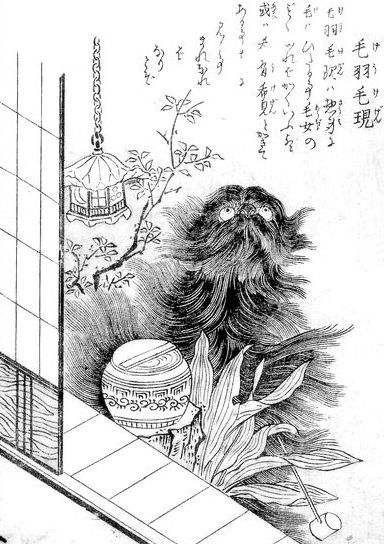
Keukegen: The Hairy Yokai Lurking in Japanese Homes
Have you ever glanced at a dark corner of your room, spotted a ball of fluff, and wondered if it just moved? In the West, we might call them dust bunnies, dismissing them as the result of a missed sweeping day. However, in Japanese folklore, that scruffy mass of hair might actually be looking back at you.
Welcome to the world of the Keukegen (毛羽毛現), a peculiar creature from Japan’s vast pantheon of yokai (supernatural monsters and spirits). Resembling a shaggy dog or a sentient ball of mildew, the Keukegen is a fascinating example of how Japanese culture personifies even the most mundane aspects of domestic life.
Introduction to the Fluff
The name Keukegen is written with characters meaning “fur,” “feathers,” “hair,” and “appear.” Literally, it translates to “a hairy thing appearing.” At first glance, this yokai looks harmless—perhaps even cute. It is typically depicted as a small creature completely covered in long, shaggy hair, with no visible face other than perhaps two eyes peering out from the gloom.
However, do not let its Muppet-like appearance fool you. In the realm of Japanese folklore, the Keukegen is not a pet; it is a minor spirit of misfortune associated with dampness, decay, and sickness.
Origins: Ink and Imagination
Unlike the ancient gods found in Japan’s oldest chronicles, the Keukegen is a relatively “modern” invention in the timeline of Japanese mythology. It first appeared in the Edo period, specifically in the work of the master yokai artist Toriyama Sekien.
Sekien included the Keukegen in his 1781 bestiary, Konjaku Hyakki Shūi (Supplement to The Hundred Demons from the Present and the Past). Sekien was known for taking idioms, puns, or everyday annoyances and turning them into monsters.
Scholars believe the Keukegen may be a visual pun. In Japanese, keukegen sounds similar to keu-na (rare) and kegen (dubious or suspicious). Sekien likely created the creature to satirize the “suspiciously rare” instance of finding weird things growing in the dark, damp corners of a neglected house during Japan’s humid rainy seasons.
The Legend: A Spirit of Sickness
According to folklore, the Keukegen is not a wandering monster; it is a squatter. It takes up residence in human homes, specifically favoring dark, damp, and cool places. You are most likely to find one under the engawa (veranda floorboards), inside a rarely opened closet, or beneath a leaky sink.
While the Keukegen does not attack humans with claws or fangs, its presence is dangerous. It is believed to be a physical manifestation of bad air, mildew, and pestilence.
- The Sickness Bringer: Legend says that if a Keukegen takes up residence in your home, the family will fall ill. It weakens the constitution of the household, bringing about lethargy and low-grade sicknesses that are hard to shake.
- A Sign of Neglect: The yokai is essentially a supernatural reprimand for poor housekeeping. It thrives in dust and moisture. Therefore, the only way to banish a Keukegen is not through exorcism spells or holy water, but through sunshine, fresh air, and a thorough cleaning.
This creates a fascinating cultural link between hygiene and spiritual purity, a concept deeply rooted in Shinto philosophy where kegare (impurity/pollution) must be cleansed.
Modern Culture: From Pest to Mascot
In contemporary Japan, the scary reputation of the Keukegen has softened significantly. Due to Japan’s yuru-chara (mascot character) culture, even filth-spirits have been given a kawaii (cute) makeover.
- Anime and Manga: The Keukegen famously appears in the franchise GeGeGe no Kitaro by Shigeru Mizuki, the godfather of modern yokai media. Here, it is often portrayed as a nuisance but is undeniably cute in design.
- Video Games: Fans of the Nioh series or Persona games may recognize enemies inspired by this hairy concept. Even in Pokémon, design elements of shaggy, obscured creatures (like Tangela or Piloswine) echo the aesthetic of the Keukegen.
Today, you are more likely to find a plush toy of a Keukegen in a Harajuku shop than you are to fear getting sick from one.
Traveler’s Tips: Hunting the Hairy Spirit
If you are a folklore enthusiast traveling to Japan, you won’t find a Keukegen under your hotel bed (hopefully), but you can visit places dedicated to these spirits.
- Mizuki Shigeru Road (Sakaiminato, Tottori Prefecture): This is the ultimate pilgrimage for yokai lovers. The street is lined with over 170 bronze statues of different spirits, including the Keukegen. You can also visit the Mizuki Shigeru Museum to learn about the classification of these monsters.
- Yokai Street (Kyoto): Located on Ichijo-dori, this shopping street embraces the legend of the Hyakki Yagyo (Night Parade of One Hundred Demons). The local shops create their own homemade yokai mascots, and you can often find hairy, Keukegen-like decorations in the storefronts.
- The Miyoshi Mononoke Museum (Hiroshima Prefecture): A newer museum dedicated to the collection of Yumoto Koichi, housing thousands of scrolls and artifacts depicting Edo-period yokai.
Sources & Further Reading
To dive deeper into the world of Japanese spirits, consider exploring the following texts:
- Konjaku Hyakki Shūi (1781) by Toriyama Sekien: The primary visual source for the Keukegen.
- The Kojiki and Nihon Shoki: While these 8th-century texts focus on Shinto gods (Kami) rather than Edo-period yokai like the Keukegen, they provide the essential context for understanding the Japanese view of the spiritual world and the concept of kegare (impurity).
- Japandemonium Illustrated by Toriyama Sekien (Translated by Hiroko Yoda and Matt Alt): An excellent English resource for browsing Sekien’s original drawings.
So, the next time you see a dust bunny under your couch, grab a broom quickly—before it grows eyes!