
Kurote: The Terrifying Black Hand of Japanese Folklore
When travelers think of Japan, they often picture serene temples, neon-lit streets, and arguably the most high-tech toilets in the world. However, beneath the veneer of the heated seats and musical bidets lies a darker, hairier history. In the pantheon of Japanese yokai (spirits and monsters), few are as specifically unsettling as the Kurote (黒手), or “Black Hand.”
This bizarre spirit, a disembodied hairy arm that haunts the restroom, serves as a reminder of a time when the bathroom was not a sanctuary of hygiene, but a dark, terrifying abyss between worlds. Join us as we explore the legend of the Kurote, its origins, and why you might want to check the bowl before you sit down.
The Roots of Fear: Origins of the Kurote
The Noto Peninsula Connection
The legend of the Kurote is most strongly associated with the Noto Peninsula in Ishikawa Prefecture. Unlike the urban legends of Tokyo, this is a rural folktale born from the architecture of the past. In traditional Japanese farmhouses (kominka), the toilet (kawaya) was often located outside the main building or at the end of a long, dark corridor. These outhouses were dimly lit and featured deep, dark pits.
The Liminal Space of the Toilet
To understand the origin of the Kurote, one must understand the Japanese cultural relationship with the toilet. In folklore studies, the toilet is considered a liminal space—a boundary between the clean and the unclean, the living world and the underworld. In the ancient mindset, looking down into the dark void of a latrine was akin to staring into a portal where spirits could dwell. The Kurote personifies the primal fear of something reaching out from that darkness to touch the vulnerable living.
The Legend: A Caress from the Abyss
The Encounter
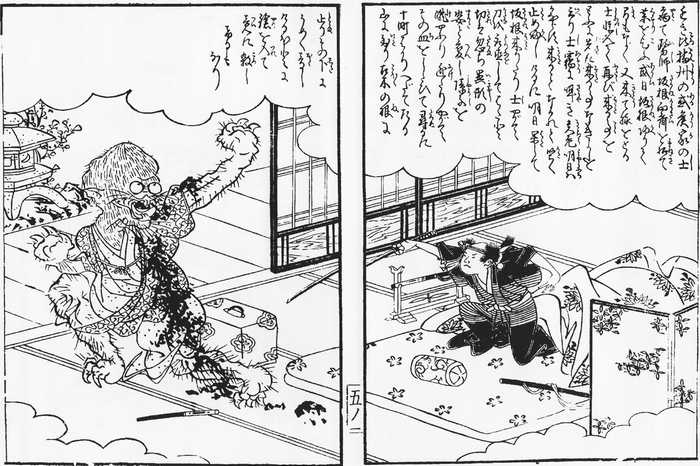
The standard tale of the Kurote is simple yet effective in its horror. An unsuspecting person squats over the toilet in the dead of night. Suddenly, a large, black, hairy hand reaches up from the depths of the pit and strokes their buttocks. Unlike other violent spirits, the Kurote does not usually pull the victim in or kill them immediately; it simply touches them, creating a sensation of profound dread and violation.
The Tale of the Samurai
One famous recounting involves a samurai or a wealthy merchant in the Noto region. His wife complained that every time she went to the outhouse, a hairy hand would stroke her. Skeptical but protective, the husband went to the toilet in her place, armed with his sword. When the hairy hand emerged to caress him, he struck down with his blade, severing the arm.
Upon inspecting the severed limb, he found it was covered in thick, wire-like black hair. In some variations of the story, the hand is revealed to belong to an old badger (tanuki) or fox (kitsune) playing a trick, but in darker versions, it is a manifestation of accumulated impurities and grudges.
Modern Culture: From Horror to Humor
The Pantheon of Toilet Spirits
The Kurote is not alone. Japan has a rich history of toilet ghosts, including Hanako-san (the girl in the third stall) and Aka Manto (the spirit who asks if you want red or blue paper). However, the Kurote represents an older, earthier generation of monsters. While Hanako is a school urban legend, Kurote is a rural, earthy terror.
Pop Culture Representation
Today, the Kurote appears in various manga and anime, often depicted by the legendary artist Shigeru Mizuki in his GeGeGe no Kitaro series. In modern media, the Kurote has transitioned from a source of genuine terror to a character that is grotesque yet slightly humorous—a symbol of the weird and wonderful imagination of Edo-period storytellers.
Traveler’s Tips: Experiencing the Folklore
If you are a folklore enthusiast traveling to Japan, here is how you can connect with the legend of the Black Hand:
- Visit Ishikawa Prefecture: The Noto Peninsula is beautiful, rugged, and steeped in history. Visiting traditional ryokans (inns) or preserved samurai districts can give you a sense of the architectural style where these legends were born.
- Explore Yokai Street: If you visit Kyoto, head to the Yokai Street (Ichijo-dori). While not the birthplace of Kurote, the shops there celebrate all manner of monsters, and you can often find merchandise depicting the famous toilet hand.
- Toilet Etiquette: While you are unlikely to encounter a hairy hand in a modern Japanese smart toilet, the legend serves as a reminder to respect the space. In Japanese temples, the toilet is sometimes guarded by Ususama Myo-o, a deity of purification. It is customary to keep these spaces incredibly clean—perhaps to keep the darker spirits at bay.
Sources & Further Reading
For those interested in diving deeper into the world of Japanese spirits and the animistic roots of these legends, the following texts and collections are essential:
- The Kojiki (Records of Ancient Matters) & Nihon Shoki (The Chronicles of Japan): While the specific legend of Kurote is from a later era, these ancient texts establish the Shinto concepts of impurity (kegare) and purification (harae) that are essential to understanding why toilets are viewed as spiritually charged places.
- Gazu Hyakki Yagyo (The Illustrated Night Parade of One Hundred Demons): Created by Toriyama Sekien in the 18th century, this series of books cataloged many yokai and solidified their visual appearances.
- Yokai Attack! The Japanese Monster Survival Guide: A modern, English-friendly resource by Hiroko Yoda and Matt Alt that details the characteristics of creatures like Kurote.