
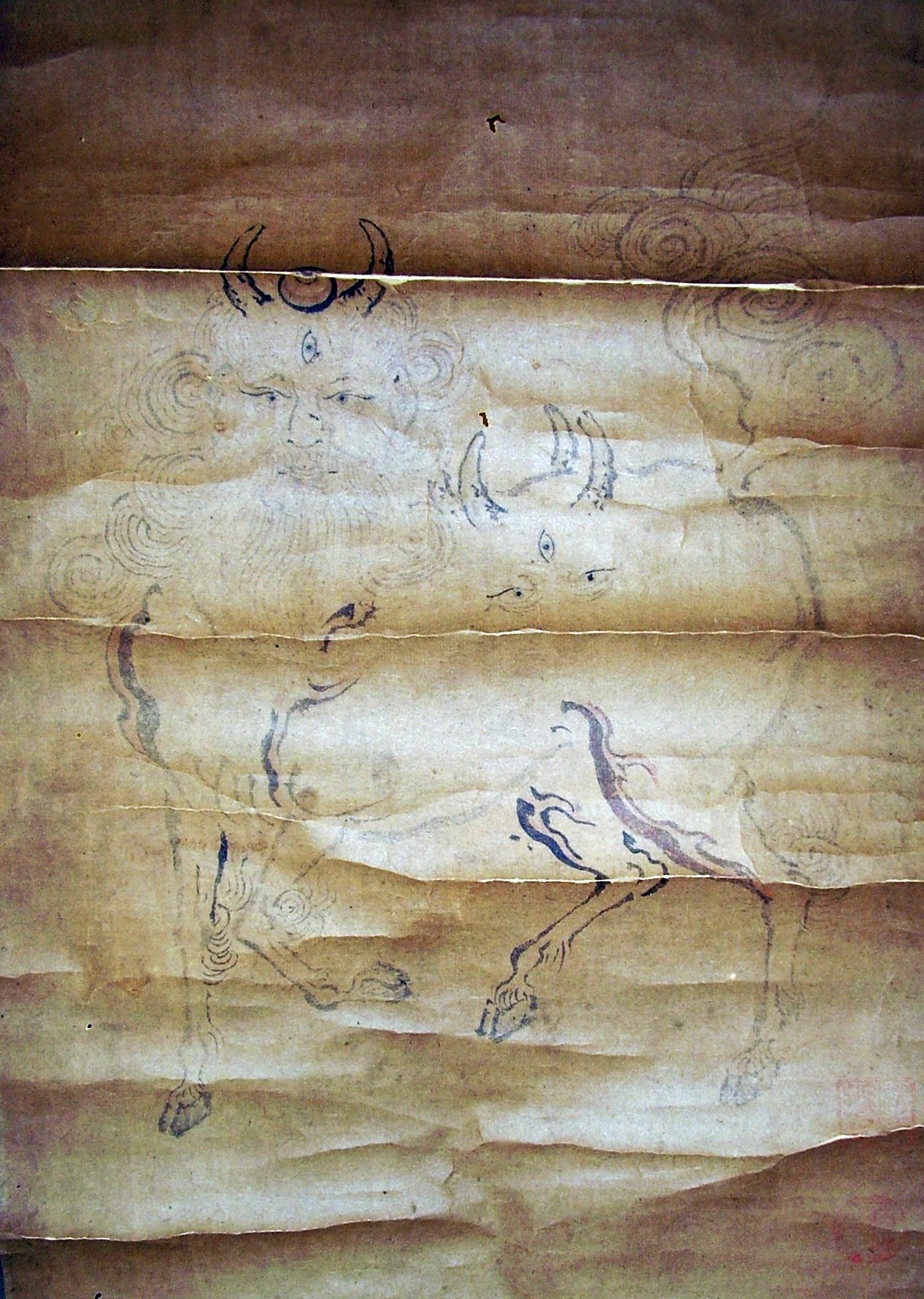
The Hakutaku Painting: Japan’s Mythical Art of Warding Evil
If you wander through the antique shops of Kyoto or browse the historic prints in Tokyo’s Jimbocho district, you might encounter an image that is at once terrifying and strangely comforting. It is a creature with the body of a white ox, the face of a human (often an old man), multiple horns, and eyes scattered across its flank and forehead. This is the Hakutaku (known as Bai Ze in China), and for centuries, the “Painting of Hakutaku” (Hakutaku-no-e) has served as one of Japan’s most powerful talismans against disease and misfortune.
While dragons and phoenixes dominate Asian art, the Hakutaku holds a unique place in cultural history as a guardian of knowledge and a protector of travelers. Here is the story behind this fascinating beast and why its image became a must-have item for historical Japanese wanderers.
Origins: The Beast of Knowledge
The Hakutaku is not native to the Japanese archipelago; its roots dig deep into ancient Chinese mythology. The creature is said to have originated from the legend of the Yellow Emperor (Huang Di). According to lore, the Emperor encountered the beast near the East Sea. Because the Hakutaku was exceptionally wise and could speak human languages, it dictated to the Emperor a comprehensive list of 11,520 different kinds of supernatural creatures, demons, and spirits that plagued the world, along with instructions on how to overcome them.
This knowledge was allegedly compiled into a text called the Bai Ze Tu (The Diagram of the White Marsh). While the original text was lost to history, the concept migrated to Japan. By the time it was assimilated into Japanese folklore, the Hakutaku was no longer just a cataloger of monsters—it had become a holy beast (zuiju) whose very image could repel evil.
The Legend: A Talisman Against Disaster
During the Edo period (1603–1867), travel in Japan was a perilous endeavor, fraught with the dangers of bandits, fatigue, and, most terrifying of all, contagious diseases. It was during this era that the Painting of Hakutaku became an essential travel accessory.
The legend held that the Hakutaku, having omniscience regarding all evil spirits, terrified the monsters themselves. Therefore, evil spirits would flee from the sight of the beast. People believed that hanging a print of the Hakutaku in their home, or carrying a small sketch of it in their luggage, would act as a spiritual shield.
One specific legend solidified this practice. A story circulated about a similar beast predicting a deadly plague and claiming that only those who possessed its image would be spared. Consequently, the demand for woodblock prints depicting the multi-eyed beast skyrocketed. It became a custom to place the picture above a doorway or carry it inside a travel amulet case (mamori-bukuro) to ensure a safe return home.
Modern Culture: From Scrolls to Anime
In contemporary Japan, the Hakutaku has transitioned from a superstitious necessity to a beloved pop-culture icon. While you might not see it hanging in every entryway today, its presence is felt deeply in the subculture of manga and anime.
Fans of the series Hozuki’s Coolheadedness (Hozuki no Reitetsu) will recognize Hakutaku as a major character—depicted as a womanizing traditional Chinese pharmacist who retains his mythical form. The Touhou Project game series also features a character based on this legend (Keine Kamishirasawa), emphasizing the creature’s role as a guardian of history.
Furthermore, during recent global health crises, there was a digital resurgence of Hakutaku art on Japanese social media. Much like the mermaid-like Amabie, the Hakutaku was drawn and shared by thousands of artists as a modern prayer for health and a ward against the pandemic, proving that the old folklore still pulses beneath the surface of modern Japan.
Traveler’s Tips: Seeking the Wise Beast
For the culture-focused traveler, hunting for the Hakutaku offers a unique way to explore Japan’s artistic history. Here is where you can find traces of the beast:
1. Nikko Toshogu Shrine
Visit the famous Yomeimon Gate at Nikko Toshogu Shrine in Tochigi Prefecture. This UNESCO World Heritage site is adorned with intricate carvings. Look closely at the pillars and beams; you will find sculptures of the Hakutaku alongside dragons and lions. It was placed there to protect the spirit of Shogun Tokugawa Ieyasu.
2. The Japan Toy Museum (Hyogo)
Traditional toys and amulets often depict the Hakutaku. Museums dedicated to folk crafts, such as the Japan Toy Museum in Himeji, often display Edo-period clay dolls (tsuchiningyo) shaped like the beast.
3. Antique Markets
If you visit the Oedo Antique Market in Tokyo or the Tenjin-san Market in Kyoto, look through piles of old woodblock prints. You may find an original or reproduction Hakutaku-no-e. They make for incredible, meaningful souvenirs that carry a wish for safety.
Sources & Further Reading
To deepen your understanding of the Hakutaku and the classification of Japanese spirits (yokai), the following texts and museums are recommended:
- The Wakan Sansai Zue (Illustrated Sino-Japanese Encyclopedia): An Edo-period encyclopedia that documents the appearance and nature of the Hakutaku.
- Konjaku Hyakki Shui: Created by Toriyama Sekien in the 18th century, this is one of the definitive visual catalogs of Japanese monsters.
- Nihon Shoki (The Chronicles of Japan): While the Hakutaku is of Chinese origin, reading the Nihon Shoki provides the necessary context for understanding the importation of mainland Asian mythology into the Shinto and Buddhist frameworks of ancient Japan.
The Painting of Hakutaku is more than just ink on paper; it is a testament to humanity’s enduring hope for protection and the belief that knowledge can conquer fear.