
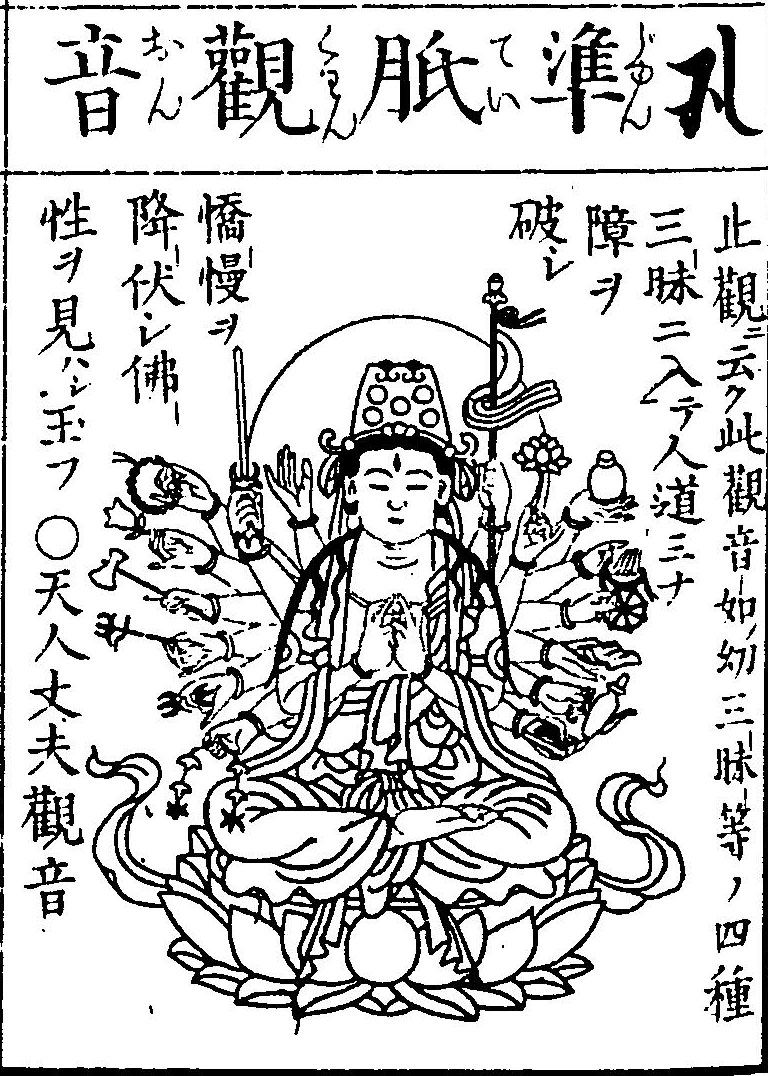
Juntei Kannon: The Mother of Buddhas in Japanese Culture
When exploring the spiritual landscape of Japan, travelers are often overwhelmed by the sheer variety of Buddhist statues. Among the serene faces of the bodhisattvas, one figure stands out for her striking complexity and maternal power: Juntei Kannon. Known in Sanskrit as Cundi, and often revered as the “Mother of Buddhas” (Butsmo), Juntei is a deity of profound compassion, wisdom, and protection.
While the standard Kannon (Avalokitesvara) is typically depicted with two arms and a gentle demeanor, Juntei Kannon commands attention with eighteen arms and a third eye. For culture enthusiasts and spiritual seekers visiting Japan, understanding Juntei offers a deeper glimpse into the esoteric traditions that have shaped Japanese history for over a millennium.
Origins: From India to the Japanese Archipelago
Juntei Kannon’s journey began in India, where she was worshipped as a manifestation of the solar deity or a form of Shakti before being integrated into Mahayana Buddhism. Her Sanskrit name, Cundi, translates roughly to “Extreme Purity.”
She arrived in Japan via China during the Nara and Heian periods, carried by the waves of Esoteric Buddhism (Mikkyo). Unlike other forms of Kannon who are strictly Bodhisattvas (beings who delay nirvana to save others), Juntei occupies a unique theological position. In the Shingon school of Japanese Buddhism, she is often venerated as a Buddha rather than a Bodhisattva, earning her the title Juntei Butsmo or “Cundi, Mother of the Buddhas.”
This distinction is significant. It suggests that her purity is so absolute that she is the source from which enlightenment itself is born.
Legend and Symbolism
To the untrained eye, Juntei Kannon might look similar to the Thousand-Armed Kannon (Senju Kannon), but her iconography is distinct and laden with specific meaning.
The Third Eye and Eighteen Arms
Juntei is almost always depicted with three eyes and eighteen arms.
- The Three Eyes: represent her ability to see the past, present, and future simultaneously, as well as her perception of the three realms of existence (form, formlessness, and desire).
- The Eighteen Arms: These represent the eighteen distinct characteristics of a Buddha (known as aveņika-dharma). Each hand holds a specific ritual implement, including a sword to cut through ignorance, a lasso to catch wayward souls, a lotus flower representing purity, and a sutra scroll representing wisdom.
Savior of the Human Realm
In Japanese Buddhist cosmology, sentient beings cycle through the “Six Realms of Existence” (Rokudo), which include Hell, Hungry Ghosts, Animals, Asuras, Humans, and Devas. The “Six Kannon” are a grouping of deities where each specific form of Kannon is assigned to save beings in one of these realms.
In the Shingon tradition, Juntei Kannon is the savior of the Human Realm. This makes her particularly approachable for us. She understands the specific struggles of the human condition—illness, relationship strife, and the difficulty of maintaining faith amidst daily distractions.
Modern Culture: Worship and Benefits
Today, Juntei Kannon is not just a relic of the past; she is an active figure in modern Japanese worship. She is widely prayed to for specific worldly benefits (genze riyaku).
- Fertility and Safe Childbirth: As the “Mother of Buddhas,” she is a primary deity for couples hoping to conceive or for women praying for a safe delivery.
- Disaster Prevention: Her many arms holding weapons symbolize her ability to ward off calamities and bad luck.
- Success and Wisdom: Students and professionals often pray to her for clarity of mind and success in their endeavors, invoking her wisdom to cut through confusion.
Traveler’s Tips: Where to Find Juntei Kannon
If you are planning a cultural pilgrimage to Japan, seeking out Juntei Kannon can lead you to some of the country’s most atmospheric temples.
Daigo-ji Temple (Kyoto)
The most famous site for Juntei worship is Daigo-ji, a World Heritage site in southeastern Kyoto. Daigo-ji is the 11th stop on the famous Saigoku Kannon Pilgrimage (a route visiting 33 temples in the Kansai region). The temple complex is massive, spanning an entire mountainside. While the original Juntei Hall was tragically lost to fire in recent years and is undergoing reconstruction, the deity remains the spiritual heart of this sacred mountain.
Identification Tips
When visiting temples, look for a statue with many arms. To distinguish Juntei from the Thousand-Armed Kannon:
- Count the arms (if visible); Juntei usually has exactly 18.
- Look for the mudra (hand gesture). Her primary hands often form the Root Mudra, where the fingers are interlaced with index fingers pointing up.
Etiquette
When approaching the altar, bow once. Toss a coin into the saisen-bako (offering box), ring the gong (if permitted), bow twice, clap twice, pray silently, and bow once more. Chanting her short mantra, “Om Cale Cule Cundi Svaha,” is considered highly auspicious.
Sources & Further Reading
For those wishing to dive deeper into the theology and history of Juntei Kannon, the following texts and concepts are recommended:
- The Cundi Dharani Sutra: The primary esoteric text detailing the mantra and rituals associated with Juntei.
- The Lotus Sutra (Hokkekyo): While this text focuses on Avalokitesvara (Kannon) generally, it provides the foundation for understanding Kannon’s role as a savior in Mahayana Buddhism.
- Japanese Esoteric Buddhism: Look into the distinction between the Shingon (True Word) and Tendai schools to understand how the “Six Kannon” groupings differ.
Juntei Kannon reminds us that within the human experience, there is the potential for profound wisdom. Whether you are a spiritual pilgrim or a lover of art history, standing before her eighteen-armed form is a powerful moment of connection with Japan’s religious soul.