
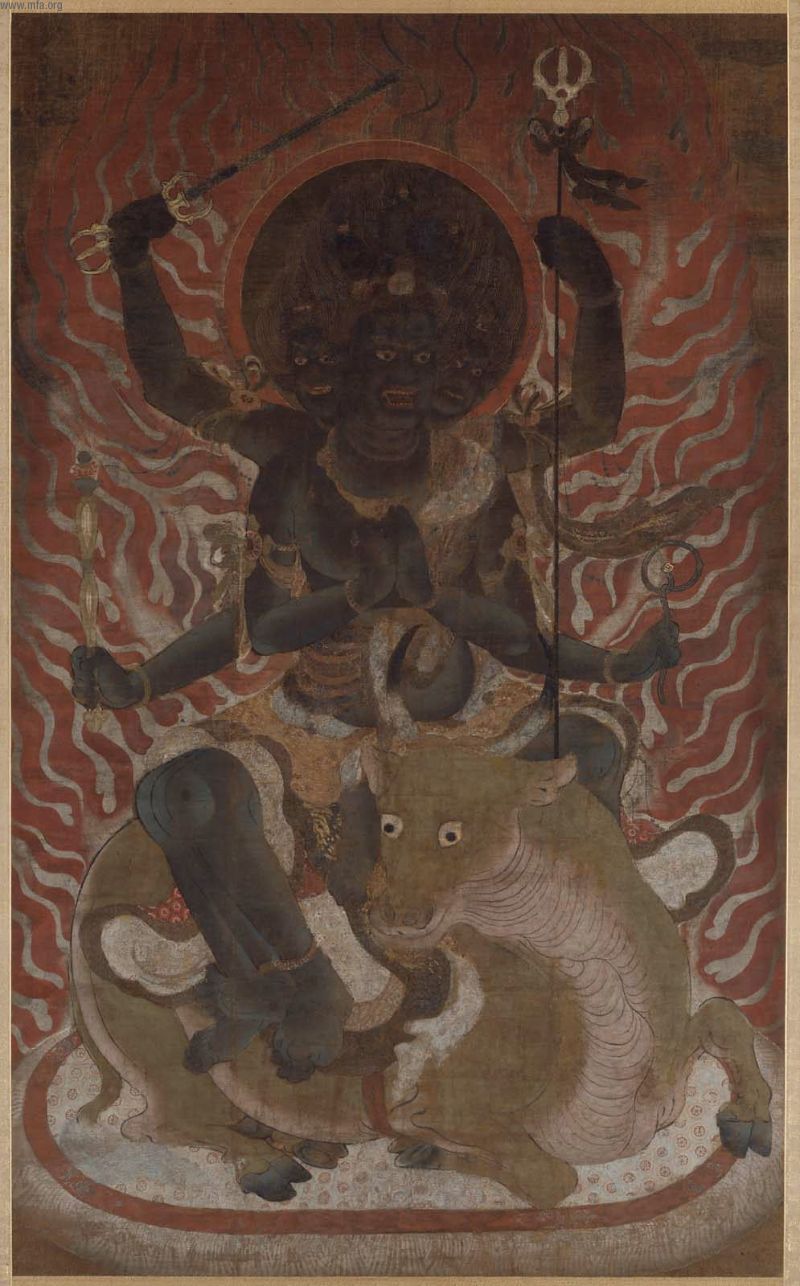
Daiitoku Myoo: The Six-Legged Guardian of the West
When exploring the dimly lit halls of Japan’s ancient esoteric temples, travelers often find themselves face-to-face with statues that look more like nightmares than deities. Flames engulf them, fangs protrude from their mouths, and they brandish ancient weapons. These are the Myoo, or Wisdom Kings, and among the most distinct of them is Daiitoku Myoo. Known in Sanskrit as Yamantaka, the “Destroyer of Death,” this six-legged guardian offers a fascinating glimpse into the intensity of Japanese Buddhism.
Introduction
In the pantheon of Japanese Buddhism, specifically within the Shingon and Tendai sects, the Buddhas are the calm embodiment of enlightenment, while the Wisdom Kings act as their wrathful enforcers. They are the fierce protectors who frighten non-believers into faith and destroy the obstacles preventing enlightenment.
Daiitoku Myoo (大威徳明王) is one of the Godai Myoo (Five Great Wisdom Kings). He presides over the West, protecting that cardinal direction. While his peers are terrifying, Daiitoku stands out visually for a very specific reason: he is almost always depicted riding a water buffalo and possessing six legs. For the cultural traveler, understanding the symbolism behind this fearsome deity unlocks a deeper appreciation of the statues found in Kyoto and Nara.
Origins: From India to Japan
The lineage of Daiitoku Myoo traces back to Hinduism and Indian Buddhism before arriving in Japan via China during the Heian period (794–1185). His Sanskrit name, Yamantaka, translates to “The Destroyer of Yama.” In Hindu mythology, Yama is the Lord of Death. Therefore, Daiitoku is the force that conquers death itself.
In the transition to Japanese Esoteric Buddhism, Daiitoku became identified as the wrathful manifestation of Amida Nyorai (Amitabha), the Buddha of Infinite Light who rules the Western Paradise. This connection explains why Daiitoku is the guardian of the West. He represents the power of wisdom to overcome the cycle of reincarnation and the fear of death, transforming the terrifying energy of mortality into spiritual liberation.
Legend and Iconography
The legend of Daiitoku Myoo is best told through his complex iconography. Unlike human figures, his form is a dense map of theological concepts.
The Conqueror of the Buffalo
According to legend, the buffalo represents the demon of death or the obstacles of the ego. By riding atop the buffalo, Daiitoku demonstrates his absolute dominion over these forces. The buffalo is often depicted kneeling or submitting, symbolizing the taming of base desires.
The Mystery of the Six Legs
Daiitoku is often referred to as Rokuso-son (The Six-Legged Venerated One). In Buddhist art, humanoid figures almost never have more than two legs, making him unique. These six legs represent the Six Paramitas (Perfections) required to attain Buddhahood:
- Charity (Dana)
- Morality (Sila)
- Patience (Ksanti)
- Effort (Virya)
- Meditation (Dhyana)
- Wisdom (Prajna)
Furthermore, the six legs symbolize his ability to travel through the “Six Realms of Existence” (Rokudo)—from the hells to the heavens—to save sentient beings. He has six faces to watch over these six realms and six arms holding weapons to shatter ignorance.
Modern Culture
While Daiitoku Myoo is an ancient deity, his image persists in Japanese pop culture, particularly where supernatural themes are concerned. The dramatic visual of a multi-limbed warrior riding a buffalo appeals to modern character designers.
He appears in the popular Shin Megami Tensei and Persona video game series (often under his Sanskrit name Yamantaka), where he is depicted as a high-level demon or persona with powerful physical and curse abilities. This modern representation keeps the name alive among younger generations, though the strict theological meaning is often simplified for entertainment. In tattoo culture (Irezumi), the image of Daiitoku is a symbol of protection against illness and bad luck, chosen by those seeking a guardian who has conquered death.
Traveler’s Tips: Where to See Him
If you are planning a cultural pilgrimage to Japan, Daiitoku Myoo is not found in every neighborhood shrine. You must seek out specific temples associated with Esoteric Buddhism.
Toji Temple (Kyoto)
This is the most essential stop. Toji Temple contains the famous Lecture Hall (Kodo), which houses a 3D mandala of 21 statues arranged by Kobo Daishi (Kukai) in the 9th century. Here, Daiitoku Myoo sits in the northwest corner of the Wisdom King grouping. It is one of the oldest and most magnificent representations of him in Japan, designated a National Treasure.
Daigo-ji Temple (Kyoto)
Another stronghold of the Shingon sect, Daigo-ji has featured imagery of the Five Great Wisdom Kings for centuries. The temple complex is massive, so check beforehand which halls are open to the public during your visit.
Tofuku-ji Temple (Kyoto)
While famous for autumn leaves, look for sub-temples that may house scroll paintings or smaller statues of the Wisdom Kings.
Etiquette Note: When visiting these statues, remember that photography is almost strictly prohibited inside the temple halls to preserve the sanctity and the condition of the ancient wood and lacquer. Buy a postcard at the gift shop instead.
Sources & Further Reading
To deepen your understanding of Daiitoku Myoo and the context of Japanese deities, the following texts and resources are recommended:
- The Vairocanabhisambodhi Sutra (Dainichi-kyo): The foundational text for Shingon Buddhism, detailing the role of the Wisdom Kings.
- Nihon Shoki (Chronicles of Japan): While Daiitoku is a Buddhist import and not a native Kami found in the Kojiki or Nihon Shoki, reading these texts provides the necessary contrast to understand how Buddhism merged with indigenous beliefs (Shinbutsu-shugo) to form the religious landscape of Japan.
- Japanese Mandalas: Representations of Sacred Geography by Elizabeth ten Grotenhuis.
- Handbook on the Four Stages of Prayoga: For those interested in the specific rituals involving the Wisdom Kings in the Tendai tradition.