
Okuribi: The Fiery Farewell to Ancestral Spirits
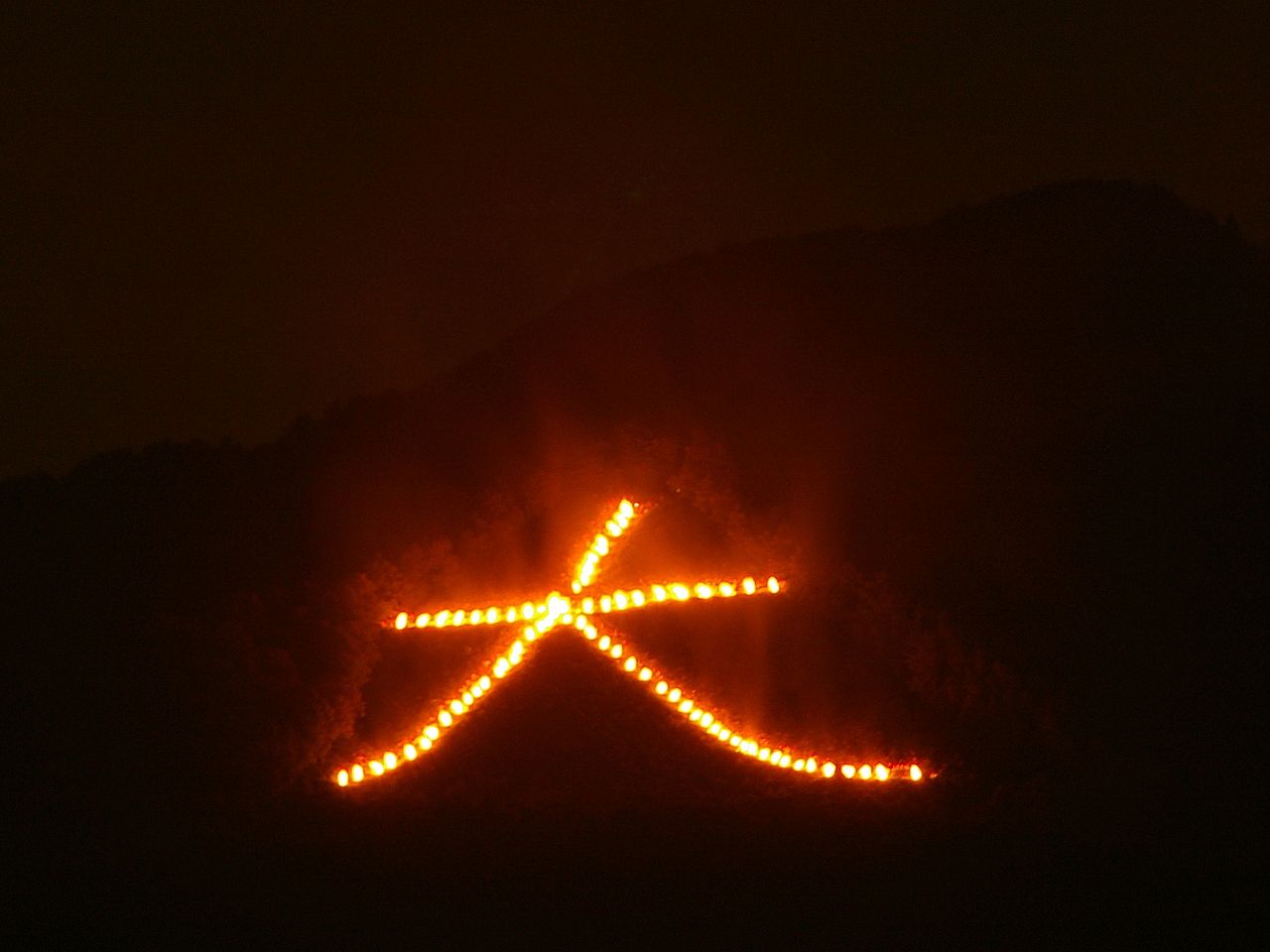
In the humid heat of a Japanese August, silence falls over the bustling city of Kyoto. All eyes turn toward the dark silhouettes of the surrounding mountains. Suddenly, a spark ignites, and within moments, a massive Chinese character constructed of fire blazes against the night sky. This is Okuribi (sending-off fire), one of Japan’s most profound and visually stunning cultural events.
While small okuribi fires are lit by families across Japan at their doorsteps to conclude the Obon festival, the most spectacular iteration is the Gozan no Okuribi (Five Mountain Send-off Fire) in Kyoto. It is a ritual not of fireworks or mere celebration, but of deep spiritual longing and gratitude, serving as a lighthouse to guide the souls of ancestors back to the spirit world.
Origins: The Bridge Between Worlds
The Okuribi tradition is intrinsically linked to Obon, a Buddhist event honoring the spirits of one’s ancestors. In Japanese belief, the boundary between the living and the dead thins during mid-August. Spirits return to visit their living relatives, an arrival marked by Mukaebi (welcoming fires).
Okuribi represents the conclusion of this visit. Held typically on the evening of August 16th, these fires serve a dual purpose: they illuminate the path for the spirits so they do not stumble on their return journey to the afterlife, and they purify the lingering spiritual energy.
The specific origins of the Kyoto mountain fires are shrouded in history, with conflicting records suggesting they began anywhere from the Heian period (794–1185) to the Edo period (1603–1867). While the exact starting date is debated, the practice is deeply rooted in the syncretic nature of Japanese religion, blending Buddhist eschatology with ancient Shinto reverence for mountains as sacred realms.
Legend and Lore
The shapes burned into the mountainsides are not random; they are steeped in legend. The most famous character, Dai (大), meaning “Big” or “Great,” appears on Mt. Nyoigatake. Local folklore often attributes the calligraphy for this fire to Kobo Daishi (Kukai), the founder of Shingon Buddhism, who is a legendary figure in Japanese history. It is said that he etched the character into the mountain to protect the city from plagues and evil spirits.
Another fire takes the shape of a boat (Funagata). Legend suggests this represents the vehicle used to ferry souls across the Sanzu River (the Buddhist equivalent of the River Styx). Alternatively, it links to the story of the monk Ennin, who was saved by a divine ship during a storm on his return from China.
These legends transform the fires from simple bonfires into glowing talismans, protecting the city below while honoring the souls above.
Modern Culture: The Five Mountains of Kyoto
Today, the Gozan no Okuribi is a focal point of Kyoto’s summer calendar. The atmosphere in the city is unique—a mix of festival cheer and solemn reverence. Starting at 8:00 PM, the fires are lit sequentially, typically in the following order:
- Daimonji (大): The large character on Mt. Nyoigatake.
- Myo-Ho (妙法): Two characters meaning “Wondrous Dharma” (Buddhist law).
- Funagata (舟形): The shape of a boat.
- Hidari Daimonji (左大文字): A second “Dai” character on the western mountain.
- Toriigata (鳥居形): The shape of a shrine gate (Torii).
Each fire burns for approximately 30 minutes. During this time, streetlights in parts of the city are dimmed, and locals gather on rooftops and riverbanks to press their hands together in prayer. It is a fleeting moment of unity where the modern metropolis reconnects with its ancient spiritual heart.
Traveler’s Tips for Viewing Okuribi
Experiencing Okuribi is a highlight for any traveler, but it requires planning.
- Location is Key: The most popular viewing spots are along the banks of the Kamo River (Kamogawa). specifically near the Demachiyanagi area, where the delta offers views of the main Daimonji. However, arrive early (before sunset) as these spots fill up hours in advance.
- Go High: Many hotels in downtown Kyoto offer rooftop viewing parties. These usually require reservations months in advance but offer a comfortable, unobstructed view.
- Etiquette: While there is a festive atmosphere with food stalls (yatai), remember that this is a religious ceremony. Keep noise levels respectful when the fires are lit.
- The Floating Lanterns: After viewing the mountain fires, head to Arashiyama for the Toro Nagashi, where thousands of paper lanterns are floated down the river, creating a mirror image of the fire in the water.
Sources & Further Reading
To understand the depth of ancestor worship and fire rituals in Japan, the following texts and historical records provide essential context:
- The Nihon Shoki (Chronicles of Japan): While predating the specific Okuribi festival, this classical text establishes the foundational Shinto concepts of the spirit world and the sanctity of mountains.
- The Kojiki (Records of Ancient Matters): Offers insight into the early Japanese mythology regarding the land of the dead (Yomi), which influences the Obon customs.
- The Urabon Sutra: The Buddhist text that forms the basis of the Obon festival, detailing the story of Mokuren saving his mother from the realm of hungry ghosts.