
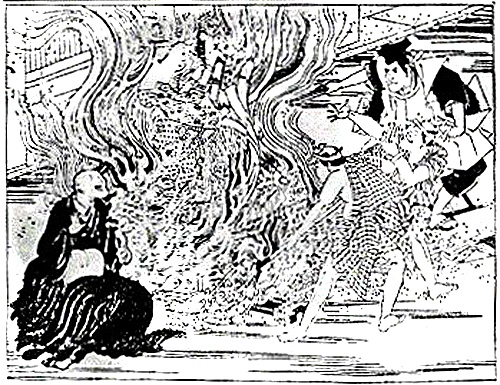
Haibutsu-kishaku: The Storm That Shook Japanese Buddhism
When travelers visit Japan today, they often marvel at the harmonious existence of Shinto shrines and Buddhist temples, sometimes located right next to one another. However, lurking beneath this peaceful facade is a scar from a relatively recent history—a violent upheaval known as Haibutsu-kishaku.
Literally translating to “abolish Buddhism and destroy Shakyamuni,” this movement during the late 19th century fundamentally altered the spiritual landscape of Japan. To understand the Japanese culture of today, one must look back at this chaotic period where centuries-old statues were beheaded and temples were reduced to ash in the name of modernization and imperial restoration.
Origins: The Meiji Restoration and Shinto Purification
For over a millennium prior to 1868, Japan practiced Shinbutsu-shugo, a syncretism where Shinto kami (gods) and Buddhist deities were worshipped together. Temples often managed shrines, and the boundaries between the two religions were fluid and indistinct.
Everything changed with the Meiji Restoration of 1868. As the Shogunate fell and power was restored to the Emperor, the new government sought to unify the nation under State Shinto, which emphasized the divinity of the Emperor. To elevate Shinto, the government issued the Shinbutsu Bunri (Separation of Kami and Buddhas) decrees.
While the government officially only intended to separate the institutions, the policy triggered a wave of pent-up anti-Buddhist sentiment. Local officials and Shinto priests, long subordinate to powerful Buddhist institutions, interpreted this as a license to purge. What began as a bureaucratic separation spiraled into Haibutsu-kishaku—a nationwide movement to eradicate Buddhism entirely.
The Legend of Lost Heritage: Tales of Destruction
While Haibutsu-kishaku is a historical event rather than a myth, the stories from this era possess a legendary, almost surreal quality regarding the scale of cultural loss.
One of the most famous anecdotes concerns the majestic Kofukuji Temple in Nara. Once a powerhouse of political and religious influence, it was stripped of its status almost overnight. The fervor was so intense that the monks were forced to become Shinto priests, and the temple walls were torn down.
History tells us that Kofukuji’s iconic Five-Story Pagoda—now a national treasure—was put up for sale for a mere 25 yen (the price of scrap wood at the time). The buyer intended to burn the pagoda to the ground simply to retrieve the metal fixtures from the ruins. The only reason the pagoda stands today is not because of religious preservation, but because residents in the surrounding neighborhood protested, fearing the massive fire would burn down their own wooden homes.
Across the country, thousands of statues were melted for bronze, ancient scriptures were used as toilet paper, and temple lands were confiscated. In the Satsuma domain (modern-day Kagoshima), the destruction was nearly absolute; for a brief period, not a single Buddhist temple remained standing in the entire region.
Modern Culture: A Divided Landscape
The scars of Haibutsu-kishaku are still visible in modern Japanese culture, primarily in the strict architectural division we see today. Before 1868, it was common to see a Torii gate at the entrance of a Buddhist temple. Today, this is rare.
This movement created the distinct “dual religion” approach of modern Japan, where people are said to be “born Shinto and die Buddhist.” Weddings and celebrations often follow Shinto rituals (celebrating life), while funerals follow Buddhist traditions (dealing with the afterlife). This compartmentalization is a direct result of the Meiji-era forced separation.
Furthermore, art historians note that many “Shinto” treasures currently housed in museums were actually Buddhist artifacts rescued from shrines during the purge. The movement ironically led to a greater appreciation of Buddhist art by Western collectors, who bought up displaced masterpieces that were being discarded as trash.
Traveler’s Tips: Tracing the History
For the history-savvy traveler, evidence of Haibutsu-kishaku adds a layer of depth to sightseeing:
- Visit Nara Park: Walk around Kofukuji and imagine the missing walls and sub-temples. The open grassy areas in Nara Park were once densely packed temple grounds confiscated by the government.
- Explore Togakushi Shrine: Located in Nagano, this was formerly a massive mountain Buddhism complex. You can see the architectural transition where Buddhist structures were repurposed into Shinto style.
- Spot the Scars: In older rural areas, look closely at roadside Jizo statues. You may occasionally find stone statues with cemented necks—evidence of where they were beheaded during the Meiji era and later repaired by locals.
- Tanzan Shrine (Nara): Formerly a temple called Tonomine, this is a prime example of a site that was forced to convert entirely to a Shinto shrine to survive destruction.
Sources & Further Reading
To deepen your understanding of the religious evolution in Japan, consider exploring the following:
- The Nihon Shoki (Chronicles of Japan): For context on the early introduction of Buddhism and its initial conflicts with native kami worship.
- The Meiji Restoration Archives: Specifically the Shinbutsu Bunri decrees of 1868.
- Ketelaar, James Edward: Of Heretics and Martyrs in Meiji Japan (Princeton University Press). This text provides a comprehensive academic look at the persecution of Buddhism.
- Grapard, Allan G.: The Protocol of the Gods, which discusses the specific history of the Kasuga-Kofukuji complex.