
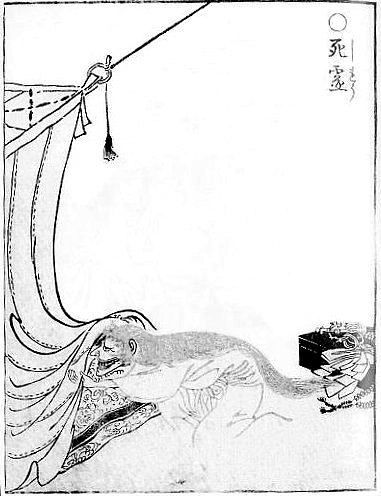
Shiryo: Unveiling the Spirits of the Dead in Japanese Folklore
In the humid heat of a Japanese summer, a chill often runs down the spine of those listening to kaidan (ghost stories). At the heart of these tales lies the concept of Shiryo (死霊), or “dead spirits.” Unlike the playful monsters known as yokai, Shiryo are the manifestations of human souls after death. They are a profound element of Japanese cultural psychology, representing the thin veil between the living and the dead, a boundary defined by ritual, memory, and occasionally, vengeance.
The Origins: Between This World and the Next
To understand Shiryo, one must look at the syncretic blend of Shinto and Buddhism that shapes the Japanese view of the afterlife. In ancient Japanese belief, a human spirit creates a Reikon (soul). upon death, this soul is in a volatile state. It does not immediately pass to the “Pure Land” or the Shinto realm of ancestors.
The Transformation of the Soul
According to tradition, if proper funeral rites are performed and the family pays adequate respect, the Shiryo eventually purifies and becomes a Sorei (ancestor spirit), acting as a guardian for the family. These benevolent spirits return during the Obon festival to be welcomed by the living.
However, if a person dies in a state of extreme rage, sorrow, or jealousy—or if they are not given a proper burial—their Shiryo cannot pass on. They remain tethered to the physical world, often becoming Onryo (vengeful spirits) intent on inflicting harm upon those who wronged them, or sometimes, upon anyone unfortunate enough to cross their path. This duality—the potential to be a god-like guardian or a malevolent ghost—is the core of the Shiryo concept.
Legend: Tales from the Shadows
Japanese folklore is replete with accounts of Shiryo interacting with the living. Unlike Western ghosts that often haunt a specific location, Japanese Shiryo are often attached to people or lineages.
One of the most defining characteristics of the malevolent Shiryo is its appearance. Historically depicted in Yurei-zu (ghost paintings) from the Edo period, they often appear in white burial kimonos (kyokatabira), with long, disheveled black hair and no feet, floating just above the ground.
The Tale of Oiwa
Perhaps the most famous Shiryo legend is that of Oiwa from the story Yotsuya Kaidan. Betrayed, poisoned, and disfigured by her ambitious husband Iemon, she dies in agony. However, her spirit does not rest. As a Shiryo, she returns to torment Iemon, driving him to madness and ruining his life. This story highlights the terrifying power of a Shiryo fueled by a grudge (urami). It serves as a cultural warning: the dead hold power over the living, and moral transgressions have supernatural consequences.
Modern Culture: From Scrolls to Screens
The concept of Shiryo has seamlessly transitioned from ancient scrolls and Kabuki theater to modern pop culture. The explosion of “J-Horror” in the late 1990s and early 2000s brought the aesthetic of the Japanese dead spirit to a global audience.
Movies like The Ring (Ringu) and The Grudge (Ju-On) feature antagonists that are classic definitions of Shiryo. Sadako and Kayako are spirits who died in trauma and rage, spreading a curse like a virus. In anime and manga, such as Bleach or Noragami, the classification of spirits often draws directly from the traditional distinctions between benign nature spirits and the dangerous, unpassed souls of humans.
Even today, the fear is real. In modern Tokyo, there are still shrines dedicated to pacifying specific ancient Shiryo, such as the grave of Taira no Masakado, which construction workers are famously afraid to disturb for fear of spiritual retribution.
Traveler’s Tips: Experiencing the Spiritual Side
For travelers fascinated by the supernatural or cultural anthropology, Japan offers unique ways to engage with the concept of Shiryo without seeking out danger.
- Visit During Obon: Held in mid-August (or July in some regions), this is the festival of the dead. It is not a Halloween-style scare fest, but a beautiful, somber family reunion where Shiryo are welcomed home with fires and danced back to the other world with the Bon Odori.
- Mount Koya (Koyasan): Stay at a temple lodging (shukubo) near Okunoin, Japan’s largest cemetery. Walking through thousands of moss-covered stupas in the mist is an atmospheric way to respect the spirits.
- Etiquette is Key: If you visit grave sites or “power spots,” always show respect. Do not take photos of specific strangers’ names on gravestones. Bow slightly when entering and leaving temple grounds. The Japanese believe that respect is the best armor against a malevolent attachment.
Sources & Further Reading
For those wishing to delve deeper into the historical and mythological roots of Japanese spirits, the following texts are essential:
- The Kojiki (Records of Ancient Matters): Contains the earliest accounts of Yomi (the land of the dead).
- The Nihon Shoki (Chronicles of Japan): Offers historical context on early funeral rites and emperor worship.
- Kwaidan: Stories and Studies of Strange Things by Lafcadio Hearn: A classic collection that introduced Japanese ghost stories to the West.
- Japanese Ghost Stories by Catrien Ross: A contemporary look at the supernatural landscape of Japan.