
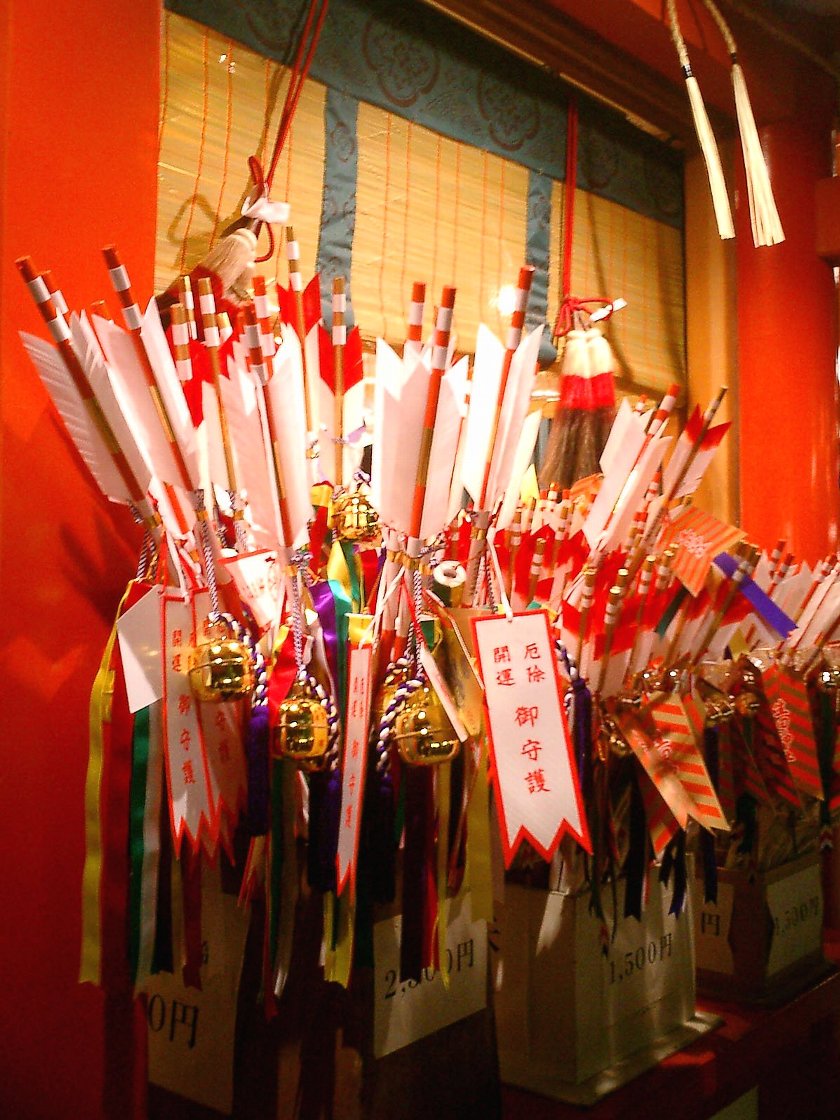
Hamaya: The Spiritual Power of Japan’s Evil-Banishing Arrow
If you visit a Japanese shrine during the first few days of January, you will witness a sea of visitors engaging in Hatsumode, the first shrine visit of the year. Amidst the crowd, you will likely spot people carrying long, wooden arrows decorated with white feathers, bells, and sometimes Ema (votive tablets). These are Hamaya (破魔矢), traditionally known as “Evil-Banishing Arrows.”
Far more than a simple souvenir, the Hamaya is a potent talisman deeply rooted in Japanese folklore and Shinto tradition. It serves as a spiritual tool to cleanse one’s surroundings of negativity and invite good fortune for the year ahead.
The Origins: From Targets to Talismans
The history of the Hamaya is a fascinating evolution of linguistics and ritual. The term originally stems from an ancient archery contest known as Jarai, which was customarily held during the New Year. In these contests, the targets were called Hama.
Over time, the word Hama (target) became conflated with a different set of Kanji characters reading Hama (breaking demons/evil). Thus, the arrow used to shoot the target became the arrow that destroys evil.
During the Edo period, it became a custom to gift a set consisting of a bow and arrow, known as Hamayumi, to families with male children to ensure their healthy growth and protection. As time passed, the bow was largely dropped from the commercial tradition, leaving the symbolic arrow—the Hamaya—as a lucky charm available to everyone, regardless of gender or age.
The Legend and Spiritual Significance
Why an arrow? In Japanese mythology and Shinto practice, the bow and arrow have always held a purifying role. It is not necessarily about the violence of a weapon, but the clarity of the flight and the sound of the string.
There is a ritual known as Meigen (twanging the bowstring), where a priest pulls the string of a bow to create a sharp, resonating sound. In folklore, this sound is believed to startle and scare away evil spirits and ghosts lurking in the shadows. The Hamaya acts as a physical representation of this power.
According to legend, the arrow does not just “kill” demons in a physical sense; it pierces through obstacles and misfortune. It creates a path of light through the darkness, allowing positive energy (ki) to flow into the home. It represents the power to break through the stagnation of the previous year.
Hamaya in Modern Culture
Today, the Hamaya is one of the most popular items purchased during New Year celebrations alongside Omamori (amulets). While they are traditionally associated with Shinto shrines, many Buddhist temples also offer them.
How is it used?
Modern Japanese families utilize Hamaya for three primary reasons:
- Home Protection: To ward off bad luck and thieves.
- Healthy Growth: Continuing the Edo tradition, they are bought for children.
- Business Success: To “hit the target” of revenue goals.
Placement
The arrow is typically displayed in the home Kamidana (Shinto altar). If a household does not have an altar, the arrow is placed in a high, clean location, such as on top of a bookshelf. Crucially, the tip of the arrow should not point directly at a person or the entrance where guests walk in aggressively. Instead, it is often oriented to point toward the year’s “Lucky Direction” (Eho), which changes annually according to the zodiac, or simply toward the South or East to welcome the morning sun.
Traveler’s Tips: Buying and Handling Hamaya
For travelers visiting Japan, a Hamaya makes for a beautiful and culturally significant memento. However, there are rules of etiquette to follow to respect the culture.
- Where to Buy: You can find them at major shrines (like Meiji Jingu in Tokyo or Fushimi Inari in Kyoto) specifically during the New Year season (January 1st to mid-January). Some shrines sell them year-round, but they are most abundant in winter.
- Handling: Treat the Hamaya with respect. It is a religious object, not a toy. Do not mimic shooting it at your friends. When carrying it home, try to keep it elevated and protected.
- The One-Year Rule: Traditionally, the power of a Hamaya is believed to last for one year. Locals return their old arrows to the shrine the following New Year to be ritually burned in a fire festival known as Dondoyaki. As a tourist, if you cannot return it, you can keep it as a respectful keepsake, but keep it in a clean, high place.
Sources & Further Reading
To understand the deep spiritual connection between archery and purity in Japan, the following texts and concepts are recommended:
- The Nihon Shoki (Chronicles of Japan): Contains early references to archery rituals and the divine significance of the bow in establishing order.
- Yabusame Rituals: Research the Tsurugaoka Hachimangu Shrine archives regarding horseback archery as a method of entertaining and appeasing the gods.
- The Kojiki: Japan’s oldest historical record, which details the weaponry of the gods, establishing the bow as a symbol of authority and protection.