
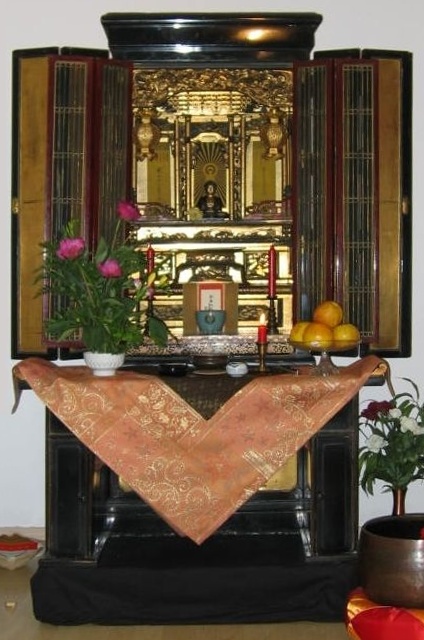
Butsudan: The Spiritual Heart of Japanese Homes
When entering a traditional Japanese home, particularly in the countryside, you may notice a distinct, fragrant scent of sandalwood incense lingering in the air. Follow the scent to the main tatami room, and you will likely find an ornate, cabinet-like shrine glowing with gold leaf and lacquer. This is the Butsudan (仏壇), a Buddhist family altar that serves as the spiritual center of the household.
More than just a piece of religious furniture, the Butsudan is a portal between the living and the dead, a space where gratitude is expressed, and a testament to the deep-rooted importance of ancestry in Japanese culture.
Origins of the Home Temple
The history of the Butsudan is inextricably linked to the arrival of Buddhism in Japan and the intertwining of religious decree with daily life. While Buddhism entered Japan in the 6th century, the widespread practice of keeping an altar at home began slightly later.
Historical records trace the official encouragement of home altars to Emperor Tenmu. In 685 AD, he issued an edict commanding that “in every house, a Buddhist altar should be established, and an image of Buddha and sutras be placed there for worship.” This decree was initially followed only by the aristocracy and the wealthy.
However, it was during the Edo Period (1603–1867) that the Butsudan became a household staple for commoners. This was largely due to the Danka system, a mandatory registration system requiring families to affiliate with a local Buddhist temple to prove they were not Christians (a religion banned at the time). The Butsudan became the physical evidence of a family’s Buddhist standing and a dedicated space for the veneration of ancestors.
Legend and Cosmology: A World Within a Box
While the Butsudan is a physical object, its design is steeped in religious legend and cosmological symbolism. It is not merely a shelf; it is constructed to represent a specific spiritual geography.
The Representation of Mount Sumeru
In Buddhist cosmology, Mount Sumeru is considered the center of the universe, a sacred peak surrounded by oceans and continents. The stepped architecture inside a formal Butsudan is designed to mimic this mountain. The central platform, usually the highest point inside the cabinet, houses the Gohonzon (the main object of worship, such as a statue of the Buddha or a scroll).
The Pure Land
For sects like Jodo Shinshu, the gilded, golden interior of the Butsudan represents the Pure Land (Sukhavati) or the Western Paradise of Amida Buddha. When the cabinet doors are opened, the brilliant gold leaf is meant to evoke the radiant light of enlightenment and the beauty of the world that awaits the faithful after death. It is said that by praying before the Butsudan, one is looking directly into the Pure Land, bridging the gap between the suffering of the physical world and the peace of the spiritual realm.
Modern Culture: The Changing Face of Worship
In modern Japan, the role and appearance of the Butsudan are evolving. Traditionally, the altar is the site of daily rituals. Every morning, family members offer fresh water, cooked rice, and incense to the ancestors and the Buddha. It is the place where family news—marriages, births, and exam results—is reported to the deceased spirits.
However, rapid urbanization and shrinking living spaces in cities like Tokyo and Osaka have impacted this tradition. Large, ornate, black-lacquer altars are often too big for modern apartments. Consequently, the industry has seen a rise in “Modern Butsudan”.
These contemporary altars are compact, stylish, and designed to blend with modern interior decor. Made of light woods like maple or walnut and often lacking the traditional heavy gold leaf, they resemble sleek display cabinets. Despite the aesthetic shift, the function remains the same: keeping the memory of the ancestors alive in the heart of the home.
Traveler’s Tips
For visitors to Japan, the Butsudan offers a fascinating glimpse into the private spiritual life of the Japanese people. Here is how you can engage with this aspect of culture:
- Where to See Them: You generally cannot see Butsudan in public temples (which have their own massive altars). However, if you stay at a traditional Ryokan (inn) or visit a preserved samurai residence or merchant house museum, look for the altar room.
- Butsudan Street: If you are in Tokyo, visit the Inaricho area near Ueno and Asakusa. There is a street famous for being lined with dozens of Butsudan shops (Butsudan-dori). You can see incredible craftsmanship, from gold-leafing to intricate wood carving, up close.
- Etiquette: If you are invited to a Japanese home, do not photograph the Butsudan without explicit permission. It is considered a private, sacred space housing the spirits of the family’s specific ancestors. If the host invites you to offer incense, it is a sign of great respect.
Sources & Further Reading
- Nihon Shoki (The Chronicles of Japan): Contains the original records of Emperor Tenmu’s decree in 685 AD regarding household Buddhist shrines.
- Nelson, J. K. (2008): Enduring Identities: The Guise of Shinto in Contemporary Japan (Discusses the relationship between domestic altars and religious identity).
- Reader, I. (1991): Religion in Contemporary Japan (covers the Danka system and ancestor worship).